
































Key Highlights
- Urgent Evacuation: The U.S. Virtual Embassy is advising citizens to depart Iran “now” via land borders to Armenia or Turkey if air travel is unavailable.
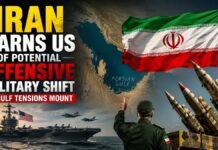
- Military Standoff: A U.S. carrier strike group, led by the USS Abraham Lincoln, is stationed in the Arabian Sea following the recent downing of an Iranian drone.
- Diplomatic Crossroads: Secret negotiations are scheduled to resume today, February 6, 2026, in Muscat, Oman, between U.S. and Iranian officials.
- Internal Unrest: Iran continues to grapple with the aftermath of a massive protest movement and a subsequent government crackdown that has killed thousands.
- Communication Blackout: Widespread internet disruptions and infrastructure instability continue to hinder movement and information flow within the country.
In a significant escalation of diplomatic and security warnings, the U.S. State Department has categorized the situation in Iran as highly volatile, prompting a “Level Red” advisory. The Virtual U.S. Embassy in Tehran issued the directive on Friday, February 6, 2026, making it clear that the U.S. government cannot guarantee the safety of those who choose to remain. With no formal diplomatic presence in the country, American officials stressed that citizens must not rely on Washington for assisted evacuation and should instead finalize independent travel plans immediately.
The advisory highlights a collapsing infrastructure, citing frequent road closures, the disruption of public transportation networks, and severe state,sanctioned internet blackouts. For those unable to secure a flight, the U.S. recommends crossing land borders into neighboring Armenia or Turkey, provided it is safe to do so.
Protests, Crackdowns, and Internal Turmoil
The current crisis is deeply rooted in widespread anti,government protests that erupted in late December 2025. Originally sparked by record,high inflation and a plummeting currency, the movement quickly evolved into a direct challenge to the clerical leadership. The Iranian government’s response has been described by international monitors as one of the bloodiest in recent history, with death toll estimates ranging from 3,000 to over 18,000.
To maintain control, Tehran has intermittently shut down mobile and landline internet networks, a tactic frequently used before large,scale security operations. While the regime claimed to have “quelled” the unrest by mid,January, the underlying economic grievances remain unaddressed, and the risk of renewed civil disobedience remains a primary concern for foreign travelers.
Military Buildup and the “Armada” in the Arabian Sea
External pressure is also mounting. President Donald Trump has deployed a significant military presence to the region, which he has publicly referred to as an “armada.” The center of this force, the aircraft carrier USS Abraham Lincoln, arrived in the Arabian Sea last week. Tensions nearly reached a breaking point on February 3, 2026, when a U.S. Navy F,35 fighter jet shot down an Iranian drone that had “aggressively approached” the carrier strike group.
President Trump delivered a forceful warning to Tehran this week, stating that Supreme Leader Ayatollah Ali Khamenei should be “very worried” about the current trajectory. The administration has hinted that military options remain on the table, especially if Iran continues to pursue nuclear capabilities at alternative sites or persists in its crackdown on civilians.
Last-Ditch Diplomacy in Muscat
Despite the bellicose rhetoric, a narrow window for diplomacy remains. High,level talks are scheduled to take place today in Muscat, Oman, involving U.S. special envoy Steve Witkoff and Iranian Foreign Minister Abbas Araghchi.
The agenda for these talks is a point of contention. While Iran seeks immediate sanctions relief and a narrow focus on nuclear limits, the U.S. State Department, led by Secretary of State Marco Rubio, has insisted that any meaningful agreement must also address Iran’s ballistic missile program and its record on human rights. As these negotiations begin, the world remains on edge, watching whether diplomacy can de,escalate a situation that many fear is on the brink of open conflict.