




























Key Points
- Trump claims he prevented India-Pakistan nuclear war in May 2025 for the 70th time
- Alleges eight aircraft were shot down before his intervention halted Operation Sindoor on May 10, 2025
- Congress accuses Modi government of compromising sovereignty by accepting third-party mediation
- Trump expressed regret over not receiving Nobel Peace Prize for saving 15-20 million lives
- Indian government maintains official policy against external mediation on Pakistan issues
- Congress General Secretary Jairam Ramesh mocks Trump’s repeated claims and Modi’s “forced hugs” diplomacy
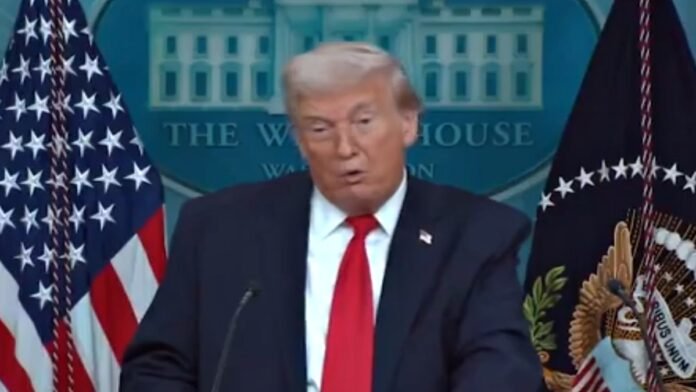
During a first-year assessment briefing at the White House on Tuesday evening, President Trump presented a sweeping narrative of his role in global conflict resolution. Beyond India and Pakistan, he claimed credit for de-escalating tensions between Cambodia and Thailand, Kosovo and Serbia, and brokering ceasefires in the Israel-Iran standoff. “I calmed eight major conflicts in just 10 months, something no president has done before,” Trump declared to assembled reporters.
Specifically addressing the India-Pakistan situation, Trump provided dramatic details. “Pakistan and India were attacking each other viciously. Eight planes were shot down, and missiles were flying. In my assessment, both nuclear powers were heading straight toward atomic war,” he stated. Trump insisted his personal intervention through direct phone calls to both Prime Minister Modi and Pakistan’s leadership resulted in an immediate halt to hostilities. “If I hadn’t stepped in when I did, we would be talking about 15 to 20 million casualties today,” he added, suggesting the conflict would have escalated into South Asia’s first nuclear exchange.
Congress Intensifies Sovereignty Concerns
Congress General Secretary Jairam Ramesh launched a blistering attack on social media platform X, meticulously documenting Trump’s escalating claim count. “Before yesterday, this number stood at 68. But yesterday it jumped not to 69, but directly to 70. Once in his opening statement and again during Q&A,” Ramesh wrote with evident sarcasm. He specifically referenced the abrupt conclusion of Operation Sindoor, India’s reported military operation, on May 10, 2025, questioning whether external pressure forced the decision.
Ramesh’s critique extended to Modi’s personal diplomacy style, referencing the Prime Minister’s well-documented physical displays of friendship with Trump during previous meetings. “This is the number of times the PM’s ‘good friend,’ who has received numerous forced hugs from the PM, has claimed responsibility for stopping our military operations,” he posted. The Congress spokesperson emphasized that India’s long-standing foreign policy doctrine categorically rejects third-party mediation on bilateral disputes, particularly with Pakistan, making Trump’s claims either false or indicative of a policy reversal by the Modi government.
Government’s Silent Response Strategy
Despite Trump’s May 2025 social media announcement that both countries had agreed to a “complete ceasefire” following Washington’s mediation, the Ministry of External Affairs has maintained strategic silence. Official spokespersons have neither confirmed nor denied the claims during routine press briefings over the past eight months. When pressed by journalists on Wednesday afternoon, MEA spokesperson Arindam Bagchi deflected questions, stating, “India’s position on third-party involvement in bilateral matters is well-established and unchanged.”
This non-denial has fueled opposition criticism and media speculation about what actually transpired in May 2025. Defence analysts note that unusual troop movements were reported along the Line of Control during that period, and satellite imagery suggested heightened military activity. However, the government classified all related information under national security protocols, preventing independent verification of Trump’s claims.
Nobel Prize Grievance and Global Reactions
Trump’s press conference took an unexpected turn when he lamented the Nobel Committee’s decision-making process. “Saving millions of lives between India and Pakistan, that’s bigger than any peace prize. They should have given it to me immediately,” he remarked with visible frustration. The Norwegian Nobel Committee has not responded to these comments, though observers note that Trump’s name has never appeared on their official consideration lists.
International relations experts expressed skepticism about the veracity of Trump’s narrative. Dr. Ashley Tellis, senior fellow at the Carnegie Endowment for International Peace, commented, “The details don’t align with known facts. Eight aircraft shoot-downs would have been documented by multiple intelligence agencies and reported globally. We’ve seen no such evidence.” Pakistani officials have also remained conspicuously silent, neither confirming nor challenging Trump’s version of events.
Political Fallout and Opposition Demands
The Congress party, along with other opposition groups, including the Trinamool Congress and Left parties, has demanded a parliamentary statement clarifying India’s position. Rahul Gandhi, Leader of Opposition in Lok Sabha, tweeted, “70 claims, zero rebuttals from our government. Is this how we protect national sovereignty? The PM must explain what happened in May 2025.” Parliamentary sessions scheduled for next month are expected to witness heated debates on the issue.
Legal experts suggest that if Trump’s claims are accurate, they could have constitutional implications regarding the government’s authority to accept foreign mediation without parliamentary consultation. Former Attorney General K.K. Venugopal noted, “Any agreement involving cessation of military operations through external mediation would require transparency and legislative oversight under democratic norms.”
Historical Context and Pattern Analysis
Trump’s pattern of making such claims dates back to his first presidency, when he repeatedly offered to mediate the Kashmir dispute, offers that India consistently rejected. The current claim represents an escalation in specificity, with detailed casualty projections and operational timelines. Political analysts view this as part of Trump’s broader re-election strategy, positioning himself as a global peacemaker ahead of the 2028 campaign cycle.
The Indian government faces mounting pressure to either validate or categorically refute Trump’s assertions. Continued silence risks emboldening opposition narratives about compromised sovereignty, while contradicting Trump could strain the US-India strategic partnership at a time when Washington’s support remains crucial for India’s Indo-Pacific security architecture.