




































Key Points
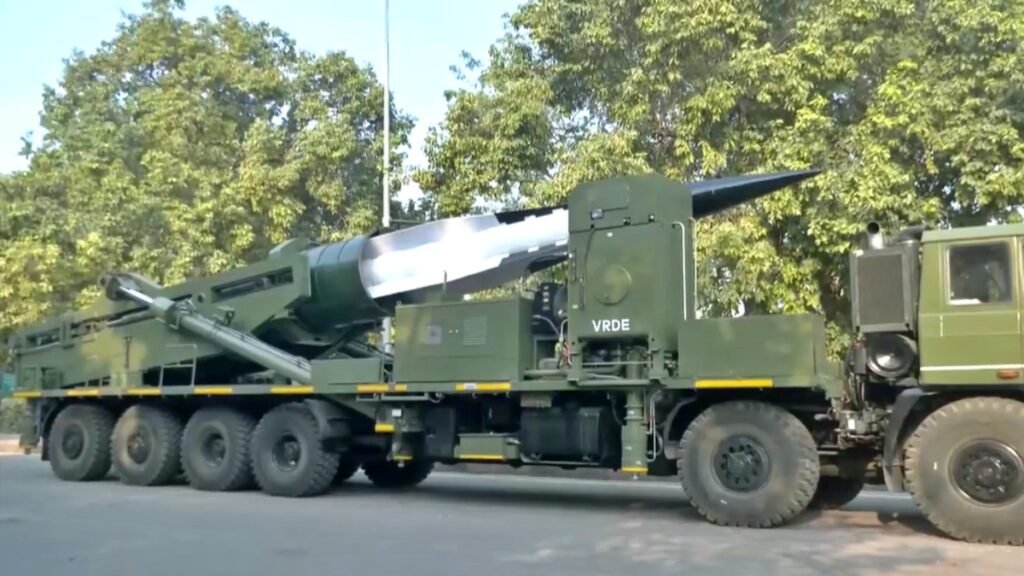
- LRASHM developed by DRDO offers 1,500 km range and hypersonic speed exceeding Mach 5
- First public display scheduled for January 26 Republic Day parade in New Delhi
- Missile’s high velocity and maneuverability make it nearly impossible for enemy defenses to intercept
- Strengthens India’s strategic position in the Indian Ocean Region against growing naval threats
- Navy tableau will showcase ancient maritime heritage alongside modern warships including INS Vikrant
- 144 specially trained sailors from across India will march in the parade contingent
The LRASHM represents a breakthrough in hypersonic glide vehicle technology, flying at speeds exceeding Mach 5, which is five times the speed of sound. This extraordinary velocity compresses enemy reaction time to mere seconds, rendering conventional radar and missile defense systems ineffective. According to DRDO scientists, the missile employs advanced scramjet propulsion and can execute evasive maneuvers throughout its flight trajectory, making interception attempts virtually futile.
Project Director A. Prasad Gaud confirmed that the missile can carry multiple payload configurations, including conventional warheads and advanced submunitions specifically designed to neutralize enemy shipborne weapon systems. The guidance system integrates satellite navigation with terminal phase seekers, ensuring pinpoint accuracy even against moving maritime targets. “This is not just a missile, it’s a complete kill chain solution that transforms how the Indian Navy will dominate sea lanes,” Gaud stated in an exclusive briefing on Wednesday.
Strategic Significance for Indian Ocean Region
The timing of this unveiling carries profound strategic weight as China expands its naval presence in the Indian Ocean through dual-use ports and frequent submarine deployments. The LRASHM provides the Indian Navy with a standoff capability that can engage hostile carrier battle groups and surface action groups before they enter India’s exclusive economic zone. Military analysts describe this as a decisive counter to anti-access, area denial strategies employed by potential adversaries.
Former Vice Chief of Naval Staff Admiral G.A.L. Naidu noted that the 1,500 km range covers critical chokepoints, including the Malacca Strait, Strait of Hormuz, and approaches to the Andaman Sea. “With this weapon, a single Indian warship can control maritime space that previously required an entire fleet,” he explained. The missile can be launched from mobile platforms, surface combatants, and potentially submarines, offering flexible deployment options across India’s 7,500 km coastline.
DRDO’s Expanding Hypersonic Portfolio
The LRASHM display caps a decade of intensive research under DRDO’s Hypersonic Technology Development Programme. This initiative has already yielded the Hypersonic Technology Demonstrator Vehicle and is now transitioning to operational weapons systems. Defence Minister Rajnath Singh, who reviewed the missile last week at DRDO’s Hyderabad facility, emphasized that this achievement positions India as the fourth country, after the US, Russia, and China, to develop operational hypersonic strike weapons.
The development team overcame significant technical challenges, including thermal management at extreme speeds, materials science for heat-resistant composites, and precision guidance in contested electromagnetic environments. The ₹2,800 crore programme involved collaboration with over 50 Indian defence firms and research institutions, aligning with Atmanirbhar Bharat’s push for indigenous defence manufacturing. Private sector partners contributed critical components, including advanced avionics and propellant systems, demonstrating India’s growing defence industrial ecosystem.
Navy’s Republic Day Showcase
The Indian Navy’s tableau will present a compelling narrative of maritime evolution, featuring a replica of a 5th-century Indian naval vessel discovered off the Gujarat coast, symbolizing India’s ancient seafaring prowess. This historical element will transition to modern might through displays of INS Vikrant, India’s indigenous aircraft carrier, and guided-missile destroyers equipped with BrahMos and LRASHM systems. The tableau’s design emphasizes continuity, from ancient trade routes to contemporary naval dominance.
The 144-member naval contingent, selected after rigorous two-month training from nearly 5,000 applicants, represents all states and union territories. The youngest sailor, 19-year-old Seaman Ankit Kumar from Bihar, will carry the LRASHM scale model. “Marching with a weapon that represents India’s technological triumph is the proudest moment of my naval career,” he said during rehearsals at Delhi Cantonment.
Expert Analysis and Future Trajectory
Strategic experts view the public display as a calibrated signal to both domestic and international audiences. Dr. C. Uday Bhaskar, Director of the Society for Policy Studies, observed that showcasing such advanced weaponry reflects confidence in the system’s readiness and deterrence value. “It’s a strategic communication that India’s defensive capabilities have offensive options when national interests are threatened,” he commented.
The DRDO is already developing a hypersonic cruise missile variant with air-breathing propulsion, expected to be ready for testing by 2027. Planners envision integrating LRASHM with the Navy’s P-8I Neptune maritime surveillance aircraft and future drone swarms, creating a layered reconnaissance-strike complex. The missile’s production will be handled by Bharat Dynamics Limited, with initial orders for 50 units and plans to scale up based on operational feedback.