































KEY POINTS
- Greenland contains an estimated 36-42 million tons of rare earth elements, potentially making it the world’s second-largest REE reserve after China
- The island hosts Pituffik Space Base, a critical US ballistic missile early warning installation vital to North American security
- Melting Arctic ice is opening new shipping routes that could revolutionize global trade, reducing distances by up to 40%
- 85% of Greenlanders oppose US annexation, despite widespread support for eventual independence from Denmark
- Denmark deployed over 100 additional soldiers to Greenland in January 2026 as tensions escalate
- A single Greenlandic copper-rare earth deposit could supply global demand for decades
Greenland’s strategic importance has reached unprecedented levels in 2026, driven by three interconnected factors, each more consequential than the last. Situated between the North Atlantic and Arctic Oceans, the 840,000-square-mile island straddles the GIUK gap, a crucial maritime corridor connecting Greenland, Iceland, and the United Kingdom that links the Arctic to the Atlantic Ocean. This geographic position alone makes it indispensable for power projection in the Arctic region, a sphere where traditional geopolitical rules no longer apply.
Currently, Greenland remains under Danish sovereignty through the Kingdom of Denmark, a relationship that dates back centuries. However, the island has possessed its own Parliament since 1979 and achieved self-rule status in 2009, making it an autonomous territory with the legal right to pursue full independence through referendum. This constitutional arrangement has become increasingly contentious as global superpowers recognize Greenland’s emerging significance.
The geopolitical tension is intensified by the island’s small population of approximately 56,000 people, concentrated mainly in scattered coastal settlements. These demographics, combined with Greenland’s vast territory and underdeveloped infrastructure, present both vulnerability and opportunity for outside powers seeking influence.
ARCTIC SHIPPING: THE NEW GLOBAL TRADE BATTLEGROUND
The rapid melting of Arctic glaciers is fundamentally reshaping global maritime commerce. Three primary shipping routes are becoming increasingly navigable due to climate change, offering revolutionary advantages to whichever nation controls them. The Northwest Passage, tracing the Canadian Arctic coast and archipelago, provides an alternative to traditional Suez Canal routes. The Transpolar Sea Route, running directly across the Arctic near the North Pole, represents the shortest theoretical distance between Europe and Asia, potentially reducing shipping times by up to 40%.
These new sea routes hold transformative economic potential. Shipping through Arctic passages could dramatically reduce travel distances and fuel consumption between Asia, Europe, and the Americas, giving tremendous competitive advantage to nations that can secure, maintain, and protect these maritime corridors. Greenland’s position directly influences control of the Northwest Passage and provides strategic depth for power projection into the Arctic region.
The economic implications are profound. The global maritime shipping industry represents trillions of dollars in annual commerce. Shaving weeks off shipping times between the world’s largest markets would create immense value creation opportunities, while the geopolitical power to tax, regulate, or restrict passage through Arctic routes would grant unprecedented leverage in global trade negotiations.
Whichever country dominates these emerging routes will effectively control a chokepoint as significant as the Panama or Suez Canals, but with far less historical competition and established international oversight. This reality has transformed Greenland from a peripheral Arctic territory into a critical node in the global shipping network.
MILITARY COMPETITION: THULE’S CRITICAL ROLE IN NORTH AMERICAN DEFENSE
The United States maintains its most strategically significant Arctic military installation directly on Greenlandic soil. Pituffik Space Base, formerly known as Thule Air Base, sits on the northwestern coast and operates as the northernmost deep-water seaport in the world. Established in 1951 under a defense agreement between the United States and Denmark, the base was renamed in 2023 to honor Greenlandic cultural heritage, though its military function has only intensified.
Pituffik’s role is utterly irreplaceable for US national security. The 12th Space Warning Squadron operates sophisticated phased-array radar systems that form the critical backbone of the ballistic missile early warning system protecting North America against potential intercontinental ballistic missile (ICBM) attacks from Russia and other hostile nations. This early warning capability is not redundant with other systems, but rather represents a vital gap-filling technology that provides crucial detection windows for incoming missile threats. The facility also manages satellite command and control operations through the Pituffik Tracking Station, connecting the installation to the broader Space Force surveillance architecture.
The base operates under extreme conditions. Locked in ice for approximately nine months annually, with continuous darkness from November through February, Pituffik still maintains year-round airfield operations through advanced infrastructure and icebreaker support. Approximately 200 US military personnel currently operate the installation under the existing defense agreement with Denmark.
Recent tensions have exposed the vulnerability of this arrangement. US military activity at the base has been met with increasing scrutiny, particularly following the revelation of leaked Danish defense documents indicating the US Army sought detailed intelligence regarding Greenland’s airfields, ports, and military installations. These disclosures have triggered diplomatic outrage in Copenhagen and raised serious concerns about potential US military expansion on the island without proper Danish consultation.
THE MINERAL TREASURE: RARE EARTHS AND THE FUTURE OF TECHNOLOGY
Beneath Greenland’s ice lies one of the world’s most valuable untapped mineral repositories, a geological fortune that explains much of the current geopolitical intensity. Greenland ranks approximately eighth globally in rare earth element (REE) reserves with currently proven, economically viable reserves of 1.5 million tons. However, geological surveys suggest the island may ultimately contain between 36 and 42 million tons of rare earth oxides, which would make it the world’s second-largest REE reserve after China alone.
Rare earth elements comprise 17 distinct metallic elements, including the lanthanide series plus scandium and yttrium. Despite their name, they are relatively abundant in Earth’s crust, but economically viable concentrations are extraordinarily rare, which is precisely why control over Greenland’s deposits matters so intensely. These minerals are essential to modern technology, with irreplaceable applications across multiple industries.
The two most significant deposits are Kvanefjeld (also known as Kuannersuit in Greenlandic) and Tanbreez, both located in southern Greenland near the town of Narsaq. Kvanefjeld alone contains over 11 million metric tons of rare earth reserves and resources, including 370,000 metric tons of heavy rare earths, which are particularly valuable and difficult to extract from other sources. The Tanbreez deposit holds significant concentrations of heavy rare earths that could address critical vulnerabilities in US supply chains.
Remarkably, not a single rare earth mining operation currently exists in Greenland, despite the staggering resource wealth. This represents a critical gap in global supply chain security, particularly as demand for rare earths accelerates due to the clean energy transition.
Strategic Applications of Greenland’s Mineral Wealth:
| Mineral | Key Applications | Current Status |
|---|---|---|
| Neodymium & Dysprosium | High-performance magnets for wind turbines, electric vehicle motors | In highest global demand |
| Lithium | Lithium-ion batteries for electric vehicles, grid storage systems | Essential for clean energy transition |
| Uranium | Nuclear reactor fuel, advanced defense systems | Abundant as REE byproduct at Kvanefjeld |
| Copper & Nickel | Electronics, alloys, aerospace materials | Explored by companies like Anglo American since 2019 |
| Zinc & Cobalt | Battery components, electronics, advanced alloys | Citronen Fjord holds one of world’s largest undeveloped zinc deposits |
| Vanadium & Titanium | Aerospace alloys, high-strength materials | Critical for defense manufacturing |
The economic stakes are staggering. A single copper-rare earth deposit in Greenland contains sufficient reserves to supply current global demand for decades. Currently, China dominates the global rare earth supply chain with overwhelming market power, controlling approximately 60% of global mining capacity and an even larger share of processing infrastructure. This dominance creates acute vulnerabilities for Western nations, particularly the United States, which has identified rare earth supply chain resilience as a national security priority.
For the United States, acquiring access to Greenland’s mineral resources represents the most viable option to challenge China’s global dominance in rare earth elements and reduce dependence on a potentially hostile or unreliable supplier. Additionally, preliminary surveys suggest Greenland may hold significant reserves of oil and gas, representing potential economic windfalls for whoever controls development rights.
Notably, 60% of Greenland’s ice-free land area has never been subjected to a detailed geological survey, suggesting that current reserve estimates may represent only a fraction of the island’s true mineral endowment.
THE MILITARY BUILD-UP: RUSSIA AND CHINA’S ARCTIC AWAKENING
While the United States seeks to maintain and expand its influence through Greenland, Russia and China have been systematically developing their own Arctic capabilities, creating a genuine great-power competition for regional dominance.
Russia’s Arctic Expansion:
Russia views the Arctic as its sphere of influence and has substantially expanded its military footprint over the past decade. The country has revitalized Soviet-era bases, deployed advanced missile defense systems, invested heavily in domain awareness capabilities, increased aerial and maritime patrols, and stepped up military exercise schedules at an accelerating pace. The Nagurskoye air base, located at approximately 80.80° North latitude, represents a dramatic example of this expansion, having grown significantly since its establishment in the 1950s.
Denmark’s 2025 Intelligence Outlook explicitly noted that “Russia continues its military build-up” in the Arctic region with particular focus on advanced submarine and surface vessel capabilities. Russian military analysts have identified Greenland as a critical enabler for what the US calls the “Golden Dome” Arctic missile defense layer, and have raised concerns about the deployment of advanced tracking and interception systems targeted at Russian weapons systems.
China’s Arctic Positioning:
China, despite being geographically distant from the Arctic, has declared itself a “near-Arctic state” in a deliberate attempt to establish a geopolitical footing in the region. The country is attempting to build influence through strategic investment, particularly targeting critical infrastructure development, though Denmark has actively blocked several such attempts.
The historical record demonstrates China’s earlier ambitions in Greenland. In 2020, a Dutch think tank report (Clingendael Institute) documented how a former Danish Prime Minister prevented a Hong Kong company from acquiring an abandoned naval base, confirming Danish government concerns about Chinese military positioning. In 2019, the US Department of Defense formally raised alarms to the Danish government regarding Chinese intentions in Greenland. More recently, Chinese companies have attempted to finance airport projects in Greenland, but the Danish government intervened to block such developments.
Recent intelligence reports note that China and Russia have collaborated on military exercises near the Arctic region, suggesting coordination in their strategic approaches to regional dominance. However, analysts have identified limits to the Sino-Russian Arctic partnership, noting that Russia, as an Arctic-bordering nation, would resist excessive Chinese expansion beyond specific economic and defense parameters.
TRUMP’S GREENLAND GAMBIT: DIPLOMATIC CRISIS AND NATO TENSIONS
In January 2026, the strategic competition over Greenland has escalated into an acute diplomatic crisis. US President Donald Trump has repeatedly and explicitly stated that the United States could and should take control of Greenland, citing national security justifications.
Trump’s rhetoric has become increasingly provocative. On January 18, 2026, he claimed, “If you take a look outside of Greenland right now, there are Russian destroyers, there are Chinese destroyers, and, bigger, there are Russian submarines all over the place. We’re not gonna have Russia or China occupy Greenland, and that’s what they’re going to do if we don’t.”
However, these claims have been disputed by multiple authoritative sources. Greenland’s business minister, Naaja Nathanielsen, stated directly that Greenlandic authorities were unaware of any Chinese or Russian ships in the immediate vicinity. Military experts cited by the Associated Press noted that Russia actually operates in the wider Arctic region, specifically the Barents Sea off the Scandinavian coast, and that both nations do maintain a presence in the Bering Sea south of Alaska, but the specific claims of a major military build-up directly adjacent to Greenland have not been independently verified.
Vice President JD Vance visited Greenland in March 2025, and while he acknowledged the principle that “the future should be determined by Greenlanders themselves,” he also stated explicitly that “it was the policy of the United States” to seek changes in the island’s Danish leadership and governance structure. This formulation provoked substantial controversy regarding whether the US was genuinely respecting Greenlandic self-determination or merely paying lip service to the principle.
GREENLAND’S DECISIVE REJECTION OF US ANNEXATION
The Greenlandic population has made its position crystal clear. Polling data indicates that 85% of Greenlanders are opposed to US control and governance, an overwhelming consensus that reflects deep skepticism toward external annexation regardless of the proposing power.
On January 12, 2026, Greenland’s Prime Minister Jens-Frederik Nielsen delivered a sharp rebuke to the Trump administration during a joint press conference with Danish Prime Minister Mette Frederiksen. Nielsen stated unambiguously, “We are now facing a geopolitical crisis, and if we have to choose between the United States and Denmark here and now, we choose Denmark. We choose NATO. We chose the Kingdom of Denmark. We choose the EU.”
This declaration, while politically supportive of Danish sovereignty, reflects a more nuanced reality. Nielsen emphasized that “Greenland has huge faith in the NATO alliance and that NATO supports us in this situation,” suggesting that Greenland views NATO collective security as preferable to exclusive reliance on any single power, including the United States.
The political tensions have revealed a critical gap in decision-making authority. While Denmark makes formal diplomatic statements and military decisions, Greenlandic politicians have expressed frustration at being sidelined in Copenhagen’s decision-making processes. As one analyst noted, Greenlandic officials have been excluded from substantive discussions about their own territory’s future, raising legitimate questions about whose interests are being represented in these critical diplomatic negotiations.
DENMARK’S MILITARY RESPONSE: REINFORCING THE ARCTIC
Denmark has responded to escalating tensions by substantially increasing its military presence in Greenland. On January 18, 2026, the Danish Armed Forces confirmed that approximately 100 additional soldiers had been deployed to Greenland, with further contingents arriving in multiple waves at both Nuuk (the capital) and Kangerlussuaq in western Greenland.
Maj. Gen. Søren Andersen, head of Denmark’s Arctic Command, oversaw the deployment. Danish Defense Minister Troels Lund Poulsen stated that Denmark has begun expanding its military footprint in and around Greenland in cooperation with NATO allies as part of broader efforts to strengthen Arctic defense capabilities.
The deployment appears intended as a dual-purpose move: asserting Danish sovereignty over the territory while simultaneously demonstrating commitment to NATO collective defense and Arctic security. This represents a significant escalation from routine military operations, with deployed forces expected to remain in position for extended periods with additional rotations planned for subsequent years.
However, this military response also highlights tensions within the NATO alliance itself. Denmark’s unilateral military reinforcement proceeded without explicit coordination with the United States, and the Trump administration responded with vocal criticism and economic pressure, imposing tariffs on key European countries in retaliation for what it characterized as insufficiently cooperative Arctic security policies.
NATO ALLIES SUPPORT DENMARK, CREATING ALLIANCE RIFT
The escalation has fractured the traditionally cohesive NATO alliance. On January 15, 2026, leaders from major European nations, including France, Germany, Poland, Spain, Britain, and Denmark, issued a joint statement explicitly supporting Denmark and Greenland’s right to self-determination.
The statement declared unequivocally, “Greenland belongs to its people. It is Greenland and Denmark, and they, to decide on matters concerning Denmark and Greenland. NATO has been clear that the Arctic region is a priority, and European allies are stepping up.”
This European solidarity represents a significant diplomatic rebuke to the Trump administration, essentially stating that NATO allies will not accept unilateral US action regarding Greenlandic sovereignty. The joint statement implicitly acknowledges that Arctic security is properly understood as a collective NATO responsibility, not a US prerogative.
The rift between the US and NATO allies continues to deepen. Beyond diplomatic statements, reports indicate that leaked Danish defense documents have revealed concerning details. US Army personnel sought intelligence regarding Greenland’s airfields, ports, and military installations, allegedly without proper Danish authorization. These revelations have triggered diplomatic outrage in Copenhagen and raised legitimate security concerns about potential US military ambitions regarding the island.
GREENLAND’S INDEPENDENCE QUEST: CONSTITUTIONAL FRAMEWORK AND ECONOMIC CHALLENGES
The broader context for all these developments involves Greenland’s own pursuit of independence from Denmark, a political movement that has gained substantial momentum while also complicating the international situation.
All political parties in Greenland’s Parliament support eventual independence, but the timeline remains highly contested. The legal framework for independence was established by the 2009 Self-Government Act, approved by the Danish Parliament. Article 21 of this act specifies that if Greenlanders vote for independence, negotiations must commence between the governments in Nuuk and Copenhagen regarding the terms of separation.
The economic dimension of independence presents substantial challenges. Denmark currently provides annual subsidies to Greenland totaling approximately 4 billion krone, roughly $703 million USD, which constitutes approximately one-fifth of Greenland’s total GDP. Without these subsidies, Greenland would face an immediate fiscal crisis. However, mining development and control of Greenland’s mineral resources could theoretically provide an alternative revenue base sufficient to achieve economic viability.
Polling reveals that while a substantial majority of Greenlanders support eventual independence, many do not favor immediate separation. The Naleraq party, the only opposition group in Parliament, campaigned aggressively for rapid independence in the 2025 legislative elections but captured only 24.5% of the votes. This suggests that while independence aspiration is deeply rooted in Greenlandic political culture, pragmatic concerns about economic sustainability and transition management lead many Greenlanders to support a more gradual approach.
Significantly, Trump’s aggressive push for annexation may actually undermine the independence movement, as political analysts have noted. One observer noted that “one of the strongest advantages for the government in Nuuk is to rely on Denmark’s deterrent value,” meaning that Greenland can appeal to Denmark for protection against external threats. If Greenlanders perceive the US as a menace rather than a partner, they may strengthen their ties to Denmark precisely to resist American pressure, paradoxically extending the very Danish sovereignty relationship that the independence movement ultimately seeks to overcome.
IMPLICATIONS FOR GLOBAL POLITICS AND TECHNOLOGY MARKETS
The Greenland crisis carries implications far beyond Arctic geopolitics. Three major consequences appear likely to unfold in the coming years.
First, the Great Power Arctic Competition Will Intensify:
China, Russia, the United States, and the European Union are now openly engaged in Arctic diplomacy and military posturing, transforming the Arctic region from a peripheral frontier into a primary theater of strategic competition. This rivalry will likely manifest through accelerated military buildups, intelligence operations, and economic investments, as each power attempts to secure influence over Greenlandic governance and resources.
Second, Global Supply Chains for Critical Technology Will Be Transformed:
Access to Greenland’s rare earth minerals could fundamentally reshape global supply chains for electronics, renewable energy systems, and defense manufacturing. If the US successfully diversifies its REE supply away from China, it would reduce Western vulnerability to Chinese supply-chain disruption, but would also create new dependencies and vulnerabilities if Greenland (either as an independent nation or under new sovereignty) develops its own commercial interests that diverge from US preferences.
Third, Environmental Costs Will Accelerate Alongside Commercial Development:
While climate change is making the Arctic more accessible for resource extraction and shipping, it simultaneously poses long-term existential risks to fragile Arctic ecosystems and indigenous communities whose livelihoods depend on traditional economies. Rapid mining development in Greenland could trigger environmental degradation that affects the Arctic food chain and marine ecosystems across the entire northern hemisphere.
A TERRITORY IN THE CROSSHAIRS
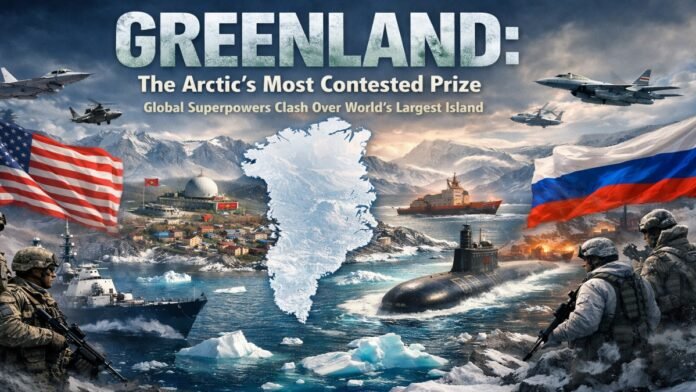
Greenland has been thrust into the center of 21st-century geopolitics not through any action of its own, but through the convergence of climate change, technological advancement, and great-power competition. With its strategic Arctic location, staggering mineral wealth, critical military infrastructure, and emerging shipping routes, the island has become the most contested prize in international relations.
The current crisis demonstrates both the fragility of the existing international order and the intense pressures that emerge when economic and strategic interests align. Greenland’s own desire for self-determination remains largely unheeded in the cacophony of great-power rhetoric and military posturing. Whether Greenland achieves independence, remains under Danish sovereignty, or somehow navigates the treacherous waters of US interest will ultimately depend less on what Greenlanders themselves desire and more on the strategic calculations of powerful external actors.
What appears certain is that the status quo cannot hold indefinitely. Either Greenland will achieve its political independence and determine its own fate, or the Arctic will become a zone of permanently intensified great-power competition, with Greenland caught perpetually in the crosshairs.