



































Key Points
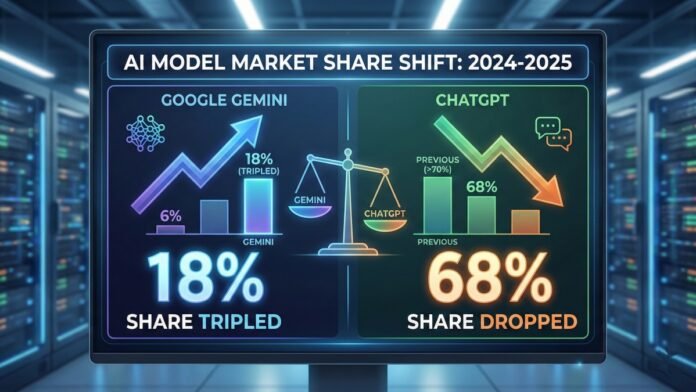
- Gemini’s market share surged from 5.4% to 18.2% in 12 months, representing 237% growth
- ChatGPT’s share declined from 87.2% to 68%, losing nearly 20 percentage points
- Google integration strategy embeds Gemini in Chrome, Android, Search, Gmail, and Docs
- “AI migration” trend shows users adopting multiple specialized tools for different tasks
- Mobile AI usage accounts for 62% of Gemini’s traffic growth, compared to 45% for ChatGPT
- Enterprise adoption of Gemini Workspace drives 3.2 million paid business users
Similarweb’s comprehensive analytics, tracking over 500 million user sessions across web and mobile platforms, confirm that Gemini’s growth trajectory has accelerated dramatically since Q2 2025. The 18.2% market share figure represents web traffic to Gemini’s dedicated platform, but the actual usage is significantly higher when accounting for embedded interactions in Google products that aren’t fully captured in traditional metrics. ChatGPT’s decline to 68% marks its lowest market share since the consumer AI boom began in late 2022, though it still maintains a substantial lead in absolute user numbers. The data reveals that ChatGPT lost ground primarily in mobile usage, where Gemini’s Android integration provides seamless access, while desktop usage remained more stable, dropping only 8 percentage points.
Integration Strategy Drives Unconscious Adoption
Google’s masterstroke lies in making Gemini invisible yet ubiquitous across its product suite. When users type in Chrome’s address bar, Gemini powers the AI suggestions. In Google Docs, the “Help me write” feature uses Gemini’s language models. Gmail’s smart compose and reply functions, Google Search’s AI overviews, and Android’s system-level AI assistant all run on Gemini infrastructure. This strategy means users engage with Gemini without consciously choosing it over alternatives. Sam Badawi, CEO of Solid Finance, explains, “These numbers are not random. If people’s web activity reflects their true preferences, then Google’s increasing share shows that it is not just competing, but the company is rapidly moving ahead.” The integration approach has proven particularly effective in emerging markets like India, where Android commands 95% market share and data costs make standalone AI apps less attractive.
ChatGPT’s Countermeasures and Enterprise Focus
OpenAI has responded to the competitive pressure by accelerating its enterprise offerings and rumored GPT-5 development. The company recently announced ChatGPT Enterprise has reached 4 million paid users, growing 60% in six months, with major clients including Microsoft, Salesforce, and PwC. OpenAI has also integrated DALL-E 3 more deeply into ChatGPT and launched specialized models for coding, data analysis, and creative writing. However, the lack of a native mobile ecosystem remains a vulnerability. While ChatGPT’s mobile app has been downloaded 180 million times, users must consciously open it, unlike Gemini’s system-level integration. OpenAI is reportedly developing a partnership with Apple to embed ChatGPT in iOS, which could help stabilize its market share among premium users. The company is also testing a search feature to compete with Google’s core business, though early reviews suggest it lags behind in real-time information retrieval.
Competitive Landscape Beyond the Duopoly
The AI market is fragmenting beyond the Gemini-ChatGPT rivalry. Anthropic’s Claude has captured 4.3% market share, appealing to users prioritizing safety and longer context windows. Perplexity AI, the search-focused conversational engine, has grown to 3.1% share among research-oriented users. Microsoft’s Copilot, despite integration with Windows and Office, holds only 2.8% share, hampered by user confusion about its positioning relative to ChatGPT. Chinese models like Baidu’s Ernie and Alibaba’s Tongyi Qianwen dominate within China’s firewall but have negligible global presence. Indian startups are also emerging, with Sarvam AI and Krutrim gaining traction in regional languages, though their combined market share remains below 1% globally. This fragmentation suggests users are segmenting their AI usage, ChatGPT for complex reasoning, Gemini for quick integrated tasks, and Claude for sensitive document analysis.
User Behavior Analysis and Migration Patterns
The “AI migration” phenomenon reflects sophisticated user behavior where individuals maintain accounts on multiple platforms and switch based on specific needs. Students use ChatGPT for homework help, professionals use Gemini for email drafting, and developers use Claude for code review. Similarweb data shows the average AI user now accesses 2.3 different platforms weekly, up from 1.4 a year ago. Mobile users show higher loyalty to integrated solutions, with 78% of Gemini’s mobile traffic coming from Android system features rather than the dedicated app. In contrast, ChatGPT’s mobile users are more engaged, averaging 7.2 sessions per day compared to Gemini’s 4.1, suggesting deeper, more intentional usage. The demographic split is also revealing, Gemini leads among users aged 35-55 who value convenience, while ChatGPT dominates the 18-34 segment seeking powerful, specialized capabilities.
Future Market Dynamics and Predictions
Experts predict the AI race will intensify in 2026 as models become more specialized and integration deeper. Google is expected to announce Gemini 2.0 with multimodal capabilities that process video, audio, and text simultaneously, potentially embedded in Pixel devices and ChromeOS. OpenAI’s GPT-5, rumored for mid-2026 release, may feature agentic capabilities that perform complex multi-step tasks autonomously. The market could reach equilibrium with Gemini capturing 25-30% share, ChatGPT stabilizing around 55-60%, and specialized players dividing the remainder. Regulatory scrutiny may also reshape the landscape, the EU’s AI Act and India’s Digital India Act could impose restrictions on data usage and integration practices. For now, Google’s ecosystem advantage appears insurmountable in the short term, but OpenAI’s technological lead and enterprise focus provide a strong defensive position.