































Key Points
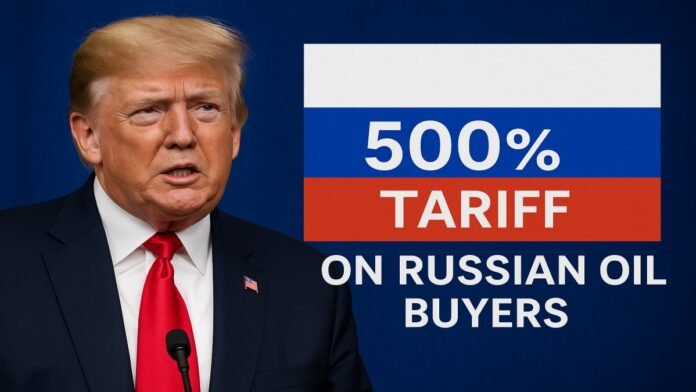
- Trump endorsed legislation allowing 500% tariffs on countries buying Russian oil, gas, petroleum products, or uranium
- Sanctioning Russia Act of 2025 has 85 Senate cosponsors, exceeding two-thirds threshold needed to override presidential veto
- US already imposed 50% total tariff on India: 25% reciprocal tariff plus 25% Russian oil penalty starting August 27, 2025
- Trump suggested adding Iran to sanctions framework, citing deep strategic and energy ties with Russia
- India’s Russian crude imports rose 11% month-on-month in October 2025 despite earlier assurances to reduce purchases
- Legislation targets China, India, and Brazil as major buyers propping up “Putin’s war machine” through energy purchases
Washington D.C.: US President Donald Trump expressed strong support on Sunday, November 16, 2025, for congressional efforts to impose sweeping sanctions on countries maintaining trade relationships with Russia, telling reporters, “I hear they’re doing that, and that’s okay with me”. Speaking before departing Florida for the White House, Trump stated: “The Republicans are putting in legislation that is very tough sanctioning, etcetera, on any country doing business with Russia. They may add Iran to that, I suggested it”.
Trump’s explicit endorsement marks his strongest statement yet on imposing such comprehensive sanctions, going beyond his earlier discussions with the European Union about targeting Russian trade partners. The President declared unequivocally: “So any country that does business with Russia will be very severely sanctioned. We may add Iran to the formula”. This warning comes amid rising tensions between Washington and Moscow and follows months of escalating economic pressure designed to cut off Russia’s revenue streams from energy exports that fund its military operations in Ukraine.
Sanctioning Russia Act Gains Overwhelming Support
The centerpiece of the congressional push is the Sanctioning Russia Act of 2025 (S.1241), introduced on April 1, 2025, by Senator Lindsey Graham (R-SC) and co-sponsored by Senator Richard Blumenthal (D-CT), along with 83 other senators. The legislation has attracted bipartisan support from at least 85 senators, surpassing the two-thirds threshold of 67 votes required to override a presidential veto, demonstrating the depth of congressional frustration over Russia’s actions. A companion bill (H.R. 2548) was introduced in the House of Representatives by Brian Fitzpatrick (R-PA 1st) with 83 cosponsors.
The bill’s proposed measures include imposing tariffs of up to 500% on imports from nations buying Russian oil, natural gas, petroleum products, or uranium, along with expanded restrictions on Russian sovereign debt and financial transactions involving sanctioned entities. Senator Graham’s legislation specifically calls for a 500% tariff on the secondary purchase and resale of Russian oil, a proposal that has gained strong support within the Senate Foreign Relations Committee. The measure was referred to the Senate Committee on Banking, Housing, and Urban Affairs for consideration.
India Faces Severe Tariff Pressure
The Trump administration has already taken significant action against India over its continued purchases of Russian energy, imposing some of the steepest tariffs in the world on Indian exports. In August 2025, Trump signed an executive order implementing a 50% total tariff on India, comprised of a 25% reciprocal tariff on Indian goods entering American markets plus an additional 25% “Russian oil surcharge” specifically tied to India’s purchases of Russian crude.
This dual-tariff structure, which took effect on August 27, 2025, was explicitly designed to penalize countries that “indirectly fund Russia’s war machine” through energy imports. According to experts, the tariffs reflect not only trade concerns but also US dissatisfaction with India’s energy relationship with Russia, which has deepened significantly since the Ukraine conflict began. The punitive measures represent the administration’s determination to use economic leverage to force allies and partners to sever commercial ties with Moscow.
Graham And Blumenthal Target Major Energy Buyers
In a joint statement issued in July 2025, Senators Graham and Blumenthal outlined their strategic rationale for the Sanctioning Russia Act, directly naming the countries they view as enabling Russia’s military capabilities. “President Trump and his team have made a powerful move, implementing a new approach to end this bloodbath between Russia and Ukraine. However, the ultimate hammer to bring about the end of this war will be tariffs against countries, like China, India and Brazil, that prop up Putin’s war machine by purchasing cheap Russian oil and gas,” the senators declared.
The legislation seeks to establish secondary tariffs and sanctions on “countries that continue to fund Putin’s barbaric war in Ukraine,” using economic coercion to force nations dependent on Russian energy to seek alternative suppliers. Senate Majority Leader John Thune indicated in October 2025 that he was prepared to bring the measure to a vote but did not “want to commit to a hard deadline,” suggesting the legislation could come to the Senate floor in the near future. The plan, long championed by Senator Graham, has gathered momentum amid growing frustration in Congress over Russia’s continued attacks on Ukraine and the perceived inadequacy of existing sanctions.
India’s Complex Energy Calculations
Despite the US tariffs and diplomatic pressure, India’s purchases of Russian crude oil actually increased by 11% month-on-month in October 2025, contradicting Trump’s earlier claims that Prime Minister Narendra Modi had assured him India would stop buying Russian oil. According to data from the Centre for Research on Energy and Clean Air (CREA), while state-run refiners initially cut their reliance on Russian crude, private refiners stepped up procurement in September 2025. By October, private refiners’ imports constituted over two-thirds of India’s total Russian crude imports, while state-owned refineries nearly doubled their volumes month-on-month.
The Indian government dismissed Trump’s characterization of Modi’s assurances, reiterating that its top priority is protecting domestic consumer interests through affordable energy access. However, India has signaled some willingness to reduce Russian energy dependence in response to US pressure. In October 2025, Trump stated he believed New Delhi had “significantly reduced” its purchases and suggested the United States could ease the tariffs, saying “We’ll bring the tariffs down at some point”. Washington has indeed scaled back from its earlier confrontational stance over India’s Russian oil purchases, signaling a willingness to engage constructively on trade after months of friction and stalled negotiations.
India Pursues Energy Diversification
Recognizing the vulnerability created by its heavy reliance on Russian energy and facing sustained American pressure, India has accelerated efforts to diversify its energy sources. On Monday, November 16, 2025, Minister of Petroleum and Natural Gas Hardeep Singh Puri announced a significant development: “Indian PSU oil companies have successfully concluded a 1-year deal for imports of around 2.2 MTPA LPG, close to 10% of our annual imports, for the contract year 2026, to be sourced from the US Gulf Coast, the first structured contract of US LPG for the Indian market”.
This landmark agreement between Indian Oil Corporation, Bharat Petroleum Corporation Limited, and Hindustan Petroleum Corporation Limited with American LPG producers represents India’s strategic pivot toward US energy supplies and may serve as a confidence-building measure in bilateral trade negotiations. According to Indian government sources, a bilateral trade agreement (BTA) with the United States is “nearing closure,” particularly a package that could address the reciprocal tariffs. “We are engaged with the US on the BTA. It has two parts. One part of negotiations will take time. The other part is a package which can address reciprocal tariffs. We are working on both aspects. The package that can address reciprocal tariffs is more or less near closure and we should get it soon,” an official stated.
Iran Also In Sanctions Crosshairs
President Trump’s warning extended beyond Russia to include Iran, reflecting the two countries’ deepening strategic partnership and energy cooperation. Trump explicitly stated that Iran could be added to the sanctions framework, noting “I suggested it” when discussing the possibility with congressional leaders. The move to potentially include Iran in secondary sanctions targeting Russia’s trading partners would create a comprehensive economic isolation strategy aimed at both countries simultaneously.
Iran and Russia have developed extensive strategic and energy ties, with both nations facing Western sanctions regimes and finding mutual benefit in deepened cooperation. By threatening sanctions on countries trading with either Russia or Iran, the Trump administration seeks to maximize economic pressure on both nations while forcing third countries to choose between access to US markets or continued relations with Moscow and Tehran. This approach represents a significant escalation in the use of secondary sanctions as a foreign policy tool.
Global Energy Market Implications
The proposed 500% tariffs on Russian oil purchases and resales could fundamentally reshape global energy markets if enacted. Such punitive measures would force major importers of Russian energy, including China, India, and Brazil, to either absorb massive cost increases or seek alternative suppliers, potentially disrupting established trade patterns and supply chains. The legislation would give Trump authority to impose these extraordinary tariffs on imports from countries deemed insufficiently supportive of Ukraine while purchasing Russian energy.
Market analysts warn that rapidly forcing countries away from Russian oil could create supply shortages and price spikes in energy markets, particularly affecting developing nations with limited alternatives. However, proponents argue that cutting off Russia’s energy revenues is essential to degrading Moscow’s ability to sustain military operations in Ukraine and that short-term market disruption is acceptable to achieve this strategic objective. The broad bipartisan support for the Sanctioning Russia Act suggests that Congress is willing to accept these economic risks in pursuit of a more aggressive approach to ending the Ukraine conflict.
Diplomatic Tensions With Key Partners
The Trump administration’s aggressive use of secondary sanctions risks straining relationships with countries that have maintained neutral or pragmatic positions regarding Russia’s war in Ukraine. India, Brazil, and other nations have argued they cannot afford to completely sever energy ties with Russia due to domestic economic considerations and have resisted Western pressure to align fully with sanctions regimes. The threat of 500% tariffs represents coercive economic diplomacy that could generate resentment and push these countries toward deeper engagement with alternative blocs.
Despite these tensions, the United States appears determined to use its economic leverage to force compliance with its Russia policy, betting that access to American markets and the dollar-based financial system provides sufficient leverage to change behavior. The coming months will test whether this strategy succeeds in isolating Russia economically or whether targeted countries find ways to circumvent US sanctions while maintaining their economic interests. Trump’s explicit backing of the congressional sanctions push signals that maximum economic pressure on Russia and its trading partners will remain a centerpiece of US foreign policy for the foreseeable future.