

































Key Points
- Shubman Gill discharged from Woodlands Hospital on November 16, 2025, after being admitted to ICU for observation on November 15.
- India captain is in stable condition, able to walk with normal neck movement and significantly reduced pain.
- Gill suffered neck spasm on Day 2 (November 15) while attempting a slog-sweep shot against South Africa spinner Simon Harmer.
- He retired hurt after facing just three balls and did not bat in India’s second innings, forcing India to play with 10 men.
- BCCI medical team and six-member specialist team continue monitoring Gill at the team hotel.
- Availability for second Test in Guwahati (starting November 22) remains doubtful, pending assessment over next few days.
- South Africa won first Test by 30 runs, bowling India out for 93 while chasing 124, with Simon Harmer taking 4 for 30.
- This is Gill’s second neck injury issue in recent months, having missed October 2024 Test vs New Zealand due to stiff neck.
Kolkata: India captain Shubman Gill was discharged from Woodlands Hospital in Kolkata on November 16, 2025, where he had been admitted on Saturday evening after suffering a neck injury during the first Test against South Africa. Gill has now returned to the team hotel and is in stable condition, providing relief to the Indian cricket establishment and fans.
According to medical updates from hospital sources, Gill can walk independently, and his neck movement has returned to normal, while the pain has significantly subsided. The encouraging signs suggest that the injury is not as severe as initially feared when he was admitted to the Intensive Care Unit for observation.
Medical Monitoring and Recovery Plan
Gill will now rest at the team hotel, where the BCCI medical team and doctors will continue to closely monitor his condition. According to reports, a six-member specialist medical team has been formed to monitor Gill’s recovery ahead of the crucial second Test scheduled in Guwahati.
Head coach Gautam Gambhir provided a cautious update in the post-match press conference on Sunday, stating: “He (Gill) is still being assessed. So, let’s see. The physios will take a call today evening and we will take a call”. This indicates that the medical team is taking a methodical approach to determining Gill’s fitness rather than rushing him back into action.
It is currently unclear whether Gill will travel with the team for the second Test in Guwahati, which begins on November 22, 2025. His availability will depend entirely on the results of his rest and treatment over the next few days, with the medical team expected to make a final decision based on comprehensive assessments.
The Injury Incident: Day 2 Drama
Shubman Gill was ruled out of the remainder of the first Test after he suffered a neck spasm at the start of India’s first innings on Day 2 (November 15, 2025). The incident occurred when Gill came out to bat after India were 75 for 2, facing South African off-spinner Simon Harmer.
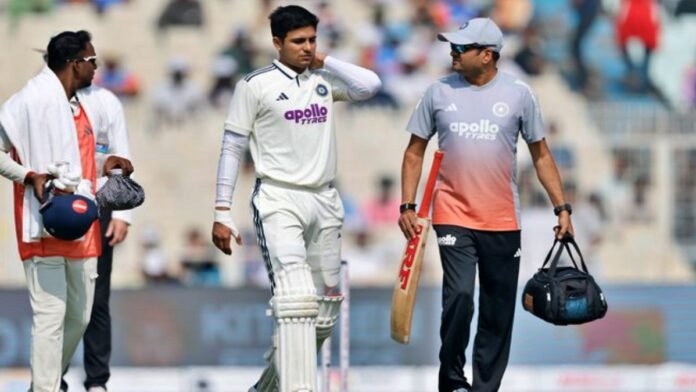
Gill played defensively on the first ball he faced. On the third delivery of his innings, he attempted an aggressive slog-sweep, which he successfully executed for four runs over square leg. However, as he completed the shot and got up, he immediately looked visibly discomfort, took off his helmet, and rubbed the back of his neck.
The team physio was immediately called onto the field. After a brief assessment and treatment, it became clear that Gill could not continue batting. He retired hurt and walked off the field for further medical evaluation. The injury appeared to be a whiplash sustained during the follow-through of the aggressive slog-sweep shot.
Hospital Admission and ICU Observation
The BCCI released an official statement confirming the severity of the concern: “Shubman Gill has a neck spasm and is being monitored by the BCCI medical team”. At the end of Day 2, Gill, wearing a neck brace for support, was stretchered out of the dressing room and into the players’ ambulance.
He was taken to Woodlands Hospital in Kolkata with the team doctor for comprehensive scans and examination. According to hospital sources, Gill was placed in the Intensive Care Unit (ICU) for observation, with scans and an MRI being carried out by medical authorities.
The BCCI issued an official update on November 16, stating: “Captain Shubman Gill had a neck injury on Day 2 of the ongoing Test against South Africa in Kolkata. He was taken to the hospital for examination after the end of the day’s play. He is currently under observation in the hospital. He will take no further part in the Test match. He will continue to be monitored by the BCCI medical team”.
Medical sources emphasized that while ICU admission might sound alarming, it was primarily a precautionary measure to ensure proper monitoring and treatment. Hospital sources confirmed that necessary medical steps had been taken for his treatment and that his condition was stable throughout his hospital stay.
Impact on Team Strategy
Gill’s injury forced the Indian team to make significant changes in their batting lineup during a crucial phase of the match. When Gill retired hurt at 75 for 2, Rishabh Pant replaced him at the crease. India went into lunch at 138 for 4, but the innings collapsed dramatically after the break.
Since it was not an external injury, Gill would not have been allowed to bat at his usual No. 4 position in the second innings even if he recovered, as he did not spend the required time in the field during South Africa’s innings. This effectively reduced India to playing with 10 batsmen in a low-scoring match.
India’s bowling coach Morne Morkel reflected on the unfortunate timing: “Gill is a very fit guy, he looks after himself very well, so it’s just unfortunate this morning that he woke up with a stiff neck and that carried him into the day, which was crucial for us. Another sort of partnership with him batting around was going to be needed for us at the time, and just bad timing”.
Morkel’s comments suggest that Gill may have been dealing with neck stiffness even before taking the field, which was then aggravated by the aggressive batting motion.
South Africa’s Dominant Victory
South Africa defeated India by 30 runs in the Kolkata Test to take a commanding 1-0 lead in the two-match series. The match was dominated by bowlers throughout, with no team posting a total above 200.
India took a first-innings lead of 30 runs after bowling out South Africa for 159 and responding with 189. However, South Africa fought back strongly in their second innings, posting 93 runs to set India a modest target of 124.
In a shocking collapse, India was bowled out for just 93 runs while chasing the small target in the fourth innings. Captain Temba Bavuma’s tactical leadership and off-spinner Simon Harmer’s brilliant bowling performance kept the Indian batsmen under relentless pressure. Harmer claimed 4 for 30 in the first innings and played a crucial role in South Africa’s victory. Marco Jansen also contributed significantly with 3 for 35 in India’s first innings.
The defeat represents a significant setback for India, which will need to win the second Test in Guwahati to level the series.
Recurring Neck Issues
This is not the first time Shubman Gill has dealt with neck problems. Last October (2024), Gill had to sit out the Test match against New Zealand in Bengaluru because of a stiff neck. The recurrence of neck issues raises concerns about whether there might be an underlying problem that requires specialized attention and preventive measures.
At just 26 years old, Gill is one of India’s most promising batting talents and the current Test captain. Managing his fitness, particularly addressing the recurring neck problems, will be crucial for his long-term career and India’s Test ambitions.
Outlook for Guwahati Test
The second Test between India and South Africa is scheduled to begin on November 22, 2025, in Guwahati, giving Gill approximately six days to recover. However, Test cricket requires not just the ability to bat but also sustained physical effort in the field for extended periods, making a full recovery essential.
According to medical updates, Gill has been advised to gradually resume physical activity and light exercises as part of his rehabilitation. The BCCI medical team will conduct comprehensive assessments over the coming days to determine whether he has recovered sufficiently to lead the team in the crucial second Test.
The relief for Indian cricket fans is that the injury does not appear to be serious, and Gill may be fully fit soon. However, the team management is unlikely to take any risks with the captain’s health, particularly given his history of neck issues.
If Gill is ruled out of the Guwahati Test, India will need to appoint a stand-in captain and potentially make changes to their batting order, adding another layer of complexity as they attempt to level the series.