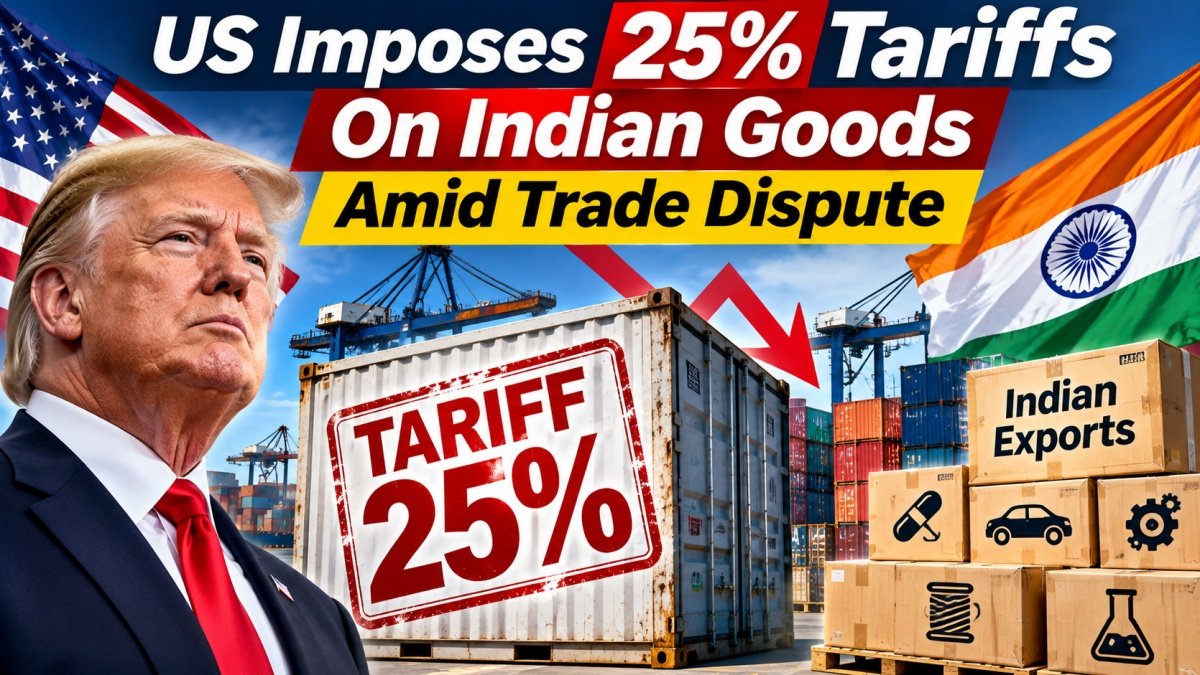
The United States has announced a 25% tariff on goods imported from India, citing policies that restrict U.S. commerce, while offering a reduction to 17% if a reciprocal trade agreement is reached.
Key Points
- New Tariff Rate: The U.S. government announced a 25% tariff on Indian imports on Wednesday.
- Trade Justification: The USTR cited structural excess capacity and unfair competition as reasons for the action.
- Potential Reduction: Tariffs could drop to 17% if India and the U.S. finalize a Reciprocal Trade Agreement.
- Indian Response: The Ministry of Commerce and Industry stated it is examining the notice and remains committed to negotiations.
- Comparative Ranking: India faces the second-highest tariff among 14 targeted nations, trailing only Vietnam at 35%.
New Trade Restrictions Announced
WASHINGTON: The United States government, through the Office of the U.S. Trade Representative (USTR), announced on Wednesday, November 25, 2026, a new 25% tariff on goods imported from India. The move comes in response to what the U.S. describes as unreasonable acts, policies, and practices by India that burden or restrict American commerce. This action marks the second-highest tariff among 14 economies targeted in the latest round of trade measures, surpassed only by a 35% tariff on Vietnam.
The USTR report concluded that India’s current trade practices contribute to structural excess capacity, which harms U.S. producers and exporters through unfair competition. The government noted that these practices result in lost exports, significant trade deficits, and a diminished manufacturing sector in the United States. While the 25% tariff is intended to be net of the existing 10% tariff, the USTR maintains the authority to adjust these figures based on other existing trade actions.
India’s Official Stance and Negotiations
The Indian government has officially taken note of the USTR’s actions and is currently examining the notice. The Ministry of Commerce and Industry stated that India engaged constructively throughout the investigation and maintains that the country does not have structural excess capacity in any sector. The ministry emphasized that India and the United States are already engaged in negotiations for a Bilateral Trade Agreement.
India remains committed to working closely with the United States to conclude the Bilateral Trade Agreement, as outlined in joint statements issued in February 2026. The Indian government maintains that all trade-related concerns should be addressed within the framework of these ongoing negotiations. If a deal is reached, the USTR indicated that the tariff on Indian goods could be reduced to 17%, which would provide India with a comparative advantage over other regional competitors.
Context of Trade Investigations
These new measures stem from a second investigation into structural excess capacity launched by the USTR in March under Section 301 of the U.S. Trade Act. This follows a previous investigation into forced labor, which resulted in a 10% tariff on Indian goods. Additionally, the U.S. continues to levy a 50% tariff on aluminium and steel imports from all countries under Section 232 of the Trade Expansion Act, which will not be added to the new 25% duty.
Furthermore, under the Lindsey O. Graham Sanctioning Russia and Iran Act of 2026, the U.S. has the power to levy tariffs of up to 100% on countries importing large quantities of Russian oil. However, President Donald Trump has temporarily paused this specific tariff. The current 25% tariff is higher than those applied to Japan, South Korea, Switzerland, Taiwan, the European Union, Indonesia, Malaysia, Thailand, Bangladesh, Cambodia, China, and Singapore, which range between 15% and 20%.
Latest Developments and Expert Reactions
Following the announcement, various news outlets reported the escalating trade pressure. According to Dynamite News, India faces a potential 17% extra duty on exports as part of the tightening trade pressure. Meanwhile, reports from The Economic Times noted that Indian experts are reacting to the USTR’s proposal to apply these tariffs across 14 trading partners.
Former USTR officials have suggested that since the Section 301 tariffs will not be stacked, there is a clear incentive for India to conclude the trade deal quickly. Despite the uncertainty, some sectors remain resilient, with reports from Free Press Journal indicating that engineering shipments have seen a 61% growth, defying the prevailing trade tensions.