
























Key Points:
- President Trump invited PM Modi to join Gaza Board of Peace on January 18, 2026
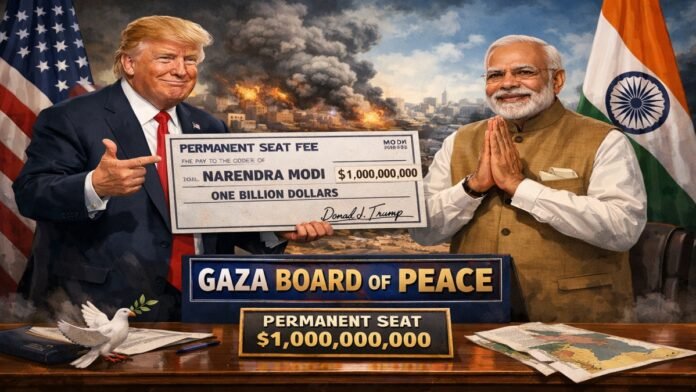
- Permanent membership requires $1 billion contribution, initial 3-year term is free
- Board will oversee Gaza reconstruction, governance, and long-term stability
- India among 60 countries invited, including Pakistan, Hungary, Argentina, Jordan, Canada
- Hamas rejected the proposal, calling it an attempt to impose external control
- India has not officially responded, maintaining its balanced Israel-Palestine stance
US President Donald Trump has formally invited Prime Minister Narendra Modi to join the newly formed “Gaza Board of Peace,” an international body designed to oversee transitional governance and reconstruction in the war-torn territory. The invitation, conveyed publicly by US Ambassador to India Sergio Gor through social media on January 18, 2026, represents the second phase of Trump’s comprehensive peace plan for the region.
The board structure includes a three-year temporary membership without mandatory financial contributions, followed by an option for permanent membership requiring a $1 billion payment. This financial requirement has sparked debate about the initiative’s accessibility and priorities, particularly for developing nations.
Board Structure and Leadership
The Gaza Board of Peace will be chaired by President Trump himself, who has described it as “the Greatest and Most Prestigious Board ever assembled”. The initiative forms part of a 20-point roadmap aimed at establishing lasting peace, stability, and prosperity in Gaza.
Key appointments include:
- Senior Advisors: Aryeh Lightstone and Josh Gruenbaum will lead day-to-day strategy and operations
- High Representative: Nickolay Mladenov will serve as the on-the-ground link between the Board and Gaza’s administration
- Executive Members: Ajay Banga (World Bank President), Tony Blair, Mark Carney, and Marco Rubio are confirmed participants
The board will supervise a technocratic Palestinian administration called the National Committee for the Administration of Gaza (NCAG), which will handle operational governance.
India’s Strategic Position and Response
India’s invitation reflects its growing geopolitical importance and reputation as a balanced power in international conflicts. New Delhi maintains strategic partnerships with Israel while continuing humanitarian assistance to Palestine, having been among the first countries to send aid to Gaza through Egypt.
Indian government sources confirmed receiving the invitation but have not yet issued an official response or communicated a decision. The Ministry of External Affairs has remained silent on queries regarding India’s potential participation.
Financial Structure and Membership Tiers
The board’s funding mechanism creates a two-tier membership system:
- Temporary Members: Three-year term with no mandatory financial commitment
- Permanent Members: $1 billion contribution grants permanent status and funds board activities
While the initial three-year appointment requires no contribution, countries seeking long-term influence must make substantial financial investments. This structure has drawn criticism for potentially limiting participation to wealthier nations.
Broader International Participation
Trump has invited approximately 60 countries to join the initiative, including several notable invitations:
- Pakistan: Also received an invitation, though Israel has objected to Pakistan’s potential involvement
- Hungary: The only country to publicly and unequivocally accept the invitation so far
- Other Invitees: Argentina, Jordan, Canada, and numerous other nations across different regions
The draft charter indicates the board may eventually expand to address conflicts beyond Gaza, positioning it as a permanent international organization for global conflict resolution.
Regional Reactions and Challenges
Hamas has formally rejected Trump’s proposal, with senior officials calling it an attempt to impose external control over Palestinian territory. The Palestinian organization views the board as undermining Palestinian sovereignty and self-determination.
Israeli Prime Minister Benjamin Netanyahu has reportedly objected to certain aspects of the board’s composition, particularly regarding countries he considers unacceptable for Gaza’s future role. These objections highlight the complex diplomatic balancing required to implement the plan.
Current Gaza Situation
Despite an ongoing ceasefire agreement, reports of Israeli attacks in Gaza continue, maintaining volatility in the region. The situation remains fragile, with humanitarian needs escalating and reconstruction efforts facing numerous obstacles.
The board aims to address these challenges by overseeing comprehensive reconstruction across infrastructure, health, education, and livelihood sectors. However, the continuing violence and political opposition present significant hurdles to implementation.
Geopolitical Implications
The invitation to India comes amid broader US-India tensions, particularly regarding trade tariffs and the inability to finalize a bilateral trade agreement. India’s exports to the US currently face steep 50% tariffs, among the highest rates worldwide.
India’s potential participation in the Gaza Board of Peace could serve as a diplomatic bridge to address these economic frictions while reinforcing New Delhi’s image as a responsible global stakeholder. The decision will require careful consideration of India’s historical support for Palestinian self-determination and its evolving strategic partnership with Israel.