
























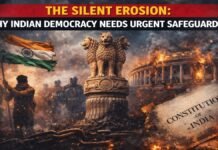



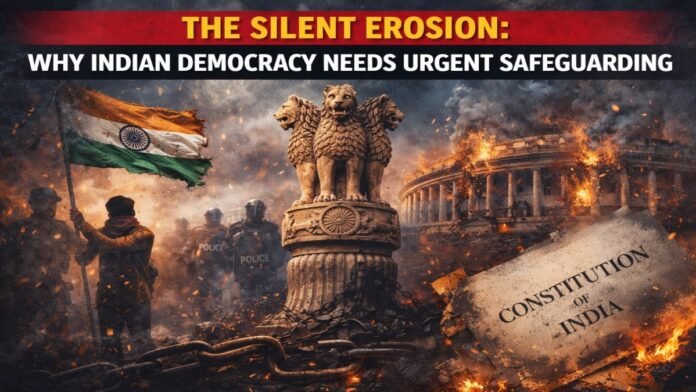
India’s democracy, once celebrated as the world’s largest and most vibrant, now faces a constellation of threats that demand our immediate attention. As someone who has spent years in the trenches of democratic activism, I’ve witnessed a troubling transformation, not through dramatic coups, but through the slow, institutional erosion that Benjamin Franklin warned about when he said we have “a Republic, if you can keep it.”
Institutional Integrity Under Siege
The independence of India’s democratic institutions has become increasingly compromised. The Election Commission, once a globally admired model of neutrality, now faces questions about its autonomy. The judiciary, while still demonstrating moments of independence, shows signs of executive overreach through delayed appointments and selective case management. When the very referees of democracy appear compromised, the playing field tilts dangerously toward permanent incumbency.
The Hollowed-Out Fourth Estate
Press freedom in India has deteriorated dramatically. Media ownership concentration in the hands of a few corporate conglomerates with vested interests has created an ecosystem where critical reporting becomes a career-limiting move. Journalists face multiple forms of pressure, legal harassment through strategic lawsuits, economic coercion through withdrawn advertising, and physical threats that have made India one of the world’s most dangerous countries for reporters. The result is a self-censored media that amplifies official narratives while marginalizing dissenting voices.
Digital Authoritarianism and Surveillance
Technology, which once promised democratic empowerment, has become a tool for control. The Pegasus spyware scandal revealed how surveillance targets not just criminals but journalists, activists, and political opponents. Combine this with the lack of a data protection law worth its name, and you have a surveillance state in the making. Meanwhile, IT rules that require traceability of messages and proactive content takedowns create a chilling effect on digital expression.
Majoritarianism and Minority Rights
The weaponization of majoritarian sentiment poses perhaps the gravest long-term threat. When citizenship laws are designed to exclude specific religious communities, when history textbooks are rewritten to serve political agendas, and when hate speech against minorities goes unpunished, we don’t just marginalize citizens, we corrode the constitutional promise of equality. This majoritarianism extends to the bulldozing of homes belonging to activists and minorities, bypassing legal processes in ways that would have been unthinkable a decade ago.
Electoral Finance and Political Capture
The electoral bonds scheme, now struck down by the Supreme Court, demonstrated how anonymous corporate funding could capture political parties. Though the scheme ended, the structural problem remains: politics requires massive funding, and those who fund it expect returns. This creates a vicious cycle where policy serves donor interests rather than public welfare, making a mockery of “one person, one vote.”
Civil Society Under Assault
The systematic targeting of NGOs through the Foreign Contribution Regulation Act (FCRA) has decimated civil society. Organizations working on human rights, environmental justice, and democratic accountability have had their licenses canceled, their funds frozen, and their leaders intimidated. When the space for organized dissent shrinks, democracy becomes an empty ritual.
The Path Forward: Safeguarding Strategies
Protecting Indian democracy requires multi-pronged action. First, we must demand true institutional autonomy,starting with transparent appointment processes for Election Commissioners and judges. Second, press freedom needs legal protection through anti-SLAPP legislation and public funding for independent media. Third, comprehensive surveillance reform with judicial oversight is non-negotiable. Fourth, electoral finance requires complete transparency, including real-time disclosure of all donations. Finally, civil society needs protection through FCRA reform and recognition of dissent as a democratic necessity rather than an anti-national activity.
The battle for democracy isn’t won in elections alone. It’s won in the daily struggle to keep institutions independent, speech free, and power accountable. As citizens, we must move beyond passive voting to active vigilance. Our democracy’s fate will be decided not by politicians, but by whether we, the people, are willing to defend it.