






























In today’s fast-paced business world, we often look for ways to balance power with ethics. Surprisingly, one of the best examples of a great leader is Lord Hanuman.
Commonly known as the “monkey god,” Hanuman is much more than a figure of strength. He represents the “monkey mind”, the restless, wandering human brain, transformed into a disciplined, focused, and powerful tool. Here are the five pillars of leadership we can learn from him.
1. Power with a Purpose
In the corporate world, power often leads to a big ego and “hubris” (overconfidence). Hanuman teaches us a better way: Strength used for service.
- Talent + Character: Hanuman was incredibly smart and strong, but he never used his skills for himself. Everything he did was for a higher cause (Dharma).
- The Lesson: A true leader doesn’t just collect power; they use their talents to help the team and the mission. Character is more important than just being “gifted.”
2. Beating Distractions (The Journey to Lanka)
When Hanuman flew across the ocean to find Sita, he faced three obstacles that every professional faces today:
- The Comfort Trap (Mainaka): A golden mountain offered him a place to rest. Hanuman touched it out of respect, but didn’t stop.
- The Lesson: Don’t get lazy or celebrate too early. Keep your momentum until the job is done.
- The Need for Wit (Surasa): A demoness tried to eat him. Instead of fighting her with brute force, he shrank himself, flew into her mouth, and popped right back out before she could bite.
- The Lesson: You don’t have to fight every battle head-on. Sometimes, being clever and humble is better than being loud.
- The Inner Saboteur (Simhika): A monster that grabbed his shadow to stop him. He destroyed her instantly.
- The Lesson: Identify and quickly eliminate the “inner demons” (like doubt or bad habits) that hold you back.
3. Being Adaptable (The Multi-Tool Leader)
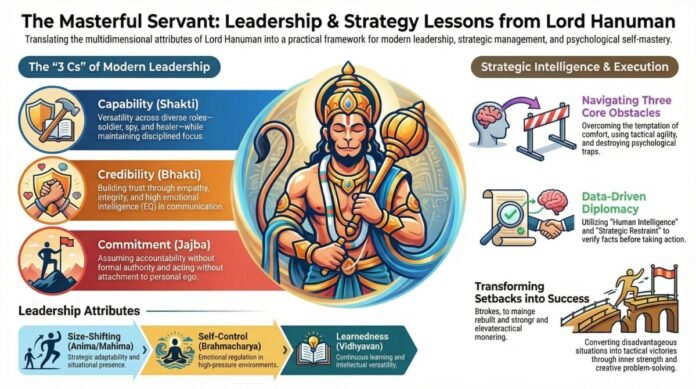
Hanuman could change his size, becoming a giant to fight or tiny to sneak into enemy territory. This is called “strategic restraint.”
- Intelligence Gathering: When he reached Lanka, he didn’t just start a fight. He observed the city, mapped out the security, and gathered facts first.
- The Five Faces (Panchmukhi): This form represents solving problems from five different angles at once: devotion, fearlessness, speed, stability, and wisdom.
- The Lesson: A modern leader must be versatile. You need to know when to be “big” and take charge, and when to be “small” and listen.
4. Communication and Diplomacy
Hanuman is considered a master communicator. When he first met Lord Rama, he spoke so well that Rama was immediately impressed.
- Body Language: He didn’t fidget; his face was calm and professional.
- Tone of Voice: He spoke clearly, not too loud to be aggressive, and not too soft to be ignored.
- The Lesson: Influence isn’t about shouting; it’s about speaking with clarity, empathy, and respect for the person you are talking to.
5. The “3 Cs” of Responsibility
Hanuman proves that you don’t need a fancy title to be a leader. He followed three rules:
- Capability: When asked to find a specific healing herb and he couldn’t identify it, he didn’t give up. He brought back the entire mountain. He solved the problem despite having incomplete info.
- Credibility: He earned trust. Before talking to a frightened Sita, he sang Rama’s praises from a distance to calm her down before showing his face. He used high “Emotional Intelligence.”
- Commitment: He took ownership even when he wasn’t the “boss” of the group. He worked for the success of the team, not for the credit.
The Bottom Line: Hanuman represents the transformation of a restless mind into a masterpiece of discipline. He shows us that you can be the strongest person in the room and still be the most humble servant to the cause.
The question for us is: Are we using our strengths just for ourselves, or are we using them to serve a bigger goal?