
































Key Points
- Advocate Ashwani Kumar Upadhyay filed the petition under Article 32 of the Constitution on March 28, 2026.
- The plea demands fingerprint and iris authentication for all voters in the upcoming assembly elections.
- It aims to eliminate “ghost voting,” impersonation, and duplicate entries that plague current manual verification.
- The petitioner argues that the Election Commission has plenary powers under Article 324 to implement these measures.
- A formal representation was submitted to the Election Commission today, March 28, before the court filing.
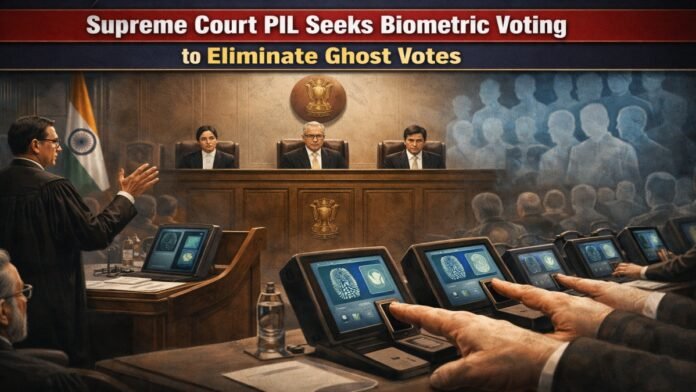
In a significant move toward electoral reform, a Public Interest Litigation (PIL) was moved before the Supreme Court on Saturday, March 28, 2026, seeking a technological overhaul of the Indian voting process. The petition, filed by social activist and advocate Ashwani Kumar Upadhyay, calls for the mandatory implementation of a biometric identification system, including fingerprint and iris scans, at all polling stations across the country.
Addressing Electoral Malpractices
The petition highlights a persistent crisis in the democratic process: the prevalence of duplicate voting and “ghost voters.” Upadhyay argues that the current reliance on Voter ID cards and manual records is insufficient, as outdated photographs and clerical errors often allow for impersonation and multiple votes by a single individual. By introducing biometric authentication similar to the Aadhaar framework, the petition asserts that the Election Commission can strictly enforce the constitutional principle of “One Citizen, One Vote,” ensuring that only verified, living citizens participate in the franchise.
Constitutional and Technical Feasibility
Invoking Article 32 of the Constitution, the petitioner has urged the top court to direct the Election Commission of India (ECI) to utilize its plenary powers under Article 324. The plea contends that the ECI is fully authorized to amend existing rules to incorporate modern identification technologies. Such a system would not only curb fraudulent voting but also provide a real-time audit trail, significantly increasing the transparency and credibility of the entire electoral process.
The petition further points out that biometric technology is already successfully integrated into various government sectors for subsidy distribution and identity verification, making its expansion into the electoral arena a logical and necessary progression.
Latest Developments and Lack of Administrative Action
The filing comes immediately after a formal representation was submitted to the Election Commission on Saturday morning. According to the petitioner, despite providing detailed recommendations on how to integrate fingerprint and iris scans to address the issues of migrant voters and fraudulent entries, no concrete action has been taken by the ECI to date.
This lack of response necessitated the Supreme Court’s intervention to safeguard the purity of the upcoming assembly elections. The court is expected to hear the matter in the coming weeks, a development that could lead to one of the most substantial shifts in Indian polling booth operations since the introduction of Electronic Voting Machines (EVMs).