
































Key Points:
- Two high-speed trains collided near Adamuz, Córdoba on January 18, 2026 at approximately 5:40 PM local time
- Death toll reached 21, with at least 73 injured and 15 in serious condition
- Iryo train from Málaga to Madrid derailed onto opposite track, hitting oncoming Renfe train
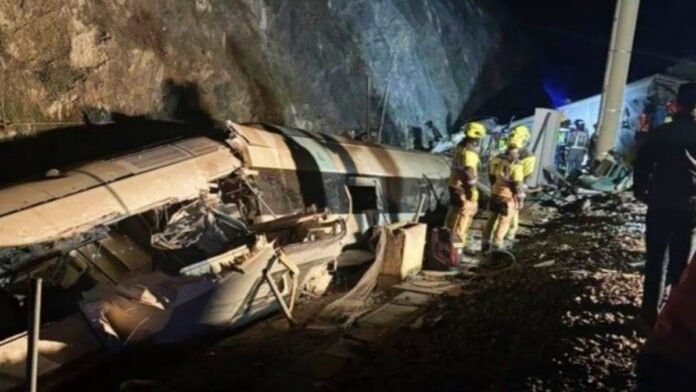
- Rescue operations faced extreme difficulties due to severely twisted carriages and fused metal
- All high-speed rail services between Madrid and Andalusia suspended indefinitely
- Investigation underway into cause of derailment on straight, recently renovated track
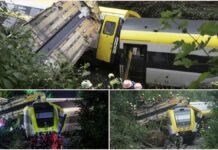
Two high-speed passenger trains collided in a devastating accident near Adamuz municipality in Córdoba province on Sunday evening, killing at least 21 people and injuring dozens more in one of Spain’s worst rail disasters in recent years. The crash occurred around 5:40 PM local time when an Iryo train traveling from Málaga to Madrid derailed and veered onto the opposite track, striking an oncoming Renfe service from Madrid to Huelva.
Spanish authorities immediately launched a massive emergency response, with Andalusia’s regional president, Juanma Moreno,o warning that the death toll could rise further as rescue operations continued through the night. The accident has sent shockwaves through Spain’s railway system and raised urgent questions about safety on the country’s high-speed network.
Death Toll and Casualties Mount
Emergency services confirmed at least 21 fatalities, though authorities cautioned this number could increase as recovery efforts progressed. Andalusia’s regional health chief, Antonio Sanz, reported that 73 injured passengers were transported to six different hospitals across the region, with 15 people in serious condition.
The scale of casualties made this Spain’s deadliest rail accident since the 2013 Santiago de Compostela derailment that killed 79 people. Francisco Carmona, head of the Córdoba fire brigade, described rescue efforts as “extremely difficult” due to severely twisted carriages where metal had fused with victims’ bodies, requiring rescuers to remove bodies to reach survivors.
Harrowing Eyewitness Accounts
Survivors described scenes of chaos and terror as the collision unfolded. Carmen, a passenger on the Iryo train, posted on social media that “ten minutes after departing from Córdoba, the train started to shake a lot, and it derailed from coach 6 behind us. The lights went out”.
A journalist from public broadcaster RNE who was aboard the train told local media the impact felt like an “earthquake,” with passengers scrambling to escape by breaking windows with emergency hammers. Television footage showed one carriage completely overturned, while others remained tilted on their sides as emergency crews worked to extract trapped passengers.
Investigation Focuses on Track Conditions
Spain’s Transport Minister Óscar Puente called the incident “truly unusual” and “a truly strange event” because it occurred on a flat, straight section of track that had undergone renovation in May 2025, less than a year earlier. The Iryo train involved in the initial derailment was less than four years old, adding to the mystery of what caused the catastrophic failure.
ADIF, Spain’s railway infrastructure agency, confirmed an investigation is underway, though the immediate cause remained unknown. Minister Puente stated that all possibilities were being examined, including potential structural failures, maintenance issues, or external factors that could have compromised the recently upgraded track section.
Rail Services Suspended Across Andalusia
The accident immediately halted all high-speed rail services between Madrid and major Andalusian cities, including Córdoba, Seville, Málaga, and Huelva. ADIF announced that services would remain suspended until at least Monday, with trains on the Seville-Madrid route being redirected back to their starting points.
The disruption affects thousands of passengers on one of Spain’s busiest rail corridors. ADIF established special assistance centers at Madrid Puerta de Atocha, Córdoba Julio Anguita, and Sevilla Santa Justa stations to support victims’ families and stranded travelers. Alternative transportation arrangements were being organized, though the indefinite suspension created significant travel chaos across southern Spain.
Emergency Response and Medical Mobilization
Andalusia’s emergency services deployed at least nine ambulances, mobile intensive care units, and numerous emergency support vehicles to the isolated crash site. The healthcare response involved hospitals across the region, with Rubén Ciria, a local doctor, posting that his facility had “all alerts activated” and was ready to receive patients.
Madrid’s regional president, Isabel Díaz Ayus,o announced that hospitals in the Community of Madrid and 112 emergency teams were on standby to support the Andalusian response, demonstrating the nationwide mobilization of medical resources. The scale of the medical operation reflected the severity of injuries, with many victims requiring immediate trauma care.
Government and Royal Condolences
Spain’s Prime Minister Pedro Sánchez expressed the nation’s grief, stating on social media that “today marks a night of deep pain for our nation due to the tragic rail accident in Adamuz”. He extended heartfelt condolences to victims’ families, acknowledging that “no words can ease such immense grief, but I want them to know that the entire country stands with them during this challenging time”.
The royal palace also issued a statement conveying deepest condolences to the families of the deceased and wishing a speedy recovery to the injured. King Felipe VI and Queen Letizia were expected to visit the crash site once rescue operations concluded, following the tradition of royal involvement in national tragedies.
Railway Safety Under Scrutiny
The disaster has reignited debates about Spain’s railway safety standards and the rapid expansion of high-speed services. Iryo, the private Italian-run operator whose train initially derailed, began operations in Spain in 2022 as part of the liberalization of the country’s rail market. The involvement of a relatively new private operator in such a catastrophic accident may prompt regulatory reviews of safety protocols and maintenance requirements for all operators.
The crash occurred despite Spain’s reputation for having one of Europe’s most modern high-speed rail networks, with extensive safety systems including automatic train protection and advanced signaling. The fact that the derailment happened on a recently renovated section of track raises particular concerns about construction quality or potential undetected structural issues.
Ongoing Recovery Efforts
As darkness fell on Sunday evening, hundreds of survivors required evacuation and support, with emergency services working through the night to ensure all passengers were accounted for. The complex recovery operation continued into Monday, with forensic teams beginning the difficult process of identifying victims and investigators securing evidence at the crash site.
The full scale of the disaster will only become clear once recovery operations are complete and a thorough investigation determines the cause of the initial derailment. For now, Spain mourns its dead and grapples with the implications of a tragedy that has shaken confidence in one of the nation’s proudest infrastructure achievements.