





























Key Points
- Supreme Court accepts a new legal definition that recognises only hills 100 meters or higher as part of the Aravalli range.
- Forest Survey of India data shows just 1,048 of 12,081 mapped hills in 15 Rajasthan districts meet this threshold, leaving about 91.3% outside protection.
- Environmentalists fear this will ease mining and construction, weakening the natural barrier that stops the Thar Desert from pushing into Delhi–NCR, Haryana and western UP.
- Sonia Gandhi calls the move a “death warrant” for Aravalli, while Ashok Gehlot says excluding 90% hills is like signing their “death certificate.”
- Supreme Court says total mining bans fuel illegal operations, and favours regulated mining, with new leases currently on hold.
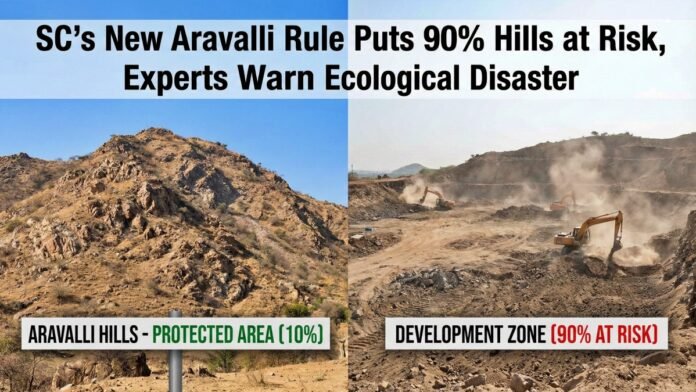
The Aravalli range, one of the world’s oldest fold mountain systems and a crucial ecological buffer for North India, now faces a legal blow that could prove more damaging than decades of quarrying and encroachment. The Supreme Court has accepted a new technical definition proposed by a central committee, according to which only hill features rising at least 100 meters above the surrounding ground will legally qualify as part of the Aravalli range.
An internal assessment by the Forest Survey of India, based on mapping in 15 districts of Rajasthan, indicates that out of 12,081 identified hill features, only 1,048 cross this 100-meter cut-off. This effectively pushes nearly 91.3% of Aravalli hillocks outside the protection net that flows from their status as part of the range, making them far more vulnerable to mining, real estate expansion and infrastructure projects.
Ecological Shock, Thar’s ‘Shield’ Weakened
The Aravalli is not merely a chain of hills; it functions as a shield against the eastward march of the Thar Desert. By breaking hot winds, trapping moisture and sustaining green cover, it helps prevent desertification from spreading toward Delhi–NCR, Haryana and western Uttar Pradesh. The range also feeds and sustains key river systems, including tributaries linked to the Chambal, Sabarmati and Luni basins, and plays a major role in groundwater recharge in semi-arid regions of Rajasthan and neighbouring states.
Experts caution that if smaller hillocks are cut away, levelled or quarried out, local rainfall patterns over northwestern India could weaken further, dust pollution episodes could intensify, and extreme heat-stress days may become more frequent and more severe. Fragmentation of the landscape will also break wildlife corridors, push leopards, hyenas and other fauna closer to human settlements and increase the risk of man–animal conflict.
Politics, Protests and ‘Death Warrant’ Charge
The court’s acceptance of the 100-meter threshold has triggered strong political and civil society reactions. Congress leader Sonia Gandhi has described the move as a “death warrant” for the Aravalli, arguing that diluting the legal scope of the range will legitimise its gradual destruction. Former Rajasthan Chief Minister Ashok Gehlot has said that excluding nearly 90% of the hills from the definition is akin to signing their “death certificate,” as it effectively removes their shield of judicial protection.
On the ground, local residents, environmental groups and the NGO “People for Aravalli” fear that the changed definition will accelerate habitat loss for birds, mammals and reptiles and shrink already stressed forest patches. They warn that once mining and construction take hold in these marginal hillocks, restoration will be almost impossible, and the region will lose precious green lungs and biodiversity hotspots forever.
Mining, Regulation and Search for a Middle Path
Defending its stance, the Supreme Court has argued that imposing a blanket ban on mining across the Aravalli encourages the rise of illegal quarries and strengthens the sand and stone mafia. The court’s view is that tightly regulated, legal mining with clear conditions and monitoring is preferable to an outright prohibition that is widely flouted on the ground. For now, while the broader principle of regulated mining is endorsed, the grant of new mining leases remains on hold pending further directions.
Environmental scientists, however, caution that if current trends continue and hillocks kept outside the new definition are systematically mined out, the Aravalli could be effectively “broken” by 2060. They warn that such large-scale degradation may increase seismic vulnerability in and around Delhi by altering stress patterns and undermining natural buffers, while simultaneously drying up local water sources and aquifers that depend on the range’s geology and vegetation for recharge.