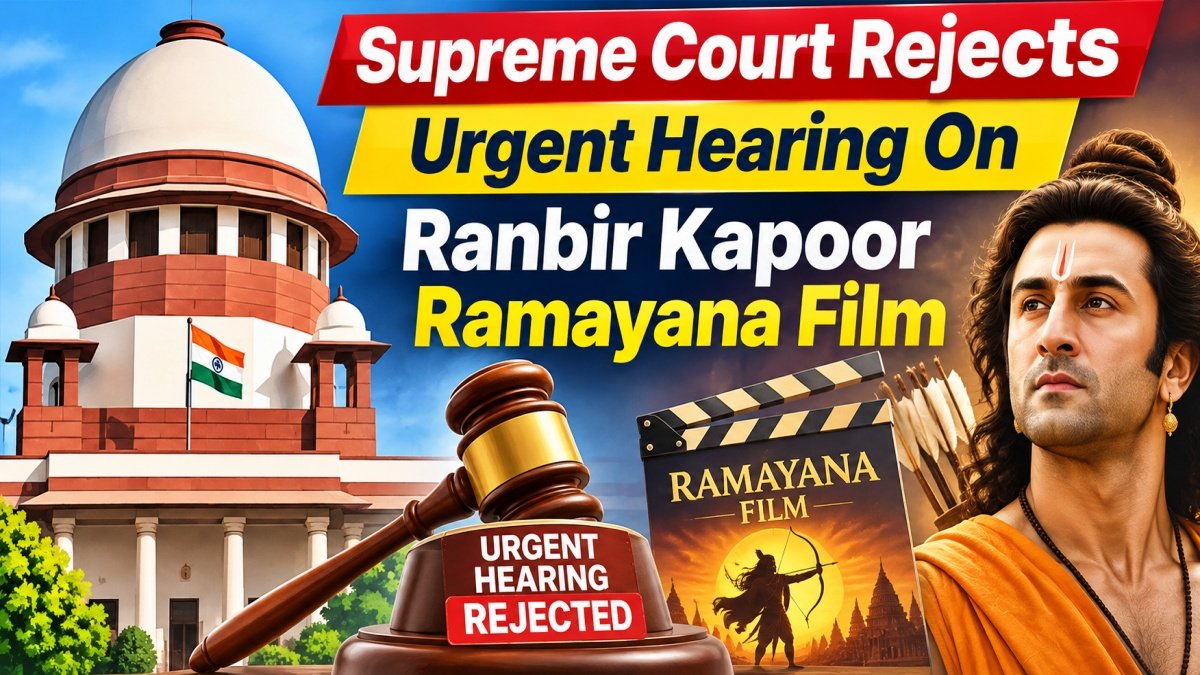
The Supreme Court has refused an urgent hearing on a petition seeking to stall the release of the film Ramayana: Rise of a Legend, citing freedom of expression.
Key Points
- Hearing Declined: The Supreme Court refused to grant an urgent listing for a petition challenging the new film.
- Freedom of Expression: The court stated that those who disagree with the film’s interpretation are free to create their own versions.
- Film Details: The movie features Ranbir Kapoor as Lord Rama, Sai Pallavi as Sita, and Yash as Ravana.
- Ensemble Cast: The production includes actors such as Sunny Deol, Ravie Dubey, and Kajal Aggarwal.
Court Refuses Urgent Listing
NEW DELHI: The Supreme Court on Friday declined to grant an urgent hearing to a petition challenging the release of the film Ramayana: Rise of a Legend. The petition sought to stall the movie, which stars Ranbir Kapoor in the lead role of Lord Rama. The court observed that those who disagree with the film’s interpretation of the epic are free to make a film presenting their own perspective.
The court’s remarks emphasized the importance of creative freedom in the film industry. By refusing the urgent listing, the bench indicated that the petition did not meet the criteria for immediate judicial intervention. The decision comes as the film prepares for its public release, following significant anticipation regarding its portrayal of the religious epic. The court essentially signaled that the judiciary should not be burdened with requests that seek to stifle artistic expression based on subjective interpretations.
Film Cast and Production Details
The upcoming production, Ramayana: Rise of a Legend, features a high-profile ensemble cast. Ranbir Kapoor portrays Lord Rama, while Sai Pallavi takes on the role of Sita. Yash is set to appear as Ravana, marking a significant casting choice for the epic. The film also features a wide array of prominent actors, including Sunny Deol, Ravie Dubey, Lara Dutta, Arun Govil, Kajal Aggarwal, Rakul Preet Singh, and Vivek Oberoi.
The project has been a subject of public discussion due to its large scale and the involvement of several well-known Bollywood personalities. The petition filed against the film alleged distortions in the narrative, which prompted the legal challenge in the highest court of the land. The production has been noted for its ambitious scope, aiming to bring a cinematic vision of the ancient Indian epic to modern audiences.
Legal Context and Judicial Stance
According to reports from The Law Advice, the Supreme Court noted that the film is already released, further justifying the refusal of an urgent listing. The Deccan Herald reported that the plea specifically alleged distortions in the depiction of the Ramayana, but the court maintained that artistic interpretation is a matter of creative choice. This ruling reinforces the principle that filmmakers have the right to present their unique perspectives on historical and religious texts.
Several news outlets, including the Hindustan Times and Telegraph India, confirmed the court’s decision to refuse the urgent listing. The court’s stance suggests a preference for maintaining the status quo of film releases unless there is a clear, immediate legal violation that necessitates a stay on the production’s distribution. This aligns with broader judicial trends regarding the protection of creative liberties under the framework of freedom of speech and expression.
Significance of the Ruling
The refusal to grant an urgent hearing is significant for the Indian film industry, as it sets a precedent for how religious and cultural epics are handled in the courtroom. By stating that dissenters are free to create their own versions, the court upholds the principle of pluralism in art. It suggests that the judiciary will not act as a censor for creative choices unless they cross into clear illegality.
For the production house and the lead actors, the ruling provides a degree of legal clarity, allowing the film to proceed without the immediate threat of a court-ordered stay. This decision ensures that the commercial and artistic journey of the film remains uninterrupted, despite the various public and legal debates surrounding its narrative choices.