





























Key Points
- Saudi military claims STC leader Aidarous al-Zubaidi fled Yemen by boat to Somalia, then flew to Abu Dhabi on UAE aircraft
- Saudi coalition spokesman named UAE Major General Awad Saeed bin Musleh Al-Hababi as allegedly coordinating the escape
- Ilyushin Il-76 aircraft used in operation disabled identification systems over Gulf of Oman before landing at Abu Dhabi military airport
- Yemen’s Presidential Leadership Council dismissed al-Zubaidi and charged him with high treason after he failed to appear for Riyadh talks
- Saudi Arabia detained over 50 STC officials in Riyadh and launched airstrikes against STC positions in Hadhramaut and al-Mahra
- UAE has not officially responded to Saudi allegations, while STC denies al-Zubaidi left Yemen
- Crisis began when STC launched military campaign to seize control of oil-rich Hadhramaut and al-Mahra, threatening Saudi interests
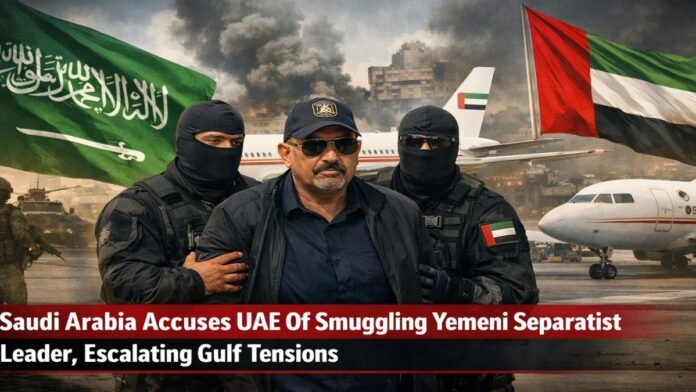
Relations between Saudi Arabia and the United Arab Emirates have recently become strained after Saudi Arabia alleged on Thursday that the UAE helped Yemeni separatist leader and head of the Southern Transitional Council, Aidarous al-Zubaidi, escape from Yemen to Abu Dhabi. Al-Zubaidi is accused of treason by Yemen’s internationally recognized government, and his escape has sparked a major diplomatic crisis between the two Gulf allies.
A statement from the Saudi military said that al-Zubaidi fled Yemen by boat to Somalia, and UAE authorities then allegedly helped him travel to Abu Dhabi, the Emirati capital. The Saudi-led coalition spokesperson, Major General Turki al-Maliki, also named the individual who allegedly assisted al-Zubaidi’s escape, identifying him as UAE Major General Awad Saeed bin Musleh Al-Hababi, commander of joint operations in the UAE Armed Forces.
Detailed Account Of Escape Operation Revealed
The Saudi military statement provided a detailed timeline of the alleged escape operation, which began late on January 7 when al-Zubaidi and his entourage boarded a vessel named Bamedhaf at the Port of Aden. The ship, sailing under the flag of Saint Kitts and Nevis, switched off its identification systems while sailing towards Somaliland and docked in Berbera around midday.
According to the coalition, al-Zubaidi then contacted Major General Al-Hababi to inform him of his arrival, and soon after, the group boarded an Ilyushin Il-76 aircraft and departed without declaring a destination. The statement mentioned that an Ilyushin Il-76 aircraft was used in the operation, a type of aircraft previously deployed in conflict zones such as Ethiopia, Libya, and Somalia.
Coalition officials said the plane again disabled its identification systems over the Gulf of Oman before reactivating them shortly before landing at Al Reef military airport in Abu Dhabi at 20:47 Saudi time. The coalition said the aircraft type is commonly used in conflict zones along routes linking Libya, Ethiopia, and Somalia, areas where the UAE has been accused of weapon smuggling, allegations that the UAE has denied.
Saudi Media Campaign And Treason Charges
Saudi media prominently featured the statement against al-Zubaidi, with the Saudi-owned satellite channel Al Arabiya reportedly broadcasting intercepted telephone calls discussing his escape. The English-language newspaper Arab News published his picture on its front page with the headline “Wanted”.
The state-run newspaper stated that the separatist leader’s refusal to return to the country confirmed his image as a traitor, alleging that al-Zubaidi, for his personal gain, collaborated with foreign powers to forcibly impose southern secession, with the primary objective of seizing power. Yemen’s Presidential Leadership Council, the country’s internationally recognized authority, charged al-Zubaidi with high treason, alleging he damaged Yemen’s political and military standing, formed an armed group, committed serious violations against civilians, killed officers and soldiers, and sabotaged military facilities.
Detention Of STC Officials And Military Escalation
The confrontation intensified when a delegation sent by the STC to Riyadh vanished shortly after landing, with STC spokesman Anwar Al-Tamimi telling Xinhua that more than 50 officials and other southern political figures “were detained upon arrival in Riyadh and transferred to an undisclosed location”. The STC condemned the action, calling it a “regrettable escalation”.
Saudi Arabia has conducted airstrikes and provided support to forces aligned with the Yemeni government, compelling the STC to retreat from both Hadhramaut, the wealthiest province in Yemen, and al-Mahra. The crisis initially erupted in early December when the STC launched a military campaign aimed at seizing control of Hadhramaut and al-Mahra, which share borders with Saudi Arabia. Riyadh expressed concern that the STC’s actions posed a threat to its national security and accused the UAE of endorsing the offensive.
Background of the Yemen Conflict And Humanitarian Crisis
The war in Yemen has killed more than 150,000 people, including civilians and combatants, and has become one of the world’s worst humanitarian crises. Meanwhile, Houthi rebels have also launched attacks on shipping in the context of the Israel-Hamas war in the Gaza Strip, disrupting a crucial route for global trade.
Saudi Arabia and the UAE first intervened in Yemen after the Houthis seized the Yemeni capital of Sanaa in 2014, with the UAE joining the Saudi-backed coalition the following year in support of the internationally recognized government. The STC was set up in 2017 with UAE backing and eventually joined the government coalition, which controls southern and eastern Yemen. The current rift threatens to fracture the anti-Houthi coalition at a time when the Houthis continue to pose a significant threat to regional stability through their attacks on commercial shipping.