
































Key Points
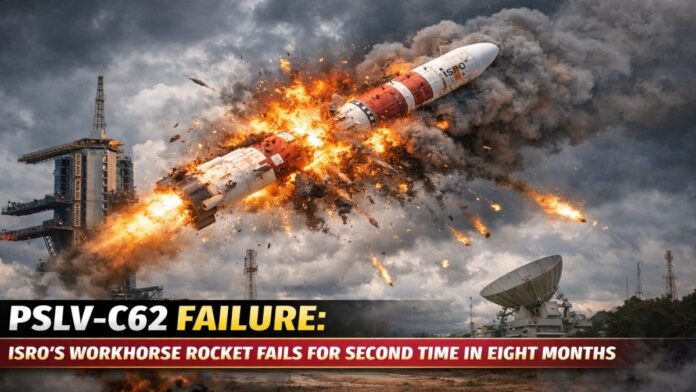
- PSLV-C62 lifted off from Sriharikota at 10:18 AM on January 12, 2026, carrying 16 satellites.
- Mission failed due to third-stage malfunction, causing trajectory deviation; ISRO chief Dr. V. Narayanan confirmed the anomaly.
- This is the second consecutive PSLV failure after PSLV-C61 failed in May 2025 during third stage.
- Rocket was destroyed by range safety officer after deviation; satellites burned up in atmosphere or fell into sea as space debris.
- Estimated financial loss is ₹250-300 crore based on previous PSLV mission costs.
- PSLV has completed 63 flights with high reliability, including Chandrayaan-1, Mangalyaan, and record 104-satellite launch in 2017.
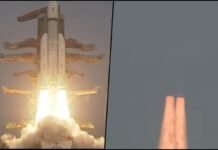
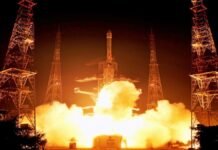
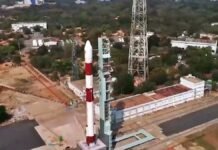
The beginning of 2026 has brought disappointment for the Indian Space Research Organisation as its first mission of the year, PSLV-C62, failed. The rocket lifted off from the Satish Dhawan Space Centre in Sriharikota, Andhra Pradesh, at 10:18 AM on January 12, 2026, carrying 16 satellites. However, a malfunction in the third stage caused the rocket to deviate from its planned trajectory, leading to mission failure.
Why the PSLV-C62 Mission Failed
The mission started perfectly, with the first two stages performing as expected after liftoff. However, a malfunction occurred in the third stage, which ISRO chief Dr. V. Narayanan identified as the cause of the failure. While ISRO has not officially declared it a success or failure, a third-stage malfunction is generally considered a mission failure. The rocket consists of millions of components, including valves, sensors, circuits, and fuel pumps. A failure in even one component for a millisecond can ruin the entire mission. In PSLV-C62, 99% of systems worked correctly, but that 1% (possibly a sensor or valve) malfunctioned, leading to the catastrophic failure.
How ISRO’s ‘Workhorse’ Failed
The PSLV rocket is considered ISRO’s ‘workhorse,’ having completed 63 flights so far. These include major missions like Chandrayaan-1, Mangalyaan (MOM), Aditya-L1, and Astrosat. In 2017, the PSLV set a world record by launching 104 satellites in a single mission. However, no rocket in the world is 100% reliable. Rockets like America’s Falcon 9 or Russia’s Soyuz have also failed several times. The PSLV has very high reliability, but the possibility of technical failure always remains.
What Happens to the Rocket and Satellites After Failure
The onboard computer and safety systems constantly monitor the rocket’s direction, speed, and altitude. If the rocket deviates from its planned trajectory and poses a threat to the ground or populated areas, the range safety officer destroys it. If the rocket fails at high altitude, it falls into the sea. As for the satellites, they usually burn up due to friction in Earth’s atmosphere. Any debris that survives falls into the sea. This debris is also called ‘Space Debris.’ In simple terms, there is virtually no chance of recovering anything after a mission failure.
Financial Loss from Mission Failure
ISRO has not disclosed the exact cost of the PSLV-C62 mission. However, the cost of previous PSLV launches is generally estimated to be between ₹250 crore and ₹300 crore, depending on mission complexity, number of payloads, and commercial components. This represents a significant financial setback for the space agency.
History of PSLV Failures
ISRO’s history has witnessed both struggles and successes. Before PSLV-C62, some missions of ISRO’s founding scientists also failed, which taught ISRO to improve further. The scientist and former President APJ Abdul Kalam, who built the first ‘Satellite Launch Vehicle’ (SLV), himself defined ‘FAIL’ as ‘First attempt in learning’.
PSLV-D1 (1993): This was the very first flight of the PSLV. Due to a software error, the mission failed, and the rocket fell into the sea. However, ISRO learned valuable lessons from this failure, which enabled it to complete 39 consecutive missions using the PSLV rocket.
PSLV-C39 (2017): This was a very rare failure. The rocket launched successfully, but the heat shield protecting the satellite did not separate. As a result, the satellite (IRNSS-1H) remained trapped inside, and the mission failed.
PSLV-C61 (2025): Last year, on May 18, ISRO’s PSLV-C61 mission also failed in the third stage due to a technical malfunction. This mission was intended to place the EOS-09 Earth observation satellite into a 524 km sun-synchronous polar orbit.
PSLV-C62 (2026): This failure is certainly unfortunate, but it is part of space science. The ISRO chairman has stated that scientific data is being analyzed to determine the exact cause of the failure. This serves as a learning experience for future, larger missions.
Implications for Future Missions
The consecutive failures of PSLV-C61 and PSLV-C62 raise concerns about the reliability of ISRO’s workhorse rocket. The space agency will need to conduct thorough investigations into the third-stage issues and implement corrective measures before future missions. The data analysis from PSLV-C62 will be crucial for identifying systemic problems and preventing similar failures in upcoming launches, including more complex missions planned for 2026 and beyond.