



























Key Points
- Pankaj Chaudhary filed nomination for UP BJP president with CM Yogi Adityanath and Deputy CM Keshav Maurya as proposers
- Seven-time MP from Maharajganj and Union Minister of State for Finance, Chaudhary belongs to the Kurmi OBC community
- Unopposed election certain as no other nominations filed, formal announcement on December 14
- BJP’s strategic move to counter Samajwadi Party’s PDA (Backward Classes, Dalits, and Minorities) equation
- Kurmi community constitutes 8-10% of UP’s electorate, crucial for OBC vote bank consolidation
- Chaudhary’s Purvanchal roots aim to recapture 160+ assembly seats in eastern UP where BJP faced challenges in 2024 Lok Sabha
- Top leadership including Deputy CMs Brajesh Pathak, Keshav Maurya, Smriti Irani, and 12 senior leaders signed as proposers
- Party aims to secure resounding victory in 2027 assembly elections and 2029 Lok Sabha elections through caste balance strategy
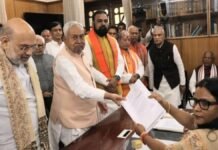
All the speculation surrounding Uttar Pradesh politics has now come to an end. The Bharatiya Janata Party (BJP) has finalised the name of its new leader. Union Minister of State for Finance and seven-time MP from Maharajganj, Pankaj Chaudhary, filed his nomination for the state president’s post on Saturday at the BJP headquarters in Lucknow. The most significant moment of this nomination process came when Chief Minister Yogi Adityanath and Deputy Chief Minister Keshav Prasad Maurya themselves became his proposers, signalling complete unity within the state leadership.
There was tremendous enthusiasm at the party office during the nomination process. Organisation election in-charge, Mahendra Nath Pandey informed that Pankaj Chaudhary filed his nomination papers in four sets to ensure procedural compliance. Central observer and National General Secretary Vinod Tawde was also present on the occasion, representing the central leadership’s oversight. Besides CM Yogi and Keshav Maurya, Deputy Chief Minister Brajesh Pathak, former Union Minister Smriti Irani, former state presidents Swatantra Dev Singh and Dara Singh Chauhan, AK Sharma, Union Minister Kamlesh Paswan, and Minister of State Asim Arun also signed as proposers on the nomination papers. The presence of the top leadership made it clear that this decision was taken unanimously after extensive consultations.
Strategic Caste Calculations and OBC Consolidation
Behind handing over the reins to Pankaj Chaudhary lies a very deep and well-calculated strategy of the BJP. He belongs to the Kurmi community, which is a significant part of the OBC category and constitutes approximately 8-10% of Uttar Pradesh’s electorate. The Kurmis, along with Yadavs and Lodhs, form the core OBC vote bank that determines election outcomes in over 150 assembly constituencies. Experts believe that by making this move, the BJP has prepared to blunt the edge of the Samajwadi Party’s PDA (Backward Classes, Dalits, and Minorities) equation, which had gained traction in the 2024 Lok Sabha elections.
By giving the reins of the organization to an OBC leader, the party has beautifully balanced the caste equation between the government and the organization. While Chief Minister Yogi Adityanath represents the upper caste and Thakur community, and Deputy CM Keshav Maurya represents the Most Backward Classes, Chaudhary’s appointment completes the OBC representation at the highest level. Pankaj Chaudhary’s long experience as a seven-time parliamentarian and his impeccable image as a clean politician will greatly help the party in consolidating the OBC vote bank, which is crucial for Mission 2027.
Purvanchal Focus and Electoral Geography
Preparing to Conquer Purvanchal is another critical dimension of this appointment. Pankaj Chaudhary’s home region is Purvanchal, the eastern part of Uttar Pradesh comprising 28 districts and accounting for 160 of the state’s 403 assembly seats. This region, including districts like Gorakhpur, Maharajganj, Kushinagar, Deoria, and Ballia, is politically crucial, but where the BJP faced tough challenges in the last Lok Sabha elections, losing several seats to the SP-Congress alliance.
By making a prominent leader from Purvanchal the president, the party has laid the groundwork to recapture that stronghold. Chaudhary’s deep roots in the region, his understanding of local issues like sugarcane pricing, migration, and infrastructure development, and his connections with local party workers will be instrumental. According to the election schedule, since no one else has filed a nomination besides Pankaj Chaudhary, his unopposed election is certain. Now, all that remains is to wait for December 14th, when his name will be formally announced at a special meeting of the state BJP executive.
Implications for 2027 and 2029 Elections
This coronation marks the beginning of a new era in the state BJP, with the ultimate goal of securing a resounding victory in the 2027 assembly elections and the 2029 Lok Sabha elections. The party’s central leadership, including Home Minister Amit Shah and BJP President JP Nadda, had been working on this succession plan for months, conducting extensive surveys and consulting with RSS leaders. The timing is significant as it gives Chaudhary over two years to reorganise the party machinery, address worker grievances, and implement a fresh strategy before the crucial assembly polls.
Political analysts view this as the BJP’s masterstroke in social engineering, similar to their successful experiments in other states. The appointment also neutralises potential dissatisfaction among Kurmi voters, who had shown signs of drifting toward smaller regional parties. With Chaudhary at the helm, the BJP aims to replicate its 2017 performance when it won 325 assembly seats, and the 2019 Lok Sabha sweep where it secured 64 of 80 seats in Uttar Pradesh.