































Key Highlights
- Government Approval: Prime Minister Shahbaz Sharif greenlit the PCB’s participation after high-level briefings.
- Deadlock Broken: The decision follows intense negotiations between the PCB, ICC, and other member boards in Lahore.
- ICC Stance: The ICC maintained its position, rejecting several of Pakistan’s demands regarding bilateral series.
- Bangladesh Protected: The BCB will face no penalties for its refusal to play in India, retaining rights to dispute resolution.
- Tournament Stability: The resolution protects broadcasters and stakeholders from massive projected financial losses.
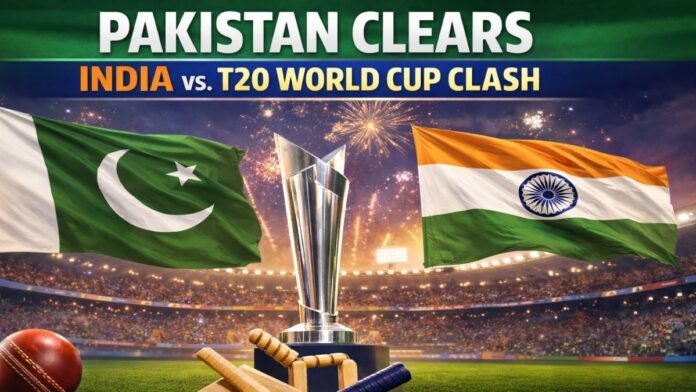
The highly anticipated clash between India and Pakistan in the ICC Men’s T20 World Cup 2026 is officially set for February 15, following a period of intense diplomatic and sporting uncertainty. On Monday, the Pakistan government formally granted the Pakistan Cricket Board (PCB) permission to participate, a move that effectively saves the tournament’s most commercially significant fixture.
The breakthrough came after PCB Chairman Mohsin Naqvi briefed Prime Minister Shahbaz Sharif on the results of exhaustive discussions involving the ICC, the Bangladesh Cricket Board (BCB), and other member nations. While Pakistan had previously weighed a boycott based on government advice, the administration ultimately directed the team to take the field to avoid putting the global event in jeopardy.
The Lahore Negotiations
The path to this agreement was paved during a marathon meeting in Lahore, where the ICC held a firm line. Despite the PCB presenting several conditions, including requests for a guaranteed bilateral series, a triangular series, and a resolution to the “handshake dispute,” the ICC stood its ground.
Faced with the ICC’s refusal to yield on these points, the PCB opted to soften its boycott stance. This pragmatic shift was essential for the tournament’s continuity, as an India-Pakistan cancellation would have triggered a financial crisis for the ICC, broadcasters, and member boards who rely on the massive revenue generated by this specific rivalry.
Safeguards for Bangladesh
A significant portion of the recent turmoil involved the Bangladesh Cricket Board (BCB) and its security concerns regarding playing in India. The ICC has clarified that the BCB will not face any financial or administrative penalties for its refusal to play specific matches across the border.
Furthermore, the ICC confirmed that Bangladesh will host an ICC tournament between 2028 and 2031, provided they meet standard hosting procedures and operational requirements. This agreement ensures that the BCB remains a protected and integral part of the cricket ecosystem, despite the geopolitical complexities currently affecting the sport.
Global Impact and Future Stability
With the match now confirmed, the cricket world has expressed collective relief. The India-Pakistan game is widely regarded as the “crown jewel” of international cricket, and its inclusion brings much-needed stability to players, organizers, and millions of fans. By resolving the deadlock, the ICC has managed to keep its 2026 schedule intact, ensuring the tournament remains a commercially viable and competitive global spectacle.