






























Key Points
- Two rare tropical cyclones, Ditwah and Senyar, devastated South and Southeast Asia in November,December 2025
- Sri Lanka’s Cyclone Ditwah, worst flooding in 10 years, killed 355 with 366 missing, over 1.1 million affected
- Cyclone Senyar classified as “exceptionally rare” system, second documented cyclone in Malacca Strait
- Indonesia recorded 637 deaths (mostly North Sumatra), over 3,200 homes submerged, 487 missing
- Thailand reported 263 deaths across 14 provinces, with Songkhla accounting for 200 deaths alone
- Hat Yai city experienced unprecedented 335mm rainfall in single day, highest in 300 years
- Over 2.7 million people affected across Southeast Asia, communication lines cut in affected areas
- Military helicopters deployed for emergency evacuations, rescue teams hampered by ongoing rain
- Cyclone Senyar caused estimated damage of USD 65 million (IDR 1 trillion) in Indonesia alone
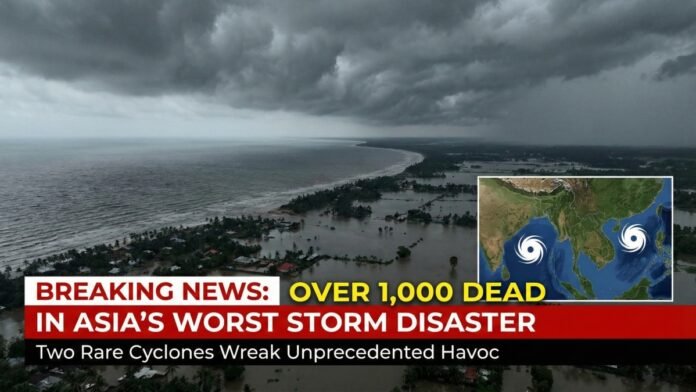
An unprecedented catastrophe has unfolded across South and Southeast Asia as two exceptionally rare tropical cyclones have unleashed their devastating fury across multiple nations in late November 2025. The combined death toll has surpassed 1,000 people, with hundreds more missing and millions displaced, as rescue teams race against time in a desperate battle to save lives buried under debris and drowning in floodwaters. The two cyclonic systems, Ditwah and Senyar, have been classified as extraordinarily unusual weather phenomena, with meteorologists noting that Cyclone Senyar represents one of the lowest,latitude cyclones ever recorded.
Sri Lanka, Cyclone Ditwah’s Deadliest Path
Sri Lanka’s President has declared that the nation is contending with the “largest and most challenging natural disaster in our history” as Cyclone Ditwah continues to devastate the island nation. The deadly storm made landfall on Friday, November 29, 2025, bringing torrential rainfall and triggering catastrophic flooding and landslides in the mountainous central regions. As of December 1, official figures documented 355 confirmed deaths with 366 individuals still missing, though officials warned that the death toll could significantly increase as search and rescue operations continue.
Over 1.1 million people from more than 300,000 families across Sri Lanka have been affected by the disaster, with entire communities remaining submerged and communication lines disrupted in many affected areas. The flooding represents the worst experienced by the island nation in ten years, surpassing previous records and straining medical facilities and rescue operations to their absolute limits. The Kelani River overflowed its banks on Friday evening, prompting hundreds to seek refuge in temporary shelters, while authorities issued evacuation orders for residents along the riverbanks.
Hardest Hit Districts in Sri Lanka
The city of Kandy emerged as the hardest,hit location in Sri Lanka, with 88 confirmed deaths and 150 people still missing following the cyclone’s catastrophic impact. The mountainous terrain of the central districts, known for their tea,growing regions and vulnerable geology, proved particularly susceptible to the devastating landslides triggered by Cyclone Ditwah’s torrential rainfall. Badulla district reported 71 deaths, Nuwara Eliya recorded 68 deaths, and Matale suffered 23 fatalities, with landslides burying entire neighborhoods and cutting off road access to remote communities.
The central highlands, with their steep slopes and poor drainage conditions, became traps of mud and debris as torrential rains saturated the earth and triggered massive slope failures. Rescue teams have faced enormous challenges accessing the most remote mountain villages, where entire families have been buried alive under meters of earth and rubble. The disaster has overwhelmed Sri Lanka’s healthcare infrastructure, with hospitals already at maximum capacity before the cyclone struck, forcing authorities to appeal for international medical assistance and emergency supplies.
International Assistance and Response
Recognizing the magnitude of the disaster, the Sri Lankan government has launched an urgent appeal for international assistance and urged Sri Lankans living abroad to contribute cash donations to support nearly half a million individuals affected by the cyclone. Prime Minister Harini Amarasuriya has met with diplomats in Colombo to provide detailed situation updates and request support from international governments. Rail operations have been halted, government offices closed, and the entire nation mobilized for emergency response operations.
Meteorological forecasters predict that rainfall levels in some areas could exceed the records set in 2016, when 200 individuals lost their lives nationwide. Officials continue to monitor weather patterns closely, as forecasts indicate continued heavy rainfall in various regions of the island despite the cyclone’s movement toward southern India.
Indonesia’s Catastrophe, Cyclone Senyar’s Rare Formation
Cyclone Senyar stands out as an exceptionally unusual meteorological phenomenon, classified by Indonesia’s Meteorology, Climatology, and Geophysical Agency (BMKG) as the second documented cyclone ever recorded in or near the Malacca Strait and the first to produce severe impacts across Indonesia, Malaysia, and southern Thailand. The system formed at an extraordinarily low latitude—just 5 degrees north of the equator in the Strait of Malacca, a region typically cyclone,free due to the weakness of the Coriolis force. Meteorologists attribute Senyar’s unusual formation to warmer,than,normal sea surface temperatures (1,2°C above average) and interactions with Typhoon Koto in the Philippines, creating perfect conditions for this rare cyclonic system to intensify.
The death toll across Indonesia has reached 637 confirmed fatalities as of latest reports, with the overwhelming majority occurring in North Sumatra province. An additional 487 individuals remain missing, while over 3,200 homes have been submerged and extensive landslides have buried entire neighborhoods. The National Disaster Management Agency (BNPB) estimates the damage at IDR 1 trillion (approximately USD 65 million), with over 10,000 people evacuated to temporary emergency shelters stocked with food, blankets, and water purification supplies.
Devastating Impact Across Indonesian Provinces
North Sumatra province emerged as the most catastrophically affected region in Indonesia, suffering 217 confirmed deaths and 209 individuals missing as of the latest reports. The cyclone made landfall near Medan after midnight on November 26, 2025, unleashing torrential rainfall and triggering catastrophic flooding and massive landslides across the province. Monsoon rains burst major rivers including the Deli and Batang Gadis, flooding mountainside villages in Karo and Simalungun districts, where entire neighborhoods were buried under meters of earth and debris.
In the Langkat district, a devastating flash flood struck beneath a mosque during prayers, sweeping away 20 worshippers and submerging 500 homes, leaving 42 people unaccounted for. Aerial drone footage captured by BNPB revealed the catastrophic scene, showing homes crushed beyond recognition by massive landslides in Simalungun district, where 14 people were buried alive in a single incident. Rescue teams deployed 5,000 personnel, helicopters with thermal imaging scanners, and heavy excavation equipment to dig through thick mud and debris, recovering 80 bodies but facing constant delays from ongoing downpours.
In Aceh province, 96 deaths were confirmed with 75 individuals reported missing, while West Sumatra province recorded 129 deaths and 118 missing. Coastal communities in Aceh and Riau faced additional devastation from extraordinarily high waves reaching up to 4 meters in height, which battered coastlines, eroded shorelines, and damaged over 100 fishing boats, destroying the livelihoods of fishing communities.
Scale of Displacement and Infrastructure Damage
Approximately 3.54 million people have been affected by the devastating floods in Indonesia, particularly across the southern regions of Sumatra. Emergency response operations have been severely hampered by major roads being completely washed away or rendered impassable by debris, cutting off access to the most affected villages. Blackouts of telecommunications and electricity have isolated entire communities, leaving families with no way to communicate with loved ones or receive emergency assistance information.
Rescue teams have been forced to deploy helicopters as the primary means of delivering emergency aid to the nearly 1.1 million people stranded in remote areas. Sanitization concerns have emerged as floodwaters have contaminated water supplies, and officials have warned of potential leptospirosis outbreaks from contact with contaminated floodwaters. Temporary emergency shelters have been established across the affected provinces, but supplies of food, water, medicine, and sanitation facilities remain critically inadequate.
Thailand’s Unprecedented Flooding
Southern Thailand experienced unprecedented flooding as Cyclone Senyar’s remnants and associated rainfall systems battered the region with extraordinary intensity. Thailand has recorded 263 confirmed deaths across 14 affected provinces, with 102 injuries reported. The provincial death toll figures reveal that Songkhla province has suffered the most catastrophic losses, with 200 deaths alone, making it the single hardest,hit province in Thailand.
The city of Hat Yai experienced an extraordinary rainfall event, recording an unprecedented 335 millimeters of rain in a single 24,hour period, the highest rainfall documented in the city in 300 years. Floodwaters surged to approximately 2,5 meters (8 feet) in height, submerging entire neighborhoods and forcing residents to escape to their rooftops to survive the rising water. The government declared a state of emergency in Songkhla province to facilitate emergency evacuations and coordinate rescue operations, but the sheer scale of devastation overwhelmed response capabilities.
Hospital Crisis and Emergency Responses
One of the most dramatic rescue scenarios unfolded when a hospital in Hat Yai became surrounded by floodwaters, leaving a maternity ward with 30 newborn babies, nursing staff, and patients stranded without access. The Thai Navy announced that military helicopters were transporting critical supplies, including generators, to the hospital, with dramatic images shared on social media showing equipment being relocated to rooftops amid dark, overcast skies. Authorities were forced to airlift critical patients from the marooned hospital to safer locations, highlighting the desperation of the medical emergency.
Emergency responders had to bring in three large refrigerated trucks just to hold the bodies from the districts with the highest death toll. In the town of Siba, which was hit hardest by the flooding, more than 30 lives were lost and at least 65 people remained missing. Communication lines and road access have been completely cut off in many areas, leaving families waiting in agony at evacuation centers with no information about their missing relatives.
Massive Displacement and Affected Populations
The interior ministry reported that flooding across the nine affected provinces has impacted over 980,000 homes and affected approximately 2.7 million individuals nationwide. As of late November, 127,000 households across nine provinces in southern Thailand remained inundated, with some areas experiencing nearly 400 millimeters of rainfall compounded by overflowing rivers and flash floods from drainage systems overwhelmed by the extraordinary rainfall. Entire streets in affected cities have been submerged, with houses partially underwater and emergency responders using boats to rescue inhabitants and distribute essential supplies throughout submerged neighborhoods.
Political Consequences and Government Criticism
Thailand’s Prime Minister Anutin Charnvirakul is facing mounting criticism over his government’s perceived slow and inadequate response to the deadly floods in the southern provinces. The government suspended the Hat Yai district chief due to his failure to properly prepare and respond to the disaster despite advance warnings of extreme rainfall. This political fallout is threatening to derail the prime minister’s party’s ambitions ahead of planned snap elections, as voters hold leaders accountable for disaster preparedness and response failures.
Climate Change and Rare Weather Phenomena
The exceptional rarity of Cyclone Senyar has prompted serious questions from meteorologists about the relationship between climate change, warming sea surface temperatures, and the emergence of increasingly extreme weather patterns in traditionally safe regions. Scientists note that formations of cyclonic systems at such low latitudes, where the Coriolis force is typically insufficient to support cyclogenesis, represent a concerning shift in global weather patterns. The unusually warm sea surface temperatures (1,2°C above historical averages) combined with atmospheric interactions created ideal conditions for this rare system to form and intensify.
This unprecedented weather event serves as a stark warning about the increasing vulnerability of populous regions across Asia to extreme weather phenomena that were previously considered virtually impossible. As climate patterns continue to shift, meteorological agencies across the region are reassessing their disaster preparedness protocols and early warning systems to account for these unprecedented scenarios.
Ongoing Rescue and Relief Operations
Despite the extraordinary challenges posed by ongoing rainfall, damaged infrastructure, and communication breakdowns, rescue teams across all three affected nations have mobilized unprecedented numbers of personnel and resources. Military forces, emergency responders, local authorities, and civilian volunteers have been deployed to conduct search and rescue operations, clear roads, and deliver emergency supplies to the most affected communities.
However, the scale of the disaster continues to overwhelm response capabilities, and with each passing day, the likelihood of finding missing persons alive diminishes. Families continue to await news of their loved ones, with hundreds still unaccounted for and authorities acknowledging that many may never be found. The financial, humanitarian, and psychological toll of this unprecedented disaster will be felt for decades as survivors struggle to rebuild their lives from the devastating aftermath of these rare and unprecedented cyclonic systems.