





























Key Points
- Cash payments at national highway toll booths will permanently end on April 10.
- Vehicles without a valid FASTag must pay 1.25 times the normal toll fee via UPI.
- An e-notice system will generate automated digital bills for unpaid tolls.
- Payments cleared within 72 hours of an e-notice will incur no additional penalty.
- Physical ID card displays for toll exemptions are banned, requiring “Exempted FASTags” instead.
- Private car owners can purchase a FASTag annual pass for ₹3,075, allowing 200 crossings.
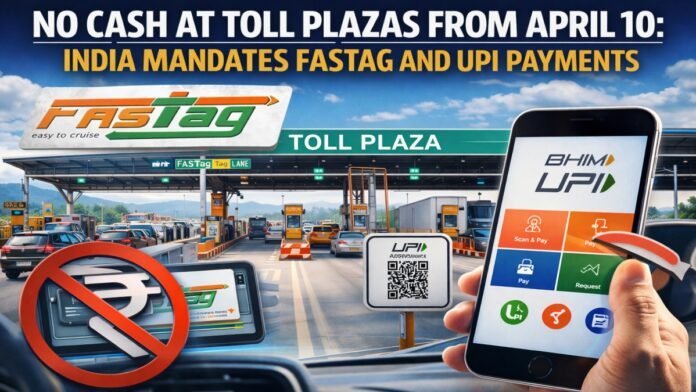
In a decisive move to ensure seamless travel and eliminate long queues, the Ministry of Road Transport and Highways (MoRTH) has notified a new rule discontinuing cash payments at toll plazas nationwide starting April 10, 2026. This transition aims to improve traffic flow, ease congestion, minimize disputes, and put an end to commuters flashing identification cards to skip payments.
Under a gazette notification issued on April 2, every vehicle entering a toll gate must either pay the user fee through a FASTag or pay 1.25 times the standard fee via UPI. The provision of paying double the applicable fee in cash, which was permitted under earlier regulations, has been entirely ruled out.
How the New Payment System Works
The ministry mandates that a car must have a valid and funded FASTag to pay the regular toll rate. For commuters without a working FASTag, UPI serves as the mandatory backup option. However, choosing the UPI route will automatically attract a 25 percent premium over the standard toll amount. While the 1.25 times UPI premium existed before the latest order, the complete removal of the cash option marks a significant regulatory shift.
The “Unpaid User Fee” and E-Notice System
To address scenarios where both FASTag and UPI fail or are unavailable, the National Highways Authority of India (NHAI) introduced a provision for an “unpaid user fee” in a recent release.
If a vehicle crosses a toll booth without making a payment, an electronic notice (e-notice) will be automatically generated and issued to the registered vehicle owner. These notices will be delivered through SMS, email, mobile applications, and a designated online portal.
While the e-notice will technically reflect double the applicable toll amount, the government has provided a 72-hour grace period. If the commuter clears the payment online within 72 hours of the e-notice issuance, no extra penalty will be levied, and they will only pay the standard toll fee. However, if the payment is delayed beyond 72 hours, the commuter is obligated to pay double the toll amount. Failure to settle the dues after 15 days will result in the outstanding sum being recorded in the MoRTH VAHAN system, inviting strict legal restrictions on the vehicle.
Ending ID-Based Exemptions
The new mandate also targets the widespread misuse of identity cards at toll plazas. Government entities and eligible officials must now obtain “Exempted FASTags” to bypass fees. Showing a physical ID card to toll booth operators will no longer be accepted, a change expected to drastically reduce daily altercations and traffic pile-ups. Frequent travelers and private car owners also have the option to purchase a FASTag annual pass for ₹3,075, which covers up to 200 toll crossings.
With nearly 6 crore active FASTags already in circulation across India, the government expects this stringent digital push to pave the way for a multi-lane, free-flow, and completely signal-free tolling network in the near future.