































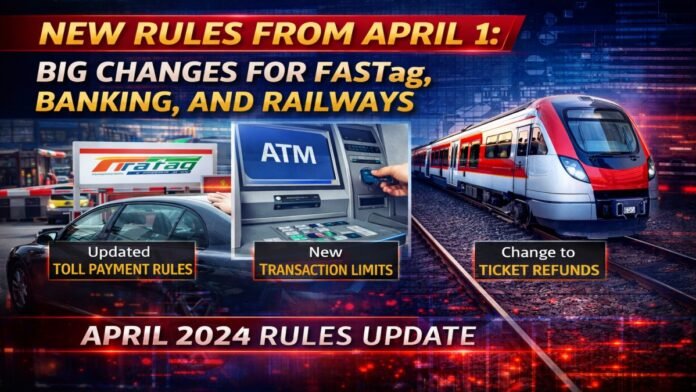
Key Points
- FASTag annual pass fee increases to ₹3,075 for private vehicles.
- UPI ATM withdrawals now count toward monthly free transaction limits at major banks.
- No railway refunds for cancellations made less than 8 hours before departure.
- Mandatory 20% ethanol, blended petrol (E20) begins nationwide rollout.
- Aadhaar card alone is no longer sufficient for PAN card date, or birth verification.
As the new financial year commences on April 1, 2026, a series of significant government and banking regulations are set to take effect. These changes, aimed at streamlining digital services and enhancing security, will have a direct impact on the daily expenses and financial planning of the general public. From the way you withdraw cash to the fuel you pump into your car, here is a detailed look at the new landscape.
FASTag Pass Prices and Highway Travel
The National Highways Authority of India (NHAI) has officially revised the fee for the FASTag Annual Pass for the 2026,27 financial year. Effective April 1, the price for a private vehicle annual pass will rise to ₹3,075, up from the previous ₹3,000. This pass, which covers up to 200 toll crossings or one year of travel, remains a cost-effective choice for frequent commuters, though the marginal hike reflects ongoing inflation and highway maintenance costs.
New ATM and UPI Withdrawal Limits
Banking customers will need to monitor their cash withdrawals more closely. Major institutions, including HDFC Bank, PNB, and Bandhan Bank, have announced that UPI-based ATM withdrawals, known as Interoperable Cardless Cash Withdrawal (ICCW), will now be counted toward a customer’s monthly free transaction limit.
For HDFC Bank customers, once the limit of five free monthly withdrawals is exceeded, a fee of ₹23 per transaction plus applicable taxes will be levied. Additionally, Punjab National Bank (PNB) has reduced daily ATM withdrawal limits for several card categories to enhance security and encourage digital transactions.
Stricter Railway Refund and Boarding Rules
The Ministry of Railways, under the direction of Minister Ashwini Vaishnaw, has overhauled the ticket cancellation policy to curb ticket hoarding and “black marketing” by agents. Starting in April, passengers will receive no refund if a confirmed ticket is cancelled less than 8 hours before the scheduled departure, a significant jump from the previous 4-hour window.
- 72 to 24 hours before: 25% of the fare will be deducted.
- 24 to 8 hours before: 50% of the fare will be deducted.
- More than 72 hours: Full refund minus a flat cancellation charge.
On a positive note, the Railways will now allow passengers to change their boarding point digitally up to 30 minutes before departure, providing much,needed flexibility for last,minute plan changes.
PAN Card and Identity Verification
The process for obtaining or updating a PAN card is becoming more rigorous. From April 1, 2026, the Income Tax Department will no longer accept the Aadhaar card as the sole proof of date of birth (DoB) for PAN applications. Applicants will now be required to provide additional supporting documents, such as a Class 10 certificate, birth certificate, or passport. This move is part of a broader effort to secure the national tax database and prevent the issuance of fraudulent identities.
Environmental Shift: The E20 Petrol Mandate
In a major step toward energy security, the government has mandated that all petrol sold across India must contain up to 20% ethanol (E20) and meet a minimum Research Octane Number (RON) of 95. This high-octane fuel blend is designed to reduce dependence on crude oil imports and lower carbon emissions. While most modern vehicles manufactured after 2023 are E20 compatible, owners of older vehicles are advised to check for potential mileage drops or component wear over time.
The Income Tax Act 2025
Adding to these changes, the new Income Tax Act 2025 officially replaces the old 1961 Act. This simplified framework introduces a tax rebate for individuals earning up to ₹12 lakh annually and replaces the traditional Form 16 and 16A with the updated Form 130 and 131 to streamline the filing process.