
































Key Points
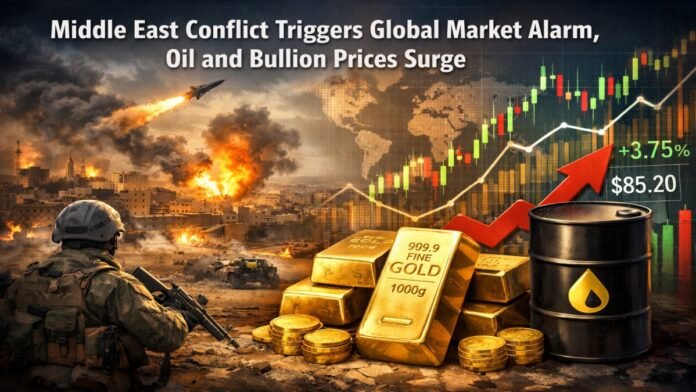
- Oil Market Jitters: Brent crude prices jumped over 8% on March 2, 2026, as shipping through the Strait of Hormuz slowed to a near standstill.
- India’s Fuel Risks: Analysts warn petrol could cross ₹105 and diesel ₹96 in Delhi if international crude reaches the $100 per barrel mark.
- Gold and Silver Record: Safe-haven demand has pushed Indian gold prices toward ₹1,67,000 per 10 grams, while silver has skyrocketed to nearly ₹2.9 lakh per kg.
- Historical Precedent: Past conflicts, including 1973 and 2022, show that energy chokepoints can trigger immediate 20% to 300% price surges.
The recent escalation in the Middle East has brought the world’s most critical oil trade route, the Strait of Hormuz, to the center of global economic concern. As of March 2, 2026, maritime transit has dropped to near zero following military strikes and the subsequent withdrawal of insurance coverage for vessels in the region.
India remains particularly vulnerable to this disruption. The nation imports roughly 90 percent of its crude oil requirements, and nearly half of these supplies transit through the Strait. If the current blockade persists for more than three weeks, market experts from firms like J.P. Morgan and Wood Mackenzie predict Brent crude could surge into the $100 to $120 per barrel range.
Projected Impact on Petrol and Diesel in India
While domestic fuel prices have remained relatively stable in the immediate days following the strikes, the pressure is mounting on Oil Marketing Companies (OMCs). If international benchmarks hold above $85 per barrel, retail price revisions are expected:
- Petrol: Currently priced around ₹94.77 in Delhi, rates could climb to ₹105 per liter.
- Diesel: From the current ₹87 to ₹89 range, prices may scale toward ₹96 per liter.
High oil prices typically impact refining margins and can lead to selling pressure on stocks like BPCL, HPCL, and Oil India, as seen in early March 2026 trading sessions.
Historical Perspective: How War Shapes Oil Prices
History illustrates a consistent pattern of “war premiums” on energy. In previous conflicts, the price of crude and Indian petrol reacted as follows:
- 1973 Israeli-Arab War: Crude rose from $3 to $12 per barrel, Indian petrol rose from ₹1 to ₹1.67 per liter.
- 1990 Iraq-Kuwait War: Crude jumped from $17 to $46 per barrel, Indian petrol rose from ₹8.50 to ₹14.62 per liter.
- 2003 Iraq-US War: Crude climbed from $30 to $40 per barrel, Indian petrol rose from ₹29 to ₹33 per liter.
- 2022 Russia-Ukraine Conflict: Crude surged from $80 to $130 per barrel, Indian petrol rose from ₹96 to ₹105 per liter.
Bullion Market: Gold and Silver as Safe Havens
As equity markets face turbulence, investors have pivoted toward precious metals. On March 2, 2026, gold prices on the MCX saw a massive intraday jump of over 5 percent. Analysts suggest that if the conflict deepens, gold could reach ₹1.7 lakh per 10 grams, while silver, acting as a high-beta haven, is eyeing the ₹3 lakh per kg milestone.
The current market sentiment is driven by fear and capital preservation, making gold and silver the most resilient assets amidst the ongoing geopolitical instability.