



























Key Points
- Historical First: For the first time in Indian history, Union Finance Minister Nirmala Sitharaman presented the budget on a Sunday (February 1, 2026).
- STT Shockwave: A significant hike in Securities Transaction Tax for futures (up to 0.05%) and options (up to 0.15%) sparked a mass sell-off in the F&O segment.
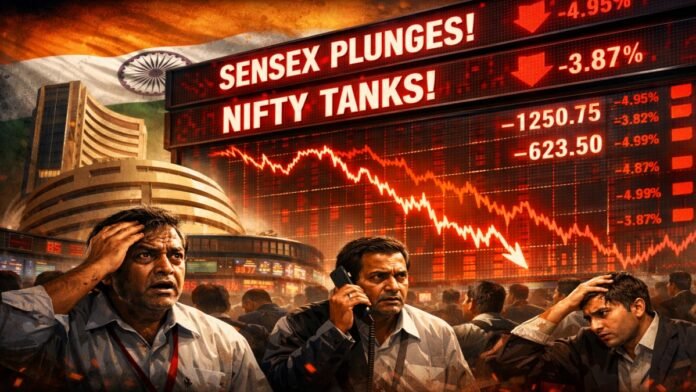
- Market Bloodbath: The BSE Sensex closed 1,547 points lower, while the Nifty 50 ended at 24,825, wiping out early intraday gains.
- Precious Metals Crash: Gold and silver futures hit lower circuits, with silver prices nosediving by 9% as investors opted for aggressive profit-booking.
- Policy Shifts: The budget introduced the “New Tax Act” to replace the 60-year-old law and a record ₹12.2 lakh crore capital expenditure outlay.
On a day intended for fiscal history, Union Finance Minister Nirmala Sitharaman presented India’s Union Budget 2026, marking the first time the national accounts were tabled on a Sunday. To accommodate the event, the BSE, NSE, and MCX held special live trading sessions. However, the initial optimism of the opening bell quickly evaporated, replaced by one of the most volatile trading sessions in recent memory.
The STT Impact: Friction in the Derivatives Market
The primary catalyst for the afternoon crash was the government’s decision to curb speculative trading in the derivatives segment. The Finance Minister proposed a steep increase in the Securities Transaction Tax (STT):
- Futures: Increased from 0.02% to 0.05% (a 150% jump).
- Options (Premium): Raised from 0.1% to 0.15%.
- Exercised Options: Raised to 0.15%.
The announcement immediately pressured high-frequency traders and retail participants. Market analysts noted that the hike adds significant “friction” to rapid-fire trading, which the government and SEBI have recently flagged as a concern for financial stability. Consequently, shares of top brokerages and exchanges, including Angel One, Groww, and MCX, saw double-digit percentage declines.
Equities and Commodities in Freefall
While the Sensex opened slightly higher at 82,445 points, it underwent a dramatic reversal during the 1-hour and 25-minute speech. By 12:45 PM, the Sensex had shed over 1,500 points, eventually closing at 80,722. The Nifty 50 followed suit, falling 1.96% to close at 24,825.
The commodity markets were not spared. Silver futures for March 2026 delivery hit the 9% lower circuit, dropping approximately ₹26,273 per kg. Gold also saw a 9% decline on the MCX, settling around ₹1,38,634 per 10 grams. This “sentiment shock” in precious metals was exacerbated by a global sell-off following news from the U.S. Federal Reserve, adding layers of external pressure to the domestic fiscal event.
Broad Budgetary Themes
Beyond the market turmoil, the budget focused on three “Kartavyas” (Duties): accelerating growth, fulfilling aspirations, and ensuring resource access for all. Key sectoral announcements included:
- Infrastructure: A record capital expenditure outlay of ₹12.2 lakh crore, representing a 9% increase over the previous year.
- Semiconductors: The launch of ISM 2.0 with a ₹40,000 crore boost for electronics manufacturing.
- Taxation: The announcement that the “New Income Tax Act” will come into effect on April 1, 2026, aiming to simplify the code and reduce legal ambiguities.
Despite the positive long-term outlook for sectors like healthcare (Medical Tourism Hubs) and green energy, the immediate cost of the STT hike dominated the narrative on Dalal Street, making this historic Sunday a day of significant losses for the trading community.