































Key Points:
- Sensex crashes 1,065 points to 82,180.47, Nifty tumbles 353 points to 25,232.50 in brutal Tuesday session
- Market capitalisation erodes ₹10.12 lakh crore, with only HDFC Bank closing positive among top 30 stocks
- FIIs extend selling streak to 10 consecutive sessions, offloading ₹3,263 crore on Monday alone
- IT sector leads downturn with Wipro falling 3% and LTIMindtree plunging 6%
- Global tariff threats and geopolitical tensions over Greenland escalate risk-off sentiment
- All sectoral indices bleed, realty plunges over 5%, auto drops 2.50%, financials shed 1.4%
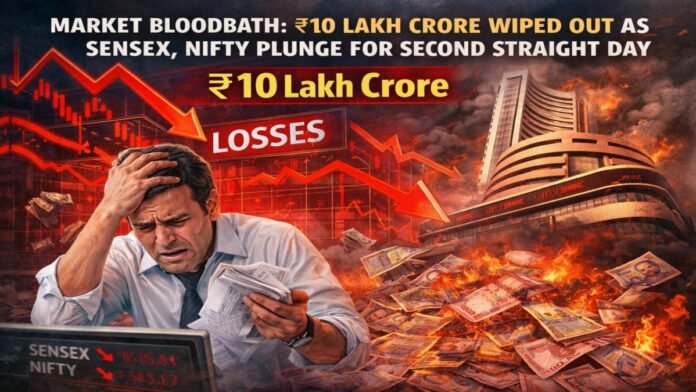
The Indian equity markets witnessed catastrophic losses for the second consecutive session on Tuesday, January 20, 2026, as benchmark indices collapsed under the weight of relentless foreign selling, global trade uncertainties, and technical breakdowns that triggered panic across Dalal Street. The BSE Sensex plummeted 1,065.71 points, or 1.28 per cent, to settle at 82,180.47, while the NSE Nifty index surrendered 353 points, or 1.38 per cent, to close at 25,232.50, marking its lowest level in over three months. The intraday carnage was even more severe, with the Sensex plunging as much as 1,200 points and the Nifty crashing below 25,000 before paring some losses in volatile late-session trading.
The bloodbath erased a staggering ₹10.12 lakh crore in investor wealth, dragging the BSE’s market capitalisation down to ₹455.72 lakh crore from ₹465.68 lakh crore on Monday. The breadth of the damage was breathtaking; only HDFC Bank managed to close in positive territory among the 30 Sensex constituents, while the remaining 29 blue-chip stocks bled red ink. Zomato emerged as the worst performer, collapsing over 4 per cent, followed by sharp declines in Bajaj Finance, Sun Pharma, Indigo, Reliance Industries, and Tata Consultancy Services (TCS).
Sectoral Carnage Spares None
The selling pressure was indiscriminate and across-the-board, with all 15 sectoral indices on the NSE ending deep in negative territory. The realty sector bore the maximum brunt, cratering over 5 per cent as rising interest rates and liquidity concerns hammered property developers. The auto sector skidded 2.50 per cent on weak demand outlook, while financial services declined 1.4 per cent amid concerns over asset quality and margin pressures. The IT pack, often considered India’s defensive backbone, suffered a brutal selloff with Wipro shares tumbling 3 per cent and LTIMindtree nosediving up to 6 per cent as global growth fears and potential US visa restrictions clouded the sector’s prospects.
Foreign Investors Accelerate Exodus
The single biggest factor driving the market meltdown remained the unrelenting selling by Foreign Institutional Investors (FIIs), who extended their net selling streak to the tenth consecutive session. On Monday alone, FIIs offloaded Indian equities worth ₹3,263 crore, and early data indicated even heavier selling on Tuesday. The outflow pattern reflects a broader shift in global risk appetite, with foreign portfolio investors pulling out over ₹11,789 crore from Indian markets in January so far, continuing last year’s trend where they dumped ₹2.92 lakh crore worth of equities. Domestic Institutional Investors (DIIs) attempted to cushion the fall, buying ₹4,189 crore on Monday, but their support proved insufficient against the FII tsunami.
Global Headwinds and Geopolitical Jitters
International factors compounded domestic woes, with US President Donald Trump’s renewed tariff threats creating fresh uncertainty. Trump’s aggressive stance on securing American control over Greenland has led to threats of imposing new tariffs on eight European Union member states, prompting France to retaliate with threats of 200 per cent tariffs on US goods. These escalating trade war fears have sent global markets into risk-off mode, with investors flocking to safe-haven assets. Gold prices surged past $4,700 per ounce for the first time in history on Tuesday, while silver touched record highs, reflecting the extreme risk aversion gripping financial markets worldwide.
Technical Breakdowns and Margin Calls
Market technicians pointed to critical support level breaches that accelerated the downward spiral. The Nifty’s fall below 25,400 triggered algorithmic selling, stop-loss hits, and forced liquidation of leveraged positions, creating a cascading effect that amplified losses through the afternoon session. The volatility index (VIX) spiked to a two-month high, indicating heightened fear and expectations of further downside. Since hitting life highs on January 5, 2026, the Nifty has now corrected 4 per cent, while the Sensex has shed 3,710 points, raising concerns about whether this marks the beginning of a deeper correction or a temporary shakeout before fresh highs.
What Lies Ahead?
Market participants remain on edge, with analysts warning that volatility will likely persist in the near term. Investors will be closely watching Wednesday’s FII flows, corporate earnings guidance, and any de-escalation in global trade tensions to gauge market direction. The continuous shift of money into precious metals suggests that risk appetite remains fragile, and the market may test lower levels before finding a stable footing.