























Key points
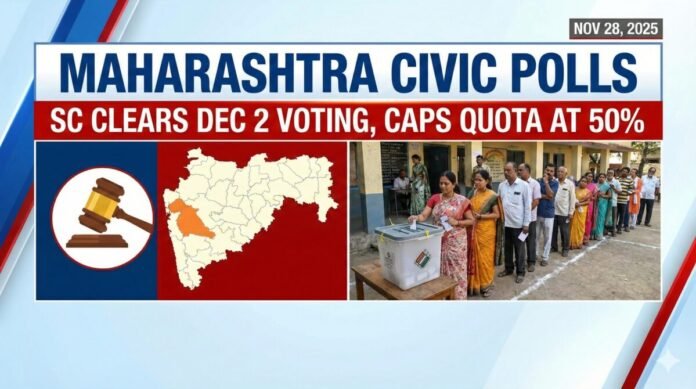
- Voting in 246 municipal councils and 42 nagar panchayats across Maharashtra will be held on 2 December, with counting on 3 December.
- The Supreme Court has allowed these polls to proceed, but said that results in bodies breaching the 50% reservation cap will depend on the final judgment in OBC quota petitions.
- In 40 municipal councils and 17 nagar panchayats, total reservations exceed 50%, and outcomes there will remain provisional till the court rules.
- For all yet to be notified elections, including municipal corporations, zilla parishads and panchayat samitis, the State Election Commission must ensure reservations stay within 50%.
- Around 1.7 crore voters, with over 13,000 polling centres, will elect 6,859 members and 288 presidents in this phase of the local body polls.
- Twenty seven petitions on OBC reservation and the 50% ceiling have been referred to a three judge bench, which will hear them from 21 January 2026.
In a crucial order ahead of the December civic polls, the Supreme Court has permitted Maharashtra’s municipal council and nagar panchayat elections to go ahead as per the notified schedule, making it clear that the ongoing electoral process will not be stalled. At the same time, the court has drawn a firm line that in all remaining local bodies where elections have not yet been announced, the total reservation, including OBC quota, cannot cross 50%, and any new notification must strictly respect this ceiling.
The bench headed by Chief Justice Surya Kant and Justice Joymalya Bagchi has also made it explicit that the validity of the election results will not be final in law wherever the 50% cap has been breached, and those outcomes will be treated as subject to the ultimate decision in the pending petitions. The judges further allowed the state government and the State Election Commission to move ahead with notifying polls for other bodies such as zilla parishads, municipal corporations and panchayat samitis, provided the 50% ceiling is honoured in every such institution.
What happens to December 2 polls
According to the State Election Commission’s data placed before the court, elections have already been notified in 246 municipal councils and 42 nagar panchayats, with voting fixed for 2 December and counting on 3 December. These polls will proceed as scheduled, and the Supreme Court has not interfered with the calendar, which means campaigning, voting and counting in these bodies will follow the existing programme.
However, within this group, there are 40 municipal councils and 17 nagar panchayats where total reservations surpass the 50% ceiling, largely because of the manner in which the OBC quota has been computed. The court has clarified that while people will vote and results will be declared in these 57 bodies, those results will carry a clear caveat that they are provisional in the legal sense and will stand or fall depending on the final verdict on the reservation challenge.
Scale of the elections and voter profile
State Election Commission figures show that in this phase, 6,859 members and 288 presidents of municipal councils and nagar panchayats will be chosen, using electronic voting machines across Maharashtra. Roughly 1.7 crore registered voters, including over 53 lakh men, more than 53 lakh women and a small number of other voters, are eligible to participate, with around 13,355 polling centres and 3,820 wards notified for the exercise.
Region wise, elections are being held in multiple belts, including Konkan, Nashik, Pune, Chhatrapati Sambhajinagar, Amravati and Nagpur, covering nearly the entire state’s municipal council and nagar panchayat network. The State Election Commission has also deployed tens of thousands of staff as returning officers, assistant returning officers and polling personnel to manage the voting and counting process smoothly in these urban local bodies.
Next steps in the OBC quota case
On the legal front, the Supreme Court has clubbed around 27 petitions that question Maharashtra’s latest OBC reservation matrix and the breach of the 50% cap in several local bodies, and has sent them to a three-judge bench for final adjudication. This larger bench will begin hearing the matter on 21 January 2026, and will examine whether the state’s reliance on the Banthia Commission framework and subsequent data is compatible with earlier constitutional rulings that fix a ceiling of 50% for total reservations.
Until that verdict is delivered, the Supreme Court has created a dual track arrangement; elections already notified will continue, with results in bodies breaching the cap being conditional, and any fresh election programme for other local bodies must be designed so that the combined reservations do not exceed the 50% limit. The court has also reminded the state that wherever zilla parishads and panchayat samitis can be configured within the 50% cap, elections should be held without delay so that local governance is not paralysed during the pendency of the litigation.