





























Key Points
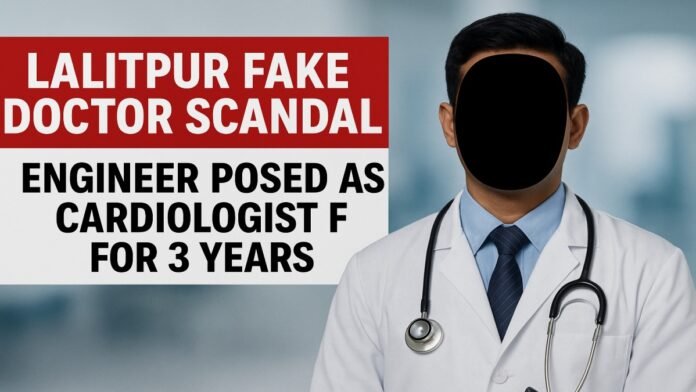
- Abhinav Singh, an engineer, allegedly posed as Dr. Rajiv Gupta, a cardiologist at Lalitpur district hospital since 2022
- Fraud exposed when Dr. Sonali Singh revealed her real husband, Dr. Rajiv Gupta, practices in the United States
- Fake doctor treated patients in the cardiology department for three years under NHM appointment
- Investigation committee examining how document verification failed and if staff collusion occurred
- Administration initiating recovery of three years’ salary and preparing police case under fraud and medical negligence sections
The Lalitpur district medical college administration was thrown into turmoil when a woman named Dr. Sonali Singh walked into the principal’s office with allegations that would expose one of the most brazen medical frauds in recent memory. Her complaint, lodged directly with Principal Dr. Mayank Shukla, alleged that the cardiologist treating patients for the past three years was not a doctor at all, but her brother, an engineer who had stolen her husband’s credentials.
According to Dr. Shukla’s statement, the woman revealed that Dr. Rajiv Gupta, the cardiologist posted at the medical college since 2022, was actually her husband, currently practising medicine in the United States. Her brother, Abhinav Singh, had allegedly created a fake identity by modifying his brother-in-law’s doctorate certificate, medical licenses, and other professional documents, inserting his own name and photograph to secure the prestigious position. This systematic deception had gone undetected for three years, raising serious questions about the integrity of the entire medical recruitment and verification system.
The Investigation Unfolds
The medical college administration immediately launched an internal probe, which confirmed the woman’s allegations. Abhinav Singh, whose real identity was quickly verified through engineering college records and previous employment documents, had indeed been appointed through the National Health Mission in 2022 as a cardiology specialist. The investigation revealed that he had treated an estimated 3,500 to 4,000 patients during his tenure, prescribing medications, interpreting diagnostic reports, and making critical cardiac care decisions.
What stunned investigators was the sophistication of the forgery. The accused had not merely faked a degree, he had constructed an entire false identity. He modified his brother-in-law’s medical school transcripts, residency certificates, and professional registration documents, replacing photographs, signatures, and personal details while maintaining the authentic institutional seals and verification codes. This level of detail apparently bypassed the standard document verification process, which typically includes direct confirmation with issuing institutions.
Systemic Failures and Oversight Lapses
The investigation committee, comprising senior medical administrators and legal experts, is now probing multiple layers of systemic failure. Dr. Shukla stated that this isn’t just a case of degree forgery, but a complete identity change that exploited weaknesses in the verification chain. The committee is examining how the document cross-check was missed during the NHM appointment process in 2022, whether any medical college staff were complicit, and how the fraud remained undetected for three years.
Key questions being investigated include: Who verified the original documents during the appointment? Why weren’t credentials re-verified during annual reviews? How did the fake doctor’s performance evaluations show satisfactory results? Was there any pattern of patient complaints that was ignored? The committee is also reviewing the salary disbursement process, as Abhinav Singh received approximately ₹1.2 crore in salary and benefits over three years, all of which the administration now seeks to recover.
Patient Safety and Medical Negligence Concerns
The most alarming aspect of this fraud is the potential risk to patient safety. Cardiology is one of the most sensitive medical departments, where misdiagnosis or incorrect treatment can be fatal. Dr. Shukla emphasised that providing medical services fraudulently is not only illegal but also directly endangers lives. The administration is now attempting to contact patients treated by the fake doctor to offer free re-evaluation and proper cardiac consultation.
Medical ethics experts have pointed out that even if Abhinav Singh possessed some medical knowledge through observation or self-study, he lacked the rigorous training, supervised clinical experience, and emergency response capabilities required of a qualified cardiologist. The district hospital, being a tertiary care center, handles complex cardiac cases, including post-myocardial infarction management, heart failure, and arrhythmia treatment, all requiring specialized expertise.
Legal Action and Administrative Measures
The Lalitpur district administration has initiated stringent action against the accused. The process of recovering the entire salary paid over three and a half years has begun, with legal notices being prepared. Simultaneously, the police are preparing to register a case under multiple sections of the Indian Penal Code, including Section 419 (cheating by impersonation), Section 420 (cheating), Section 467 (forgery of valuable security), Section 468 (forgery for purpose of cheating), and relevant sections of the Medical Council Act and Information Technology Act for digital document manipulation.
The Uttar Pradesh health department has also ordered a statewide audit of all doctors appointed through NHM and other contractual schemes since 2020. The Medical Council of India has been notified and is reviewing its verification protocols. The NHM state mission director has suspended the Lalitpur district program manager pending investigation into recruitment process lapses.
Broader Implications for Medical Recruitment
This scandal has exposed critical vulnerabilities in India’s rural health recruitment system, particularly for district hospitals that rely heavily on contractual appointments under NHM. Unlike permanent government positions that require rigorous verification through state medical councils, contractual posts often face expedited hiring processes to fill critical vacancies in underserved areas.
Health activists argue that this case is symptomatic of larger issues, including inadequate background checks, overburdened verification systems, and lack of digital integration between medical councils and hiring agencies. They demand implementation of blockchain-based credential verification and mandatory biometric authentication for all medical appointments. The Lalitpur case may catalyze nationwide reforms in medical recruitment and professional verification systems.