





























Key Points
- AK-47 rifle with 30-round magazine recovered from Dr. Adeel Ahmad Rather’s locker at GMC Anantnag
- Doctor arrested from Saharanpur, UP on November 7 for putting up Jaish-e-Mohammed posters in Srinagar
- Second doctor also detained in connection with expanding terror-link probe
- Case registered under Arms Act and UAPA Sections 13, 28, 38, and 39
- Four-pronged investigation includes forensics, digital surveillance, NIA involvement, and hospital records
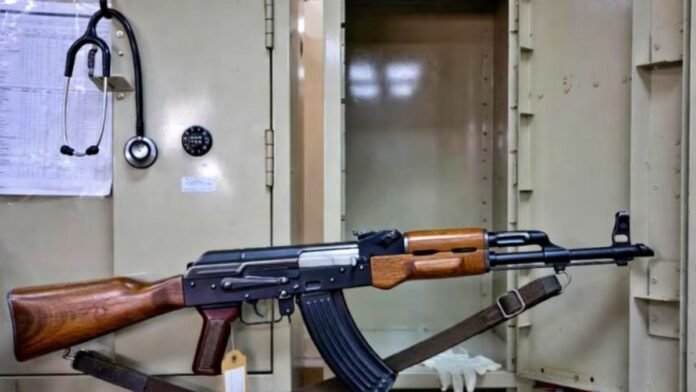
Srinagar: In a coordinated late-night operation conducted on the intervening night of November 8-9, Srinagar Police, assisted by the Joint Interrogation Centre (JIC) Anantnag, recovered an AK-47 assault rifle with a magazine containing 30 rounds from the personal locker of Dr. Adeel Ahmad Rather at Government Medical College, Anantnag. The operation followed his arrest two days earlier from Uttar Pradesh in connection with a separate case involving pro-terror propaganda.
The weapon seizure occurred during a comprehensive sweep of the GMC Anantnag campus conducted in the presence of a magistrate, ensuring legal compliance and evidence integrity. Police sources confirmed that the discovery represents one of the most serious cases of potential terror infiltration within government institutions in recent years.
Doctor’s Background and Employment History
Dr. Adeel Ahmad Rather, son of Abdul Majeed Rather, is a resident of Wanpora Choimulla in Qazigund, Anantnag district. He holds an MD degree in General Medicine and served as a senior resident doctor at Government Medical College, Anantnag, until October 24, 2024. After leaving his government position, he secured employment as a medicine specialist at a reputed private hospital on Ambala Road in Saharanpur, Uttar Pradesh, where he had been working for just a few months before his arrest.
According to sources, Dr. Rather had married a local lady doctor in Saharanpur on October 4, 2025, barely a month before his arrest. His recent marriage and relocation to Uttar Pradesh initially appeared to be a routine career progression, making the subsequent revelations even more shocking to colleagues and hospital administration.
Initial Arrest for Jaish-e-Mohammed Poster Case
Dr. Rather was first taken into custody on Thursday, November 7, 2025, following a coordinated raid by Srinagar Police, assisted by the Special Operations Group (SOG) and Uttar Pradesh law enforcement authorities at the private hospital in Saharanpur where he was employed. The arrest stemmed from his alleged involvement in putting up posters supporting the banned terrorist outfit Jaish-e-Mohammed across multiple locations in Srinagar.
On the night of October 27, 2025, several posters promoting Jaish-e-Mohammed and carrying pro-terror messages appeared at multiple locations throughout Srinagar city. The Srinagar Police immediately registered an FIR against unknown persons under relevant sections of the Unlawful Activities (Prevention) Act. Intensive investigation involving CCTV footage analysis and technical surveillance led investigators to identify Dr. Rather as the suspect.
Saharanpur ASP (City) Vyom Bindal confirmed that local police extended full cooperation to the Jammu and Kashmir Police team as per standard procedure. Dr. Rather was produced before a Saharanpur court, which granted transit remand for his transfer to Jammu and Kashmir for interrogation. He was flown to Kashmir the same day.
Separate UAPA Case for Arms Recovery
Following the AK-47 discovery, a separate case has been registered at Nowgam Police Station in Srinagar under stringent provisions. The FIR includes charges under Sections 7/25 of the Indian Arms Act, 1959, which deal with possession of prohibited firearms without proper authorization. Additionally, multiple sections of the Unlawful Activities (Prevention) Act have been invoked, including Sections 13 (unlawful activities), 28 (punishment for certain terrorist acts), 38 (offence relating to membership of terrorist organizations), and 39 (offence relating to support given to terrorist organizations).
Legal experts note that the combination of the Arms Act and UAPA charges carries severe penalties, including extended detention periods and the possibility of life imprisonment if terror links are conclusively established.
Four-Pronged Investigation Strategy
Jammu and Kashmir Police have adopted a comprehensive four-angle investigative approach to unravel the complete conspiracy and establish all connections:
Forensic Investigation: Specialized forensic teams are conducting detailed technical examinations of the seized AK-47 rifle. Investigators are tracing the weapon’s serial number to determine its manufacturing origin and tracking its supply chain. Ballistic analysis is being performed to ascertain whether the rifle has been used in any prior criminal incidents, terrorist attacks, or encounters. Experts are also examining whether the weapon was smuggled across borders, stolen from security forces, or diverted from official armories.
Digital Surveillance and Financial Analysis: Police are conducting an exhaustive examination of Dr. Rather’s digital footprint and financial transactions. This includes analyzing his call data records, bank account transactions, email communications, social media activity, and messaging app content. Investigators are mapping his contact network to identify potential handlers, accomplices, or members of terror modules. Any suspicious patterns in fund transfers or communication with Pakistan-based numbers are being flagged for deeper scrutiny.
Multi-Agency Coordination: Beyond district and state police resources, authorities are coordinating with central intelligence and investigative agencies. Sources indicate that the National Investigation Agency (NIA) may formally join the probe if substantive evidence of terror financing, cross-border links, or organized militant networks emerges. Intelligence inputs are being gathered from multiple security agencies to build a comprehensive threat assessment.
Institutional Investigation: Police are collecting evidence from hospitals and medical colleges where Dr. Rather worked. This includes reviewing hospital access logs, CCTV footage from the medical college premises, locker assignment records, and statements from colleagues and administrative staff. Investigators are examining how and when the weapon was stored in the locker, who knew of its presence, and whether any institutional security protocols were compromised.
Second Doctor Detained in Expanding Probe
Police sources have confirmed that another doctor has been detained in connection with the expanding investigation, though authorities have not released the second individual’s identity or specific role. The detention suggests that investigators suspect a wider network operating within the medical community or governmental institutions in Jammu and Kashmir.
Senior police officers have declined to provide detailed comments, citing the sensitive and ongoing nature of the investigation. However, sources indicate that the case is being treated with the highest priority given its national security implications.
Legal Framework and Penalties
Under the Indian Arms Act, 1959, possession of prohibited or modern weapons, including automatic rifles like the AK-47, without proper licensing carries strict punishment including imprisonment that may extend to seven years, along with fines. However, when such weapons are linked to terrorist activities or organizations, the case automatically attracts provisions of the Unlawful Activities (Prevention) Act.
UAPA provisions allow for extended detention periods of up to 180 days before filing charges, and conviction can result in life imprisonment or even the death penalty in cases involving terrorist acts resulting in death. The law also permits the attachment of property and freezing of assets if terror financing is established.
Security Concerns and Institutional Vulnerability
The recovery of a sophisticated automatic weapon from a government medical college has raised serious concerns about institutional security and the potential infiltration of terror elements into professional and academic spaces. Security experts note that medical colleges, with their relatively open access for staff and students, may represent soft targets for concealing weapons or establishing sleeper cells.
The fact that Dr. Rather maintained his employment at a prestigious government institution until just weeks before his arrest, while allegedly maintaining terror connections, highlights the challenge of identifying radicalized individuals operating within mainstream society and professional settings.
Officials have stated that full details of the case will be shared only after completion of preliminary forensic findings and intelligence assessments. The investigation continues to expand as authorities work to determine the complete scope of the alleged terror network and any planned activities that may have been prevented by the arrest.