






























Key Points
- Technological Leap: Iran utilizes “Khaibar-Shekan” solid-fuel technology, allowing for rapid-response launches.
- Stealth and Mobility: Unlike liquid-fuel rockets, these missiles are pre-loaded and mobile, making them nearly impossible to detect before firing.
- Strategic Impact: The reduced launch window challenges the efficacy of even the most advanced missile defense systems.
- Global Proliferation: Solid-fuel tech, once a Soviet-era breakthrough, is now a cornerstone of Iran’s modern “True Promise-4” military operations.
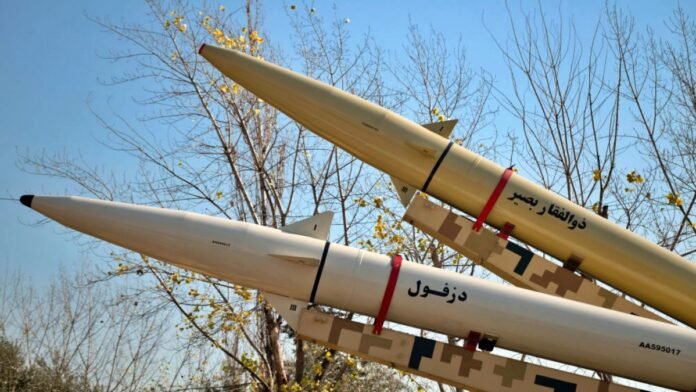
The ongoing conflict in the Middle East has entered a sophisticated and dangerous phase, characterized by the dominance of advanced electronic warfare and high-speed missile technology. Iran has significantly upped the ante by deploying its “Khaibar-Shekan” (Fortress Breaker) solid-fuel missiles. These weapons are not merely faster than their predecessors, they represent a fundamental change in how Tehran projects power across the region, causing deep concern among global military analysts.
Understanding Solid-Fuel Technology
The core advantage of solid-fuel technology lies in its readiness and stability. In traditional liquid-fuel systems, missiles must be fueled immediately before launch, a volatile and time-consuming process that creates a clear window for satellite detection and preemptive strikes.
In contrast, solid-fuel missiles use a pre-mixed, rubbery chemical propellant that is packed directly into the casing. This allows the missiles to be stored for years in a combat-ready state. Because they do not require on-site fueling, they can be launched from mobile transporters in minutes, granting them a “shoot-and-scoot” capability that evades traditional reconnaissance.
Why the “Khaibar-Shekan” is a Game Changer
Under the strategic umbrella of “Operation True Promise-4,” Iran’s Aerospace Division has specifically targeted Northern Israel and vital refineries with these new systems. The Khaibar-Shekan is designed to be highly maneuverable during its terminal phase, meaning it can change its path while descending at hypersonic speeds.
For defense networks like Israel’s Iron Dome and Arrow systems, this reduces the “decision window” to a matter of seconds. By the time a launch is detected, the missile is already nearing its target. This technological shift has turned the backbone of the regional economy, particularly oil and energy installations, into vulnerable targets that are increasingly difficult to protect.
Historical Context and the Road Ahead
Solid-fuel technology was first successfully weaponized by the Soviet Union in the 1970s. In the decades since, nations like France, China, and North Korea have perfected the tech. Iran has now joined this tier of missile powers, having modernized the Soviet blueprints into a domestic arsenal that is both cost-effective and highly lethal.
The future remains deeply uncertain as the technological arms race outpaces diplomatic efforts. Israeli Prime Minister Benjamin Netanyahu has vowed to “uproot” this threat entirely, targeting not just the launch sites but the manufacturing hubs of this solid-fuel technology. As long as these high-speed systems remain active, the conflict threatens to spiral into an uncontrollable regional disaster with global economic consequences.
| Feature | Liquid-Fuel Missiles (e.g., Shahab-3) | Solid-Fuel Missiles (e.g., Khaibar-Shekan) |
| Fuel State | Liquid fuel and oxidizer stored separately. | Propellant and oxidizer mixed into a solid, rubbery grain. |
| Launch Readiness | Requires hours to fuel before launch, making them easy to detect by satellites. | Pre-fueled and ready to fire in minutes, enabling “shoot-and-scoot” tactics. |
| Storage Life | Short, liquid fuels are often corrosive or volatile and cannot be stored in the missile for long. | Extremely stable, can be stored in silos or mobile launchers for 5 to 20 years. |
| Mobility | Low, typically requires large, stationary support equipment and fueling trucks. | High, can be transported on 10-wheel commercial trucks and camouflaged easily. |
| Thrust Control | High, the engine can be throttled, shut down, or restarted in flight. | None, once ignited, the missile burns until all fuel is exhausted. |
| Complexity | High, requires intricate pumps, valves, and plumbing systems. | Low, the missile body itself acts as the combustion chamber, with fewer moving parts. |
| Accuracy (MaRV) | Generally lower in older models unless fitted with complex guidance. | High, modern versions use Maneuverable Re-entry Vehicles to dodge defenses. |
Technical Spotlight: The Khaibar-Shekan (Fortress Breaker)
The Khaibar-Shekan represents the third generation of Iranian missile technology. Its most dangerous attribute is the Maneuverable Re-entry Vehicle (MaRV), which allows the warhead to adjust its trajectory after re-entering the atmosphere.
- Range: 1,450 km (capable of reaching all of Israel from western Iran).
- Speed: Reaches Mach 2 to 3 during the terminal impact phase.
- Weight Reduction: The use of advanced composite materials has reduced the weight by one-third compared to previous generations, allowing for greater mobility.
- Detection Profile: Because it uses solid fuel, there is no “propellant burning” signature during the re-entry phase, making it significantly harder for systems like the Iron Dome to track.