






























Key Highlights
- Maritime Blockade: The IRGC has warned vessels via radio that the Strait of Hormuz is “closed to traffic,” a move confirmed by the UK Maritime Trade Operations (UKMTO).
- Retaliatory Measure: This escalation follows “Operation Epic Fury,” a coordinated US-Israeli strike on Saturday that reportedly killed Supreme Leader Ayatollah Ali Khamenei and several top military commanders.
- Global Energy Threat: Approximately 20% to 25% of global maritime oil trade and 20% of global LNG pass through this chokepoint daily.
- Oil Price Surge: Global benchmark Brent crude has spiked toward $80 per barrel, with experts warning of a jump past $130 if the blockade persists.
- India’s Response: New Delhi has activated contingency plans to protect energy security, as nearly half of India’s crude imports transit through this narrow waterway.
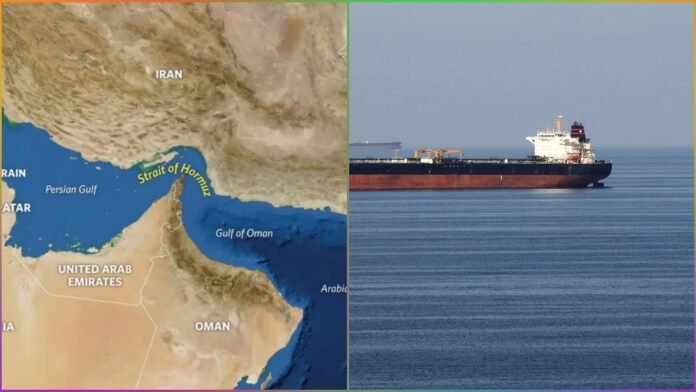
The military conflict between Iran and the US, Israel’s alliance has reached a perilous flashpoint. Following the devastating joint aerial operation on Saturday, February 28, which targeted Iranian government compounds and military bases, the Islamic Revolutionary Guard Corps (IRGC) has moved to weaponize geography. Ships transiting the Persian Gulf reported receiving direct VHF radio transmissions from Iranian naval forces stating that no passage is allowed through the Strait of Hormuz.
This strategic waterway, linking the Persian Gulf to the Gulf of Oman, is the lifeblood of the global energy market. The UKMTO has verified these reports, noting that multiple vessels have been hailed and warned to stay clear. This move is seen as Iran’s primary asymmetric response to the loss of its Supreme Leader and the degradation of its command and control centers by US and Israeli forces.
The Global Economic Fallout
The closure of the Strait of Hormuz is often described as the “nuclear option” in global trade. The route is essential for major oil producers including Saudi Arabia, Iraq, the UAE, and Kuwait. While some bypass pipelines exist, such as the Habshan, Fujairah pipeline in the UAE and the East,West pipeline in Saudi Arabia, their combined capacity is insufficient to replace the 15 million to 20 million barrels of oil that move through the strait daily.
Market analysts warn that a prolonged blockade will lead to a systemic shock. Global energy security, already fragile, now faces the prospect of triple-digit oil prices. Shipping insurance premiums have already skyrocketed, and several major commercial carriers have suspended navigation in the region until security can be guaranteed by international naval coalitions.
Implications for India and Strategic Reserves
India finds itself in a particularly vulnerable position. The country imports roughly 90% of its crude oil requirements, with over 40% to 50% of that volume traditionally flowing through the Strait of Hormuz. Any sustained disruption would not only increase the national import bill, potentially adding $13 billion to $14 billion for every $10 rise in per-barrel prices, but also trigger domestic inflation in fuel and food costs.
In response, the Indian government has begun reviewing its Strategic Petroleum Reserves (SPR). Current reserves, including cavern storage and refinery stocks, are estimated to be sufficient for approximately 74 days of national demand. External Affairs Minister S. Jaishankar is reportedly in high-level talks with counterparts in Washington and Riyadh to secure alternative supply routes and ensure the safety of the Indian diaspora in the Gulf.
As “Operation Epic Fury” continues to unfold on land, the focus of the world now shifts to the waters of the Middle East, where the next phase of this conflict could reshape the global economy for years to come.