



























Key Points
- Naval Blockade Initiated: President Trump ordered the U.S. Navy to interdict all vessels entering or leaving Iranian ports starting April 13, 2026.
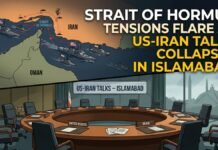
- Diplomatic Collapse: The blockade follows the failure of high-stakes ceasefire negotiations in Islamabad, Pakistan, led by Vice President JD Vance and Iranian Speaker Mohammad Bagher Ghalibaf.
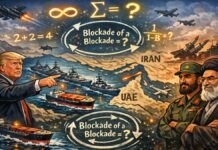
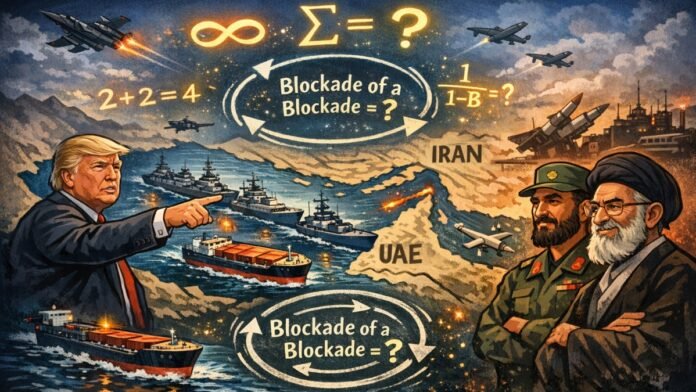
- The “Price Surge” Formula: Ghalibaf mocked the move on social media, sharing a mathematical expression suggesting that supply disruptions will trigger exponential gas price hikes.
- Market Reaction: Oil prices have already spiked, with Brent crude jumping over $100 per barrel as the blockade went into effect at 7:30 PM IST.
- Nuclear Standoff: The U.S. maintains that the blockade is necessary to prevent Iran from advancing its nuclear weapons program amid the ongoing 2026 conflict.
The long-standing shadow war between the United States and Iran has transitioned into a direct maritime confrontation. Following the breakdown of peace talks in Pakistan, President Donald Trump announced a total naval blockade of the Strait of Hormuz, a narrow waterway through which approximately 20% of the world’s oil and gas supply flows. U.S. Central Command confirmed that the restrictions, targeting all ships linked to Iranian ports, officially commenced on April 13, 2026, at 7:30 PM IST.
In a pointed rebuttal, Mohammad Bagher Ghalibaf, the Speaker of the Iranian Parliament and a former Revolutionary Guard commander, took to the social media platform X to taunt the U.S. administration. Ghalibaf posted a screenshot of current gasoline prices near the White House, showing rates between $4 and $5 per gallon, and warned that Americans would “soon miss these prices.”
Decoding the Mathematical Warning
The centerpiece of Ghalibaf’s post was the cryptic formula: $$\Delta O_{BSOH} > 0 \Rightarrow f(f(O)) > f(O)$$
According to economic analysts and technical experts, the formula serves as a warning of non-linear economic warfare. The first part, $\Delta O_{BSOH} > 0$, represents an increase in the intensity of the “Blockade of the Strait of Hormuz.” The second part, $f(f(O)) > f(O)$, uses function notation to illustrate a “compounding effect.” It suggests that the impact on oil prices ($O$) will not be a simple linear increase but a recursive chain reaction, where the initial price shock triggers secondary and tertiary surges that far outpace the original disruption.
A Failed Path to Peace in Islamabad
The escalation comes directly on the heels of failed diplomatic efforts. Over the weekend of April 11, 2026, a U.S. delegation led by Vice President JD Vance met with Iranian officials in Islamabad for “intensive and challenging” talks mediated by Pakistan. The negotiations reportedly collapsed over “red lines” regarding Iran’s nuclear program and U.S. demands for the unconditional reopening of the Strait.
“We will not allow Iran to develop nuclear weapons under any circumstances,” Trump stated, justifying the blockade as a necessary measure to choke off the resources fueling Tehran’s nuclear ambitions. However, the move has already sent shockwaves through global finance. West Texas Intermediate (WTI) rose roughly 8% to $104.50 per barrel, while Brent crude surpassed the $102 mark.
As the U.S. Navy begins mine-clearing operations and vessel interdictions, the world waits to see if Ghalibaf’s mathematical prophecy of a “nostalgic” $5-per-gallon era comes to pass, or if the blockade succeeds in forcing Tehran back to the negotiating table.