

























Key Highlights
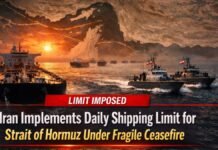
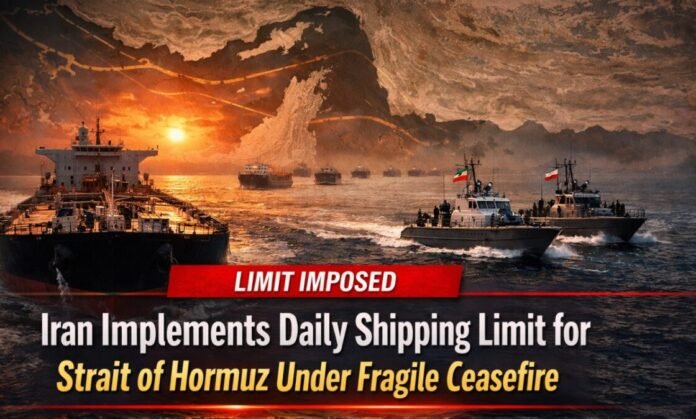
- Strict Daily Quota: Only 15 shipping tankers or vessels are permitted to transit the strategic waterway daily, a fraction of the pre-war volume.
- IRGC Oversight: All maritime traffic must receive direct approval and follow specific safety protocols dictated by the IRGC Navy.
- New Navigation Routes: Vessels are mandated to follow the “Larak Route” to avoid potential naval mines laid during the initial weeks of the conflict.
- Economic Demands: Reports indicate that Tehran is requiring transit fees to be paid in cryptocurrency or Chinese yuan as part of the new coordination process.
- Fragile Stability: The two-week truce remains under immense pressure following recent military escalations in Lebanon.
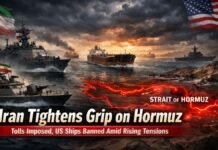
In a move that underscores the volatility of global energy markets, Tehran has formalized a highly restrictive transit policy for the Strait of Hormuz. Following the implementation of a fragile two-week ceasefire with the United States, Iranian authorities announced that they will permit no more than 15 ships to pass through the strategic channel per day. This directive, reported by the Russian news agency TASS, marks a significant but limited opening of a waterway that has been effectively sealed since full-scale hostilities erupted on February 28, 2026.
Before the conflict began, the Strait typically handled over 100 vessels daily, carrying roughly 20% of the world’s oil supply. The new 15-ship limit represents a controlled “trickle” intended to manage maritime safety while maintaining Iran’s leverage over a primary global economic artery.
The IRGC Approval Protocol and “Larak Route”
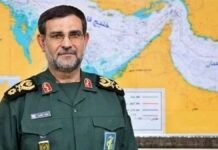
Under the new regulations, the era of open transit through the Strait has been replaced by a rigorous military approval process. Every vessel seeking passage must now coordinate directly with the Islamic Revolutionary Guard Corps (IRGC) Navy. According to senior Iranian sources, shipping companies are required to submit their manifests and vessel details for IRGC approval well before entering the Gulf of Oman or the Persian Gulf.
Further complicating the passage is the mandatory use of the “Larak Route,” an alternative navigation path introduced by the IRGC. This route requires ships to sail near Larak Island, bypassing the traditional shipping lanes that Iran warns may still contain anti-ship mines. Vessels are instructed to maintain constant VHF radio contact with Iranian naval units to ensure compliance with a specific protocol that Tehran claims is necessary for “maritime security in a state of war.”
Background: A Month of Conflict and Economic Pain
The current crisis was triggered on February 28, when coordinated airstrikes by the U.S. and Israel resulted in the death of Iran’s Supreme Leader, Ali Khamenei. In the immediate aftermath, the IRGC moved to block the Strait of Hormuz, an act that sent Brent crude prices soaring past $125 per barrel and disrupted essential shipments of liquefied natural gas (LNG) to Asia and Europe.
As part of the recent ceasefire negotiations, Iran has reportedly sought to bypass traditional financial systems. Modern shipping logs and intelligence reports suggest that Tehran is demanding transit fees be settled in cryptocurrency or Chinese yuan, a move designed to circumvent the heavy sanctions that have crippled its economy since the start of the “Operation Epic Fury” campaign.
A Truce Under Fire
Despite the limited reopening of the Strait, the ceasefire is being described by international observers as “hanging by a thread.” While the 14-day agreement was intended to provide a humanitarian window and stabilize energy prices, tensions have flared anew following Israeli strikes on Hezbollah targets in Lebanon. Iran has warned that any perceived violation of the spirit of the truce could lead to an immediate re-closure of the Hormuz.
For the global shipping industry, the 15-ship limit and the requirement for IRGC permits present a logistical nightmare. Major carriers such as Maersk and MSC remain cautious, with many vessels still anchored outside the Gulf while awaiting clarity on the safety of the IRGC-mandated routes. For now, the world’s most critical energy corridor remains under a state of military management, with the global economy tethered to a fragile diplomatic experiment in Tehran and Washington.