




























Key Points
- Over 1,000 deaths confirmed, 218 people missing in Sumatra floods and landslides
- 1,200 public facilities damaged including 219 health facilities, 581 schools, 434 places of worship, 290 office buildings
- 145 bridges destroyed, cutting off access to remote affected areas and hindering rescue operations
- President Prabowo Subianto visited Aceh province, assured full government assistance for all basic needs
- Verification process ongoing at sub-district level, final casualty figures may change as data is cross-referenced
- High-level meeting chaired by president instructed joint military, police, BNPB, and local government operation
- Experts cite lack of early warning systems in remote areas and regional planning deficiencies as major contributing factors
- Thousands left homeless, many areas destroyed according to BNPB official data
- Government committed to rehabilitation and restoring normalcy in education and community activities
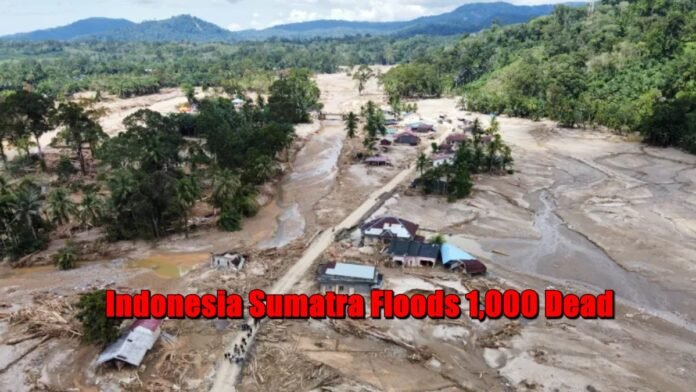
Severe floods and landslides in three provinces of Sumatra Island in Indonesia have caused widespread devastation. More than 1,000 deaths have been confirmed so far in this natural disaster, while 218 people remain unaccounted for. The National Disaster Management Agency (BNPB) officially released this information on Saturday, marking one of the deadliest natural disasters in Indonesia’s recent history.
According to the BNPB, the floods and landslides have caused massive loss of life and property. Thousands of people have been left homeless, and many areas have been destroyed. The disaster affected Aceh, North Sumatra, and West Sumatra provinces, with Aceh bearing the brunt of the damage. Heavy monsoon rains, which began on December 10, triggered flash floods in mountainous regions, causing landslides that buried entire villages under tons of mud and debris.
Infrastructure Damage and Relief Challenges
According to the agency’s latest figures, approximately 1,200 public facilities have been damaged. These include 219 health facilities, 581 educational institutions, 434 places of worship, 290 office buildings, and 145 bridges. The damage to these structures is also severely hindering relief and rescue operations, as rescue teams struggle to reach remote areas cut off by destroyed infrastructure.
The destruction of 145 bridges has created critical logistical challenges, forcing rescue teams to use helicopters and boats to access affected communities. The damage to 219 health facilities, including community health centers and rural hospitals, has left thousands of injured survivors without adequate medical care. In North Sumatra’s Mandailing Natal district, the main hospital was completely submerged, forcing medical staff to treat patients in temporary tents.
Ongoing Verification Process
According to the Xinhua news agency, Abdul Muhari, head of the BNPB’s data and information center, said at a press conference that data is being verified at the sub-district level in the affected areas. Efforts are underway to confirm the identities of the deceased and missing persons through cross-referencing with civil records. He said that the verification process is still ongoing in several districts, so the final figures may change.
The verification process is complicated by the fact that many victims were buried in landslides, requiring heavy machinery to recover bodies. In some remote villages, entire families were wiped out, leaving no one to report missing persons. BNPB has deployed forensic teams to identify bodies through DNA testing when visual identification is impossible. The agency is also working with local religious leaders to ensure proper burial rites are conducted while maintaining health protocols.
Presidential Response and On-Ground Assessment
Meanwhile, Indonesian President Prabowo Subianto visited the disaster-stricken Aceh province and assessed the situation. The President assured the affected people that the government is fully committed to meeting all their basic needs, including food, clean water, medical care, and temporary shelter. He said that together they will overcome this situation. The government will assist at every level and stands with the affected communities during this difficult time.
President Subianto appealed to the citizens to maintain patience and courage during the recovery process. He expressed hope that children’s education and other community activities would soon return to normal. Earlier, the president also chaired a high-level meeting on disaster response and rehabilitation efforts after visiting several affected areas in Aceh. At this meeting, instructions were given to the military, police, National Search and Rescue Agency, BNPB (National Disaster Management Agency), and local governments to conduct a robust joint operation.
Military-Led Joint Operation and International Aid
The Indonesian military has deployed over 5,000 personnel, 20 helicopters, and 50 boats for rescue operations. The National Search and Rescue Agency (Basarnas) is using drones with thermal imaging to locate survivors trapped under debris. Local governments have established 150 temporary shelters housing over 50,000 displaced people.
International assistance has started arriving, with Singapore sending a C-130 Hercules aircraft loaded with emergency supplies, and Malaysia deploying a team of disaster response specialists. The United Nations has allocated $5 million from its Central Emergency Response Fund, while the Red Cross is setting up mobile health clinics in the worst-affected districts.
Expert Analysis on Systemic Failures
Experts believe that structural and planning deficiencies are also major contributing factors to such disasters. Hijra Saputra, a lecturer in disaster management at Airlangga University in Indonesia, said that effective early warning systems have still not reached remote areas of the country. Furthermore, a lack of discipline in regional planning and an irregular process of environmental rehabilitation exacerbate the situation.
He warned that to minimize future casualties, well-planned regional development, ecologically-based planning for watersheds, and strengthening integrated early warning systems at the regional level are essential. The expert pointed out that deforestation in Sumatra’s highlands has increased soil erosion, while unregulated mining and quarrying activities have destabilized slopes. Climate change has intensified rainfall patterns, making historically safe areas vulnerable to new disaster risks.
Long-Term Recovery and Prevention Measures
The government has announced a comprehensive rehabilitation package worth $500 million for immediate relief and long-term reconstruction. This includes rebuilding infrastructure to disaster-resilient standards, relocating vulnerable communities to safer areas, and establishing a regional early warning system by 2027. The BNPB is also conducting a nationwide risk assessment to update Indonesia’s disaster hazard maps, which have not been revised since 2012.
Environmental rehabilitation efforts will focus on the reforestation of 100,000 hectares in critical watershed areas and stricter enforcement of spatial planning regulations. The government is considering a new disaster insurance scheme to help communities rebuild without relying solely on state aid.