






























Key Points
- Leadership Transition: William Walsh, the current Director General of IATA, will officially assume the CEO role on August 3, 2026.
- Aviation Veteran: Walsh brings over four decades of experience, having previously led Aer Lingus, British Airways, and International Airlines Group (IAG).
- Recent Resignation: The appointment follows the departure of Pieter Elbers on March 10, 2026, who stepped down after a major operational crisis in late 2025.
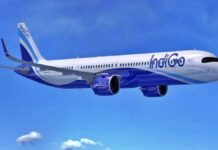
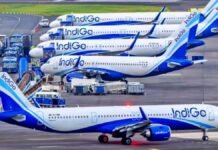
- Market Dominance: IndiGo maintains a commanding 64% share of the Indian domestic market with a fleet of 440 aircraft and over 2,200 daily flights.
- Future Strategy: Walsh is tasked with spearheading IndiGo’s aggressive international expansion and managing a record-breaking order of 500 new aircraft.
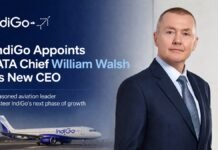
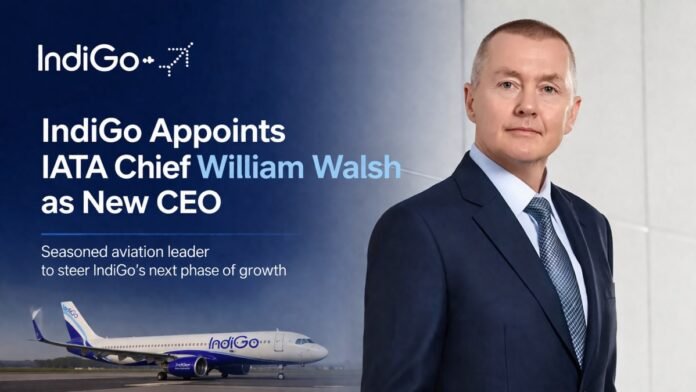
In a strategic move to reinforce its leadership, InterGlobe Aviation Limited, the parent company of IndiGo, announced on Tuesday, March 31, 2026, the appointment of William Walsh as its new Chief Executive Officer. Walsh, widely known in the industry as “Willie,” is a formidable figure in global aviation. His tenure as the Director General of the International Air Transport Association (IATA) is scheduled to conclude on July 31, and he is expected to take the helm at IndiGo by August 3, 2026.
The appointment comes at a critical juncture for India’s largest airline. IndiGo Chairman Vikram Singh Mehta expressed high confidence in the decision, noting that Walsh’s track record in managing large-scale operations and navigating complex market dynamics makes him the ideal choice. Managing Director Rahul Bhatia, who has been serving as interim CEO, added that Walsh brings a “rare combination of global perspective and operational expertise” as the airline enters a pivotal phase of growth.
Background: The Departure of Pieter Elbers
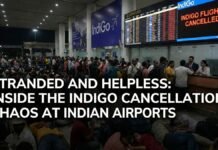
The leadership vacuum was created by the sudden resignation of Pieter Elbers earlier this month. While Elbers officially cited personal reasons for his departure, his exit followed a turbulent period for the carrier. In December 2025, IndiGo suffered an unprecedented operational meltdown triggered by new pilot fatigue regulations, resulting in the cancellation of over 2,500 flights and affecting approximately 300,000 passengers.
The crisis led to a ₹22.20 crore penalty from the Directorate General of Civil Aviation (DGCA) and significantly impacted the airline’s quarterly profits. Walsh’s primary mandate will be to restore operational excellence and rebuild stakeholder trust while continuing the ambitious global expansion plans initiated during the Elbers era.
A Career Defined by Transformation
Walsh’s journey in aviation began in 1979 as a cadet pilot for Aer Lingus, eventually rising to become its CEO in 2001. He later gained international prominence as the CEO of British Airways, where he navigated the 2008 financial crisis, and as the founding CEO of International Airlines Group (IAG), the parent company of carriers like Iberia and Vueling.
His deep experience with mergers, acquisitions, and restructuring is expected to be a major asset as IndiGo integrates its massive 500-aircraft order from Airbus. Upon his appointment, Walsh noted that the aviation landscape is changing rapidly, and he looks forward to positioning IndiGo at the forefront of this transformation through innovation and collaborative excellence.
Market Context and Regulatory Challenges
As of March 2026, IndiGo operates an expansive network connecting 95 domestic and over 40 international destinations. The airline has recently pushed into long-haul markets, launching services to cities such as Amsterdam and Manchester.
However, Walsh will also have to contend with new domestic regulatory pressures. The Federation of Indian Airlines (FIA) is currently navigating updated government mandates that require carriers to provide at least 60% of seats free of charge, a move that could challenge the ancillary revenue models typical of low-cost carriers. With a fleet that is already 78% “new-generation” and among the most fuel-efficient in the world, Walsh’s leadership will be vital in balancing these regulatory hurdles with the airline’s goal of becoming a global aviation leader.