


































Key Highlights
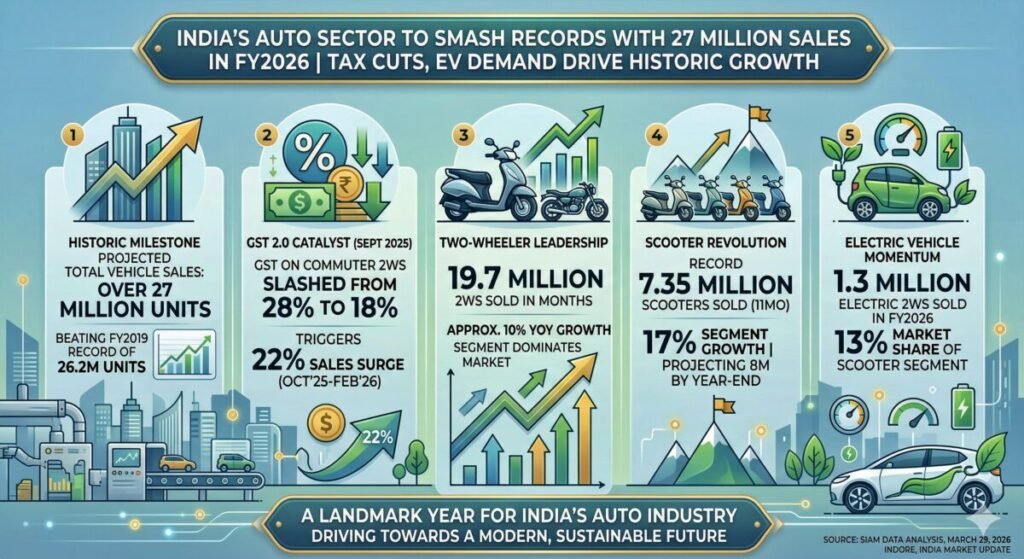
- Historic Milestone: Total vehicle sales are projected to exceed 27 million units, eclipsing the long-standing FY2019 record of 26.2 million.
- GST 2.0 Impact: The September 2025 tax cut from 28% to 18% for commuter two-wheelers has triggered a 22% sales surge in that segment.
- Scooter Revolution: Sales hit a record 7.35 million in the first 11 months, with the segment likely to touch the 8 million mark by year-end.
- EV Momentum: Over 1.3 million electric two-wheelers sold this fiscal year, now accounting for 13% of all scooter sales.
- Economic Relief: Recent excise duty cuts on fuel in late March 2026 have further bolstered consumer sentiment amid global energy volatility.
Despite a backdrop of global economic uncertainty and Middle Eastern tensions, India’s automobile market has demonstrated extraordinary resilience. As the 2026 fiscal year (FY2026) draws to a close, the nation has solidified its position as the world’s third-largest automotive market. Industry analysts project that total volumes will blow past the 27 million mark, a decisive move beyond the previous peak of 26.2 million units recorded in FY2019, an achievement that highlights the sector’s recovery and expansion.
The “GST 2.0” Catalyst
The most significant driver of this growth has been the implementation of the “GST 2.0” framework on September 22, 2025. This policy shift fundamentally restructured the tax burden on two-wheelers, which represent the backbone of Indian mobility.
Under the new rules, motorcycles and scooters with an engine displacement of up to 350cc saw their tax rate slashed from 28% to 18%. This 10% reduction made personal transport significantly more accessible for the middle class and rural buyers. Conversely, the government shifted the tax on premium motorcycles (above 350cc) to a 40% “demerit” rate, clearly distinguishing between essential mobility and luxury. The impact was immediate: the five-month period following the reform witnessed a robust 22% spike in sales as buyers who had delayed purchases entered the market.
Two-Wheelers and the Scooter Surge
The two-wheeler segment continues to lead the charge, with over 19.7 million units sold in the first 11 months of the fiscal year. While motorcycles still hold a 60% market share, the real story is the explosive growth of the scooter segment.
Scooter sales have reached an all-time high of 7.35 million units so far, growing at a rate of 17% compared to the 6% growth seen in motorcycles. This shift reflects changing urban preferences and the increasing participation of women in the workforce. By the end of March 2026, the scooter segment is expected to hit a historic 8 million units.
The Electric Transition and Future Outlook
Electric vehicles (EVs) are no longer a niche market in India. In FY2026, electric two-wheeler sales crossed 1.3 million units, driven by stable 5% GST rates and improving charging infrastructure. Within the scooter category, one in every eight vehicles sold is now electric, bringing the EV penetration rate to approximately 13%.
To further support this momentum, the government recently announced excise duty cuts on fuel in late March 2026 to mitigate the impact of rising global oil prices. This move is expected to sustain high consumer confidence as the industry transitions into the next fiscal year. With a combination of favorable tax policies, a growing EV ecosystem, and diverse product offerings, India’s auto sector has entered a new era of high-velocity growth.