






























Key Highlights
- Tariff Reduction: U.S. reciprocal tariffs on Indian imports lowered from 25% to 18%, effective immediately.
- Punitive Duties Shelved: The additional 25% “secondary” tariff, previously imposed due to India’s Russian oil purchases, has been fully rescinded.
- Energy Realignment: Prime Minister Modi has reportedly agreed to halt Russian oil imports, shifting sourcing to the U.S. and potentially Venezuela.
- Economic Commitment: India pledges to move toward zero tariff barriers for U.S. goods and commit to over $500 billion in American energy and technology purchases.
- Global Impact: Both leaders emphasize the deal’s role in ending the conflict in Ukraine and stabilizing global markets.
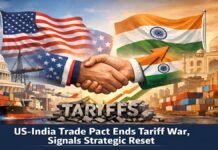
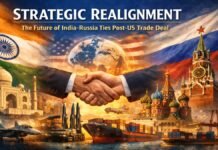
In a decisive shift that has revitalized the Indo-Pacific alliance, President Donald Trump announced on Monday, February 2, 2026, that the United States and India have reached a definitive trade agreement. The deal concludes months of high-stakes negotiations and effectively de-escalates a trade war that had seen duties on certain Indian exports climb as high as 50% last year.
President Trump, sharing the update on Truth Social, described the move as a gesture of “friendship and respect” for Prime Minister Modi. The agreement slashes the core reciprocal tariff from 25% to 18%, a move that Prime Minister Modi hailed as a “wonderful announcement” on behalf of 1.4 billion Indians.
Sector-Specific Impacts
The transition from a 50% combined tariff to a unified 18% rate has created a dramatic shift in competitiveness for India’s primary export industries:
- Textiles and Apparel: As one of India’s most labor-intensive sectors, the textile industry had seen orders stall under the 50% tariff regime. With the new 18% rate, Indian garment manufacturers now enjoy a competitive edge over regional rivals such as Vietnam and Bangladesh, where tariffs remain at roughly 20%. The Confederation of Indian Textile Industry (CITI) noted that this move restores India’s positioning in its largest overseas market.
- Gems and Jewelry: This sector was among the hardest hit, with exports to the U.S. plummeting by nearly 76% in late 2025. The reduction is viewed as a “critical life-line” that will restore buyer confidence in the American market, particularly for high-value cut and polished diamonds.
- Seafood and Agriculture: Seafood exporters, particularly shrimp farmers, have celebrated the deal. India is the top exporter of shrimp to the U.S., and the 18% rate allows them to reclaim market share from competitors in Ecuador and Indonesia.
- Pharmaceuticals and IT: These sectors were largely shielded from the initial tariff “net” to protect U.S. healthcare and technology supply chains. However, the deal provides much-needed regulatory stability and signals a deeper partnership in drug innovation and the newly proposed “Pax Silica” semiconductor initiative.
- Automobile Components: While manufacturers are still awaiting specific technical details on passenger vehicle parts, the general de-escalation has improved earnings visibility for Indian OEMs that supply global American brands.
The “Russia Factor” and Global Peace
Central to this agreement is a significant shift in India’s energy policy. According to President Trump, Prime Minister Modi has agreed to stop the purchase of Russian oil, which had been a major point of contention during the “Liberation Day” tariff waves of 2025. By transitioning its energy needs to U.S. and Venezuelan sources, India is now positioned as a key partner in Washington’s strategy to resolve the ongoing war in Ukraine.
“This will help END THE WAR in Ukraine,” Trump posted, noting that the economic pressure on Russia is a vital component of his peace plan. While New Delhi has focused its public comments on the economic benefits of the tariff reduction, the strategic pivot marks one of the most consequential changes in Indian foreign policy in decades.
Strengthening “Make in India” and “Buy American”
The deal creates a “win-win” framework for the world’s two largest democracies. Beyond the immediate relief for Indian exporters, the agreement includes a reciprocal commitment from India. New Delhi will move rapidly to eliminate non-tariff barriers and reduce duties on American products to zero.
Furthermore, President Trump claimed that India has committed to a massive “Buy American” initiative, involving more than $500 billion in U.S. energy, technology, and agricultural products. U.S. Ambassador to India, Sergio Gor, reinforced the sentiment, stating that the relationship now possesses “limitless potential” and that the personal rapport between the two leaders was the engine behind this historic outcome.