



























Key Points
- Fuel Price Relief: Excise duty on petrol and diesel reduced by ₹10 per liter to curb inflation.
- Coal Reserves Secured: 55.18 million tonnes available at power plants, sufficient for 24 days of operations.
- LPG Rationing: Booking intervals set to 25 days for urban and 45 days for rural areas to manage stocks.
- Citizen Evacuation: 1,864 Indians rescued from Iran via Armenia and Azerbaijan, while 1,754 seafarers are confirmed safe.
- Diplomatic Support: India officially welcomes the Pakistan-mediated two-week ceasefire and calls for permanent de-escalation.
At a high-level joint press conference held at the National Media Centre in Delhi on April 8, 2026, the Ministries of Petroleum, Coal, External Affairs, and Shipping presented a comprehensive strategy to navigate the economic fallout of the US-Iran conflict. The briefing aimed to reassure markets and the public that India is fully prepared for potential energy or logistical shocks resulting from the disruption of the Strait of Hormuz.
Government officials emphasized that proactive measures taken over the last month have insulated the nation’s core infrastructure. Despite the intensity of “Operation Epic Fury,” India’s internal supply chains remain robust, and the government is now focused on utilizing the newly announced 14-day ceasefire to stabilize trade routes.
Fortifying Energy and Industrial Power
The Ministry of Coal confirmed that India has built a formidable stockpile to prevent a power crisis. Beyond the 55.18 million tonnes currently at thermal power stations, an additional 171.90 million tonnes are held at mines and ports. In a move to protect industrial consumers, Coal India has slashed e-auction reserve prices by 20%, ensuring that electricity costs do not spike during this period of global uncertainty.
In the petroleum sector, the government has moved to shield citizens from “imported inflation.” By cutting excise duties by ₹10 per liter, the administration hopes to prevent a surge in transport and essential goods costs. To manage current inventory, “rationalization” measures have been introduced for LPG. While standard bookings are now spaced further apart, the government reported a massive surge in “Free Trade LPG” (FTL) sales, with over 110,000 of the 5-kilogram cylinders sold on April 7 alone.
Success in Large-Scale Citizen Repatriation
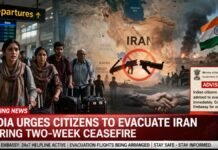
The Ministry of External Affairs (MEA) and the Directorate General of Shipping provided a detailed update on the safety of Indian nationals. Of the approximately 7,500 Indians identified as stranded within Iran at the start of hostilities, 1,864 have been successfully evacuated through land corridors in Armenia and Azerbaijan.
For those in other conflict-affected areas, such as Israel and Iraq, alternative evacuation routes through Egypt and Jordan are being utilized to bypass airspace restrictions. Meanwhile, a 24×7 naval control room is monitoring the safety of Indian-flagged vessels in the Persian Gulf, ensuring that seafarers remain in constant contact with the mission in Tehran.
The Path Toward Diplomacy and Stabilization
As the two-week ceasefire announced by U.S. President Donald Trump takes hold, the Indian government has reiterated its stance that dialogue remains the only viable path to peace. The MEA noted that the upcoming peace talks in Islamabad, scheduled for April 10, are a critical opportunity to restore the freedom of navigation through the Strait of Hormuz.
The briefing concluded with a firm appeal to the public to avoid panic buying. Officials noted that the current “rationing” is a precautionary measure to ensure equitable distribution rather than a sign of a shortage. India remains optimistic that the diplomatic window opened by the ceasefire will lead to a restoration of stability in global trade networks, allowing for a normalized flow of energy and goods.