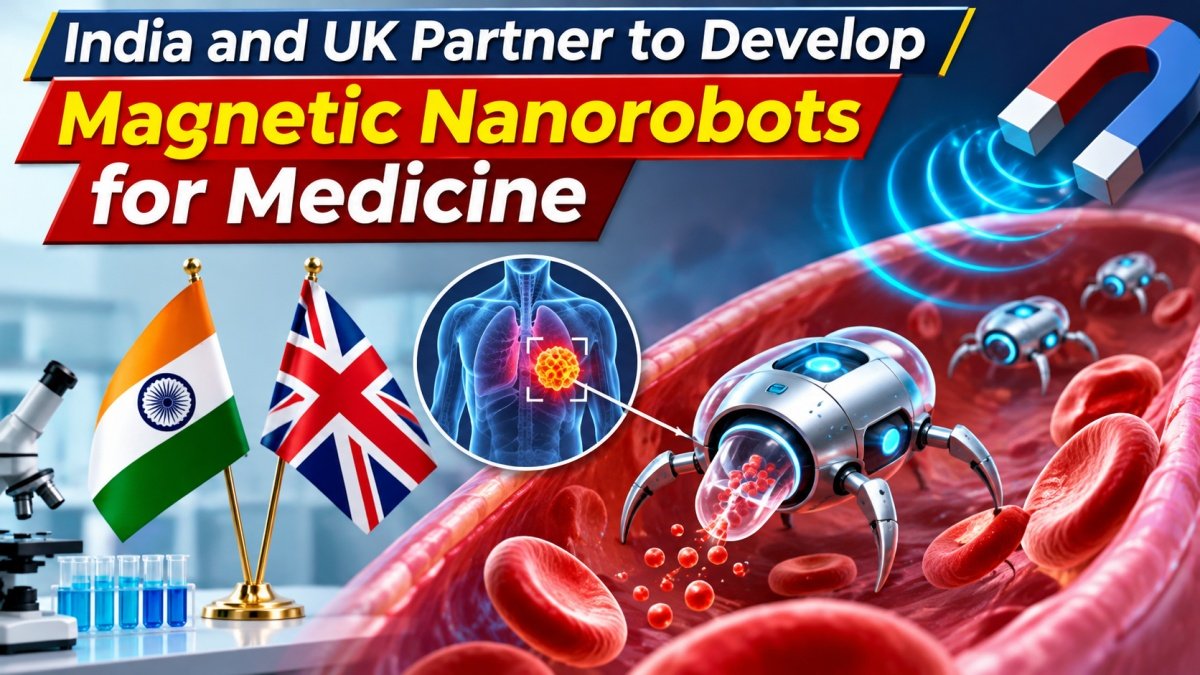
Scientists from India and Britain have partnered to develop magnetic nanorobots capable of delivering medicine directly to specific body cells to reduce side effects.
Key Points
- Joint Partnership: Imperial College London and the Indian Institute of Science (IISc) are collaborating on nanorobotics.
- Targeted Delivery: The robots will use magnetic fields to transport medicine to specific locations within the body.
- Reduced Side Effects: Precise delivery aims to lower drug dosages and minimize impact on healthy organs.
- Technical Fusion: The project combines synthetic biology with nanorobotics to create functional artificial cells.
- Shared Resources: The India Connect Fund will facilitate information sharing and research facilities between both nations.
Collaborative Advancement in Nanotechnology
NEW DELHI: Scientists from India and Britain have announced a joint initiative to develop advanced nanorobots controlled by magnets. This technology aims to revolutionize medical treatment by allowing microscopic robots to navigate the human body, carry essential materials, and release them at designated locations. By ensuring that medicine reaches only the affected area, the project seeks to significantly reduce the dosage required and minimize unwanted side effects.
The collaboration brings together the Indian Institute of Science (IISc) in Bengaluru and the UK’s Imperial College London. This partnership, announced this week, focuses on merging the fields of synthetic biology and nanorobotics to create a sophisticated delivery system for treating serious diseases in the future.
Engineering Artificial Cells and Motors
A primary objective of the research is the creation of artificial cells equipped with tiny magnetic motors. These motors are designed to function like miniature engines, providing the necessary propulsion for the cells to move through harsh biological environments. While standard artificial cells created in laboratories often lack independent mobility, these new structures will utilize magnetic nanomotors attached to polymer bags known as vesicles.
Professor Ambarish Ghosh’s team at IISc is spearheading the development of the magnetic nanorobots. Their research has already demonstrated systems capable of entering human blood, tissues, and even living cells. While these robots are currently composed of inorganic substances, they provide the mechanical movement required for the system to function.
Integrating Synthetic Biology
Complementing the mechanical side of the project, Dr. Claudia Contini’s team at Imperial College is focusing on the biological components. Their work involves creating artificial cells capable of holding specific materials and releasing them upon command. By combining Dr. Contini’s artificial cells with Professor Ghosh’s magnetic nanomotors, the researchers aim to create a complete system that can be steered by an external magnetic field.
This dual approach addresses a major limitation in current medicine, where drugs often spread throughout the bloodstream and affect healthy organs. With the ability to transport medicine directly to a specific site, the technology could offer a more precise and safer alternative to systemic drug administration.
Research Infrastructure and Future Goals
The project is being supported by the Imperial College’s India Connect Fund, which provides a shared platform for technical information, training, and research facilities. This framework is intended to foster long-term cooperation beyond the immediate development of nanorobots, creating a hub for research in synthetic biology.
According to Rediff.com, this collaboration is viewed as a significant step in revolutionizing nanorobotics. While the technology is currently in its early research stages and requires extensive further testing before clinical use, the partnership aims to provide students and researchers from both countries with unique opportunities to develop next-generation medical technologies.