





























Key Points
- Retail inflation reached 1.33% YoY in December 2025, increasing from 0.71% in November.
- Food inflation remained in negative territory for the seventh consecutive month at -2.71%.
- Urban inflation stood at 2.03% while rural inflation was much lower at 0.76%.
- This marks the fourth straight month that inflation stayed below the lower end of RBI’s inflation band.
- October 2025 recorded a historic low of 0.25%, the lowest in nearly 14 years in the current CPI series.
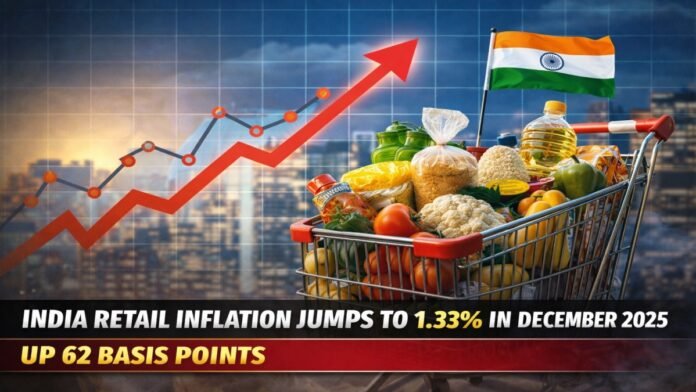
India’s retail inflation rate stood at 1.33 percent year-on-year in December 2025, representing an increase of 62 basis points compared to the 0.71 percent retail inflation rate in November. This information was released by the Ministry of Statistics and Programme Implementation on Monday, providing the first major economic data point for the new year.
Urban-Rural Divide Widens in Inflation Trends
The ministry stated that in December 2025, the retail inflation rate in urban areas was 2.03 percent, while in rural areas it was significantly lower at 0.76 percent. This urban-rural gap reflects differing consumption patterns and price pressures across regions. Additionally, food inflation continued to remain in the negative zone, standing at -2.71 percent in December 2025. In urban areas, food inflation was -3.08 percent, while in rural areas it was -2.09 percent in December 2025, indicating persistent deflationary pressures in food prices across both geographies.
Fourth Consecutive Month Below RBI Target Band
A statement issued by the Ministry of Statistics and Programme Implementation said that December 2025 marks the fourth consecutive month that the inflation rate has remained below the lower end of the inflation band set by the RBI. The central bank typically maintains an inflation target of 4% with a tolerance band of +/- 2%, meaning the acceptable range is between 2% and 6%. The prolonged period of below-target inflation suggests weak demand pressures in the economy, giving the RBI room to maintain an accommodative monetary policy stance.
Reasons Behind the Inflation Increase
According to the data released by the ministry, the increase in headline inflation and food inflation in December was due to a rise in the prices of personal care products, vegetables, meat and fish, eggs, spices, and pulses. These categories saw upward price pressure after months of deflation, contributing to the overall uptick in inflation. Furthermore, housing inflation was 2.86 percent in December 2025, compared to 2.95 percent in November, showing a slight moderation. Education inflation was 3.32 percent in December 2025, compared to 3.38 percent in November 2025, indicating a marginal easing in this category. Inflation in transport and communication was 0.76 percent in December, compared to 0.88 percent in November, reflecting continued softness in these sectors.
Historical Context and Recent Trends
In October, retail inflation had fallen to a record low of 0.25%. This was due to a decrease in the prices of food items. This was the lowest inflation rate in the current CPI series, representing a nearly 14-year low. Previously, in September, it was at 1.44%. The sharp volatility in inflation rates over the past few months highlights the sensitivity of price levels to food price movements and base effects. The December uptick, while significant in percentage terms, still leaves inflation at historically low levels, well below the RBI’s comfort zone.
Policy Implications and Outlook
The persistent low inflation, particularly the negative food inflation for seven consecutive months, presents both opportunities and challenges for policymakers. On the one hand, it provides the RBI with flexibility to support growth through lower interest rates. On the other hand, prolonged deflation in food prices can hurt farmer incomes and agricultural sector viability. The government may need to consider targeted interventions to support the farm sector while the central bank monitors core inflation trends, which remain relatively muted across most categories.