

































Key Points
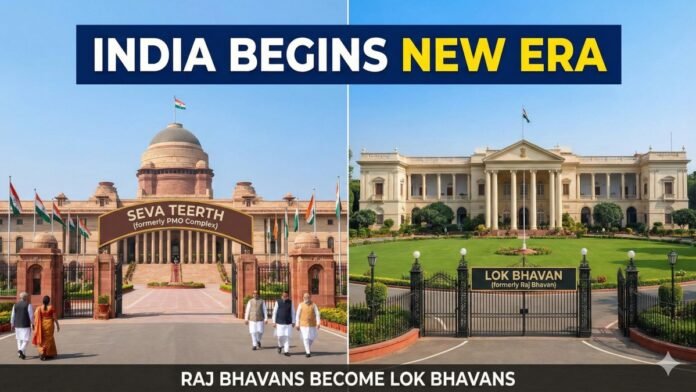
- New PMO complex called Seva Teerth is part of three-building Executive Enclave, with Seva Teerth 2 housing Cabinet Secretariat and Seva Teerth 3 housing National Security Advisor’s office
- Union Home Ministry directed all states and UTs to rename governors’ houses from “Raj Bhavan” to “Lok Bhavan” or “Lok Niwas” to shed colonial legacy
- Central Secretariat already renamed Kartavya Bhavan in August 2025, housing major ministries including Home Affairs, MSME, Petroleum, and Rural Development
- This is part of larger governance rebranding including Rajpath renamed Kartavya Path in 2015 and PM’s residence renamed 7, Lok Kalyan Marg in 2016
- Seva Teerth complex cost approximately ₹467 crore, covers 2,26,203 square feet built-up area with PM’s residence spanning 36,328 square feet
- Opposition termed it “name changes without work,” with Congress demanding Guinness World Record for renamings while questioning governance priorities
- Minister Giriraj Singh called the changes “rising of a new Sanatan Bharat,” accusing previous governments of keeping PM’s residence like a “loot bhavan”
December 1, 2025, represents a watershed moment in India’s administrative identity, marking the formal transition from monarchy and colonial-era symbolism to a governance model centred on public service. The renaming of the new Prime Minister’s Office complex as “Seva Teerth,” meaning “service pilgrimage,” encapsulates this philosophical shift from “satta” (power) to “seva” (service) and from authority to responsibility. Simultaneously, the Union Home Ministry instructed all states and union territories to rename governors’ residences from “Raj Bhavan” (king’s house), which “smacks of colonialism,” to “Lok Bhavan” or “Lok Niwas” (people’s house), signalling a complete decolonisation of institutional nomenclature.
Government officials framed this change as more than administrative rebranding, characterising it as a “cultural and moral” transformation reflecting deeper ideological commitments. As one official stated, “The idea of governance is moving from ‘satta’ (power) to ‘seva’ (service) and from authority to responsibility. The change is not just administrative, but cultural and moral”.
Seva Teerth, The New Home Of National Priorities
The Seva Teerth complex, still in the final stages of completion, represents a bold architectural and symbolic reimagining of India’s highest executive spaces. Located within the Executive Enclave near South Block in New Delhi, Seva Teerth is designed as a workplace reflecting “the spirit of service and where national priorities take shape”. The complex costs approximately ₹467 crore to construct and covers 2,26,203 square feet of built-up space, with the Prime Minister’s residence occupying 36,328 square feet.
The three-building Executive Enclave structure comprises:
- Seva Teerth 1, housing the Prime Minister’s Office, symbolises governance as a sacred calling to serve the nation
- Seva Teerth 2, already operational since September 2025, houses the Cabinet Secretariat, the coordinating mechanism of national governance
- Seva Teerth 3, destined to house the National Security Advisor’s office, overseeing the nation’s strategic security priorities
This tripartite structure embodies the concept that all three pillars of executive governance, the Prime Minister, the Cabinet, and national security decision-making, exist fundamentally to serve the nation’s interests.
Broader Institutional Rebranding Over A Decade
The Seva Teerth renaming represents merely the latest chapter in a comprehensive institutional rebranding initiative spanning over a decade, reflecting what government officials describe as an “ideological transition and shift in mindset” in India’s governance apparatus. This systematic renaming effort includes:
Rajpath Renamed Kartavya Path (2015): The iconic street that symbolised colonial power and monarchy was transformed into “Duty Path,” carrying the message that “power is not an entitlement; it is a duty”
PM’s Residence Renamed 7, Lok Kalyan Marg (2016): Changed from 7, Race Course Road which evoked elite leisure and exclusivity—to emphasise that the Prime Minister’s residence is “a centre for public welfare, not a symbol of privilege”
Central Secretariat Renamed Kartavya Bhavan (August 2025): This vast administrative hub housing multiple central government ministries was rebranded to reflect the principle that “public service is a commitment”
Together, these renamings create a coherent symbolic framework: governance spaces and symbols no longer emphasise power, status, or colonial heritage, but rather duty, service, and responsibility toward the citizenry.
Raj Bhavans Become Lok Bhavans Across The Country
The Union Home Ministry’s December 1 directive to all states and union territories represents perhaps the most geographically comprehensive institutional rebrand in Indian history. Governors’ residences, previously termed “Raj Bhavan,” have been uniformly redesignated as “Lok Bhavan” or “Lok Niwas,” fundamentally altering the symbolic representation of the Vice-Regal offices that once epitomised British colonial authority.
The naming shift carries profound symbolic weight, as “Raj” historically denoted monarch or ruler, while “Lok” means people. By transforming these residences from “king’s house” to “people’s house,” the government repositions the governor’s office from a seat of imperial authority to an institution serving the populace. Several states and union territories have already implemented the directive, with more expected to follow in the coming weeks.
Kartavya Bhavan, Central Secretariat’s Transformation
The Central Secretariat, the bureaucratic nerve centre coordinating all central government ministries, was renamed Kartavya Bhavan (Duty House) in August 2025 and inaugurated by Prime Minister Narendra Modi. This ten-building complex now houses major ministries, including:
- Ministry of Home Affairs
- Ministry of Petroleum and Natural Gas
- Ministry of Rural Development
- Ministry of MSME (Micro, Small and Medium Enterprises)
- Several additional central government departments
The symbolic renaming emphasises that bureaucratic machinery exists not to accumulate power or serve narrow interests, but to execute constitutional duties toward citizen welfare. Senior government officials describe Kartavya Bhavan as “a vast administrative hub built around the idea that public service is a commitment”.
Government’s Ideological Framework, Seva, Kartavya, Citizen-First
The institutional rebranding reflects a deliberate philosophical framework that government officials and political leaders promote as central to governance strategy. According to officials, the new nomenclature emphasises three interconnected principles:
Seva (Service): Governance exists to serve the people, not to concentrate power or privilege within elite circles
Kartavya (Duty/Responsibility): Elected officials and civil servants are duty-bound to prioritise national interests and constitutional obligations over personal advancement
Citizen-First Governance: All institutional structures, spaces, and symbols should communicate that citizens are the ultimate authority and beneficiaries of governance
As one government official articulated, “Every name, every building and every symbol now points to a simple idea: government exists to serve”.
Political Support, BJP And Allies Celebrate Transition
Union Minister Giriraj Singh welcomed the institutional renamings as reflecting “the rise of a new Sanatan Bharat” and representing a fundamental departure from previous governance models. Singh criticised earlier governments for keeping “the Prime Minister’s residence like a ‘loot bhavan’ (plunder house),” while celebrating the current dispensation’s linking of governance with public welfare.
BJP National Secretary Dr. Arvind Menon emphasised the interconnection of all recent renamings in a post on social media, stating, “PMO’s Seva Teerth, the Raj Bhavans’ Lok Bhavan, and the Central Secretariat’s Kartavya Bhavan, these are not mere changes; they are a clear message of a new work culture being developed in the national interest”.
Opposition Criticism, ‘Names Changed, Work Not’
Opposition parties have been highly critical of the institutional rebranding initiatives, questioning whether renaming exercises constitute meaningful governance improvements. Congress leader Pramod Tiwari, deputy leader of Congress in Rajya Sabha, sarcastically remarked that the Modi government “should get a Guinness World Record for name changes,” implying that rebranding is prioritised over substantive policy improvements.
Opposition critiques focus on the argument that while institutional nomenclature may symbolically shift, underlying governance outcomes, service delivery quality, and accountability mechanisms require substantive rather than cosmetic changes. The Opposition contends that renaming Raj Bhavans to Lok Bhavans does not inherently democratize governance or improve citizen access to administrative services.
Timeline Of Central Vista Redevelopment
| Project Component | Status | Timeline |
|---|---|---|
| Seva Teerth 2 (Cabinet Secretariat) | Operational | Shifted in September 2025 |
| Seva Teerth 1 (PMO Complex) | Final completion stages | Expected migration by end 2025 |
| Kartavya Bhavan (Central Secretariat) | Operational | Inaugurated August 2025 |
| PM’s Residence (Executive Enclave-3) | Under construction | Expected completion by end 2027 |
| Overall Central Vista Project | Ongoing | Expected complete by end 2027 |
The Central Vista Redevelopment Project, encompassing new administrative complexes and institutional spaces, represents one of India’s largest government infrastructure initiatives, with completion targeted for 2027.
Migration From South Block To Seva Teerth
The Prime Minister’s Office will soon migrate from its historic South Block premises, where it has been housed for decades, to the newly constructed Seva Teerth complex. This relocation symbolises more than administrative reorganisation, as South Block carries historical significance as the seat of post-independence executive power. The move to “Seva Teerth” physically and symbolically represents the transition from inherited colonial governance structures to newly conceived citizen-centric institutional spaces.
South Block will continue housing other government offices, but the PMO’s departure marks a symbolic end to an era. Some observers view this relocation as the physical manifestation of India’s ideological transition from colonial bureaucratic governance to independent, service-oriented governance models.
Global Context, Institutional Rebranding Trends
India’s comprehensive institutional rebranding is not unique in global governance contexts, though its scale and systematic nature are remarkable. Many post-colonial nations have engaged in symbolic institutional transformation to mark transitions from colonial to independent governance identities. However, the Indian rebranding initiative spanning street names, administrative buildings, governors’ residences, and the Prime Minister’s Office represents an unusually comprehensive and coordinated effort at symbolic governance transformation.
December 1, 2025, marks India’s formal transition from colonial-era administrative nomenclature to a governance model explicitly centred on service, duty, and citizen-first principles. The renaming of the PMO complex to Seva Teerth and governors’ residences to Lok Bhavans, coupled with the already-completed rebranding of Rajpath to Kartavya Path and the Central Secretariat to Kartavya Bhavan, creates a coherent symbolic framework communicating that Indian governance exists fundamentally to serve citizens. While supporters celebrate these renamings as reflecting genuine ideological transformation in governance culture, critics argue that symbolic changes must be accompanied by substantive improvements in service delivery, accountability, and citizen welfare outcomes.
The relocation of the PMO to the new Seva Teerth complex, expected by the end of 2025, will mark the physical embodiment of this ideological transition, moving India’s highest executive office from historic South Block to architecturally and symbolically reimagined governance spaces designed around principles of service and duty.