































KEY POINTS
, Historic tragedy, Hong Kong’s deadliest fire in decades claims 94 lives
, Construction materials and bamboo scaffolding identified as fire origin
, Only 900 of 4,800 residents evacuated from Wang Fuk Court complex
, Rescue operations severely hampered by 53-meter ladder limitations
, Police arrest three including construction company directors
, Older buildings lack mandatory fire safety systems like sprinklers and smoke detectors
, Temporary shelters provide relief to hundreds of survivors
, Safety standards debate reignited for Hong Kong’s aging housing stock
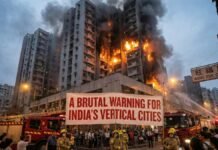
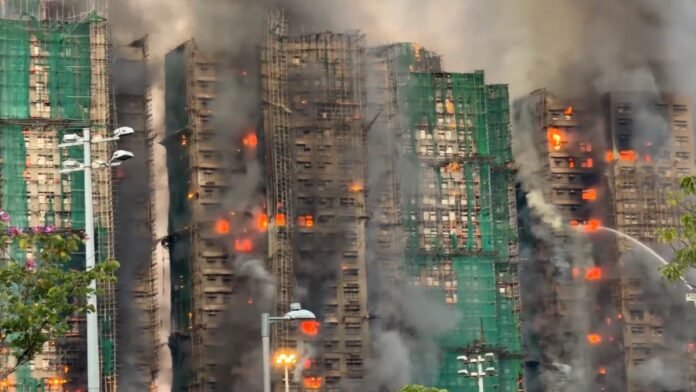
A catastrophic fire has struck Hong Kong’s Wang Fuk Court residential complex, leaving the city reeling from one of its deadliest fire disasters in recent history. At least 94 people have been confirmed dead in the inferno that consumed seven of the eight 32-story towers of this government-subsidized housing complex. The tragedy has cast a harsh spotlight on serious safety vulnerabilities in Hong Kong’s aging housing infrastructure, with rescue operations continuing amid extreme heat, structural challenges, and ongoing search efforts for missing residents.
MASSIVE FIRE SPREADS RAPIDLY: RESCUE OPERATIONS FACE CRITICAL CHALLENGES
Hong Kong firefighters battle unprecedented obstacles in containment efforts
The catastrophic blaze began when construction materials and bamboo scaffolding, used in an ongoing exterior renovation project, suddenly ignited at Wang Fuk Court. Fueled by strong winds and rapid flame spread, the fire engulfed seven of the complex’s eight towers with devastating speed. As rescue operations continue, authorities have confirmed that only 900 of the complex’s 4,800 residents have been successfully evacuated, meaning approximately 3,900 residents remain unaccounted for or require assistance.
Hong Kong’s firefighting capabilities have proven inadequate against the scale of this disaster. The city’s fire department equipment, specifically their ladder trucks and water delivery systems, can only reach a maximum height of 53 meters (174 feet), less than half the actual height of the 32-story buildings. This critical limitation has severely hampered both rescue operations and water delivery to upper floors, forcing firefighters to rely on aerial ladder platforms and helicopter assistance. The extreme heat radiating from the burning structures has further complicated rescue and search operations, forcing rescue teams to proceed with extreme caution.
This tragedy surpasses the deadly 1996 Hong Kong fire that claimed 41 lives, making it one of the most devastating residential fire incidents in the city’s documented history.
CONSTRUCTION MATERIALS BLAMED: FIRE SAFETY STANDARDS UNDER INVESTIGATION
Three arrested as authorities probe substandard materials and safety violations
Investigators have identified construction materials and bamboo scaffolding as the fire’s origin, with particular focus on plastic foam panels that may not have met required fire resistance standards. These materials were being used to protect windows during the exterior renovation of the high-rise complex, but potentially inadequate fire-resistant properties allowed the flames to spread with alarming velocity.
Police have arrested three individuals connected to the incident, including directors of a construction company and an engineering consultant. Although authorities have not officially named the construction firm, the Associated Press confirmed that Prestige Construction and Engineering Company’s office was searched as part of the investigation. Preliminary findings suggest that some materials used in the renovation, particularly insulation and protective panels, failed to comply with Hong Kong’s fire safety building codes.
Environmental factors also accelerated the disaster, strong winds significantly contributed to the fire’s rapid horizontal and vertical spread across multiple towers, overwhelming containment efforts and preventing effective evacuation procedures.
AGING HOUSING INFRASTRUCTURE: A SYSTEMIC SAFETY CRISIS EXPOSED
Wang Fuk Court reveals decades-old deficiencies in Hong Kong’s residential fire protection
Wang Fuk Court, constructed in the 1980s as a privately owned but government-subsidized housing complex, exemplifies the dangerous safety gaps plaguing Hong Kong’s aging residential stock. These apartments are characteristically small, typically ranging from 40 to 45 square meters, with minimal safety infrastructure. Critically, the buildings were constructed before 1989, prior to major amendments to Hong Kong’s Fire Code that mandated the installation of fire safety floors in all new high-rise residential buildings.
Unlike modern buildings, Wang Fuk Court and similar older complexes lack fundamental fire protection systems including automatic sprinkler systems, comprehensive smoke detection networks, and modern fire alarm technology. These safety deficiencies are common across Hong Kong’s mass-market and older housing developments, creating a widespread vulnerability affecting hundreds of thousands of residents. The tragedy has reignited urgent debates among city officials, housing authorities, and safety experts regarding mandatory retrofitting requirements for buildings constructed before modern fire safety standards were implemented.
This incident raises critical questions about Hong Kong’s responsibility to upgrade aging housing infrastructure in a city where nearly 40 percent of the residential population lives in buildings constructed before contemporary fire safety regulations.
COMMUNITY RESPONSE: SHELTERS, AID, AND ONGOING RELIEF EFFORTS
Hundreds of survivors find temporary refuge as volunteers mobilize support
More than 300 survivors evacuated from Wang Fuk Court, along with residents who were outside the complex at the time of the disaster, have been relocated to temporary shelters established in nearby schools and community centers. Additionally, over 70 people sustained injuries in the fire and are receiving medical treatment across multiple Hong Kong hospitals.
The community response has been heartwarming and coordinated, with volunteers and members of the public continuously delivering essential supplies including water, food, blankets, and clothing to affected residents. Local charitable organizations and government agencies have mobilized rapidly to provide psychological counseling, emergency housing assistance, and financial aid to survivors. The fire department and emergency services continue coordinated search and rescue operations, with hopes of locating additional survivors diminishing as rescue efforts transition toward recovery operations.
Relief organizations are establishing long-term support programs for displaced residents, recognizing that recovery from this tragedy will require sustained community effort, government assistance, and comprehensive rehabilitation support for affected families.