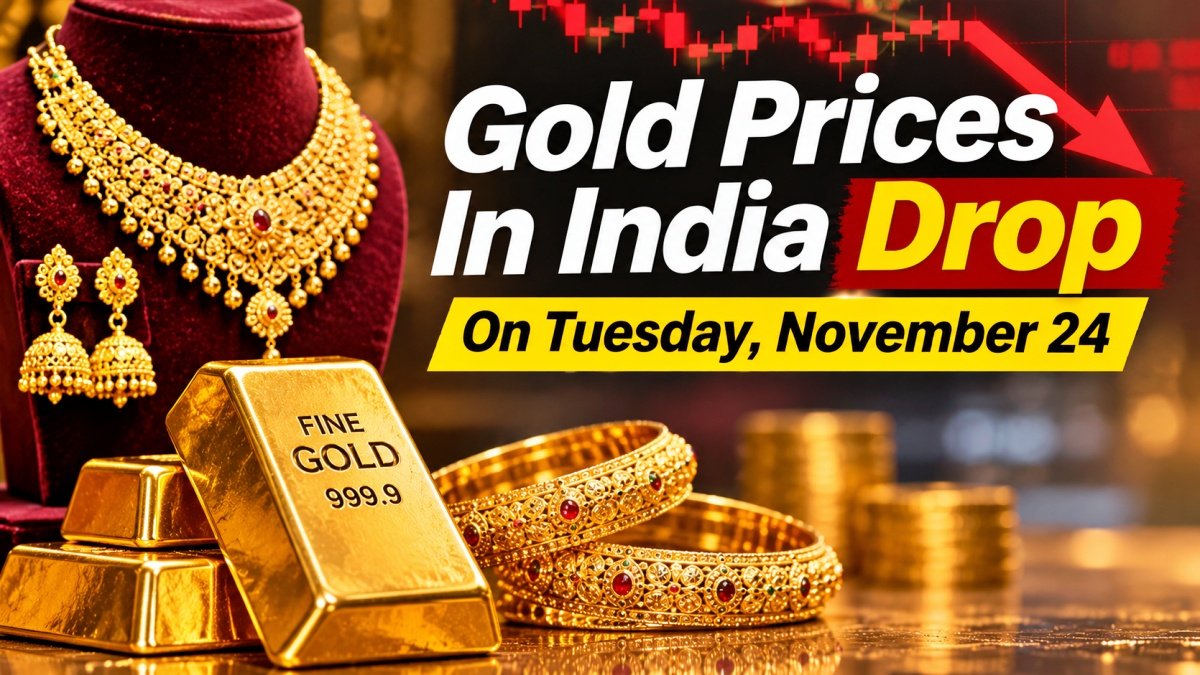
Gold prices in India witnessed a slight decline on Tuesday, November 24, 2026, with 24-carat gold trading lower across major domestic markets.
Key Points
- 24K Gold Rate: The price of 24 carat gold stands at ₹12,508 per gram.
- 22K Gold Rate: The price of 22 carat gold is currently ₹11,465 per gram.
- 18K Gold Rate: The price of 18 carat gold is recorded at ₹9,381 per gram.
- Price Trend: Gold prices decreased slightly compared to the rates recorded on November 20.
Current Gold Market Trends
NEW DELHI: The gold market in India showed a downward trend on Tuesday, November 24, 2026. According to data from Good Returns, the price of 24 carat gold is currently trading at ₹12,508 per gram. This figure reflects a decrease of ₹49 compared to the closing prices recorded on November 20.
In addition to the 24K rates, the prices for 22K and 18K gold also saw a decline. 22K gold is priced at ₹11,465 per gram, marking a drop of ₹45 from the previous period. Meanwhile, 18K gold is trading at ₹9,381 per gram, which is a decrease of ₹37 from the prices observed on November 20.
These fluctuations indicate a cooling period for the precious metal market in India, which is often influenced by a combination of domestic demand, currency strength, and international supply chain dynamics.
Regional Market Overview
These price fluctuations are being observed across major Indian metropolitan hubs, including Chennai, Mumbai, Delhi, and Kolkata. While specific city-wise variations may occur based on local taxes, making charges, and regional demand, the national trend remains consistent with a slight cooling in gold prices.
Investors and consumers are closely monitoring these daily fluctuations as they impact the broader jewelry market and personal savings. In India, gold is not only a primary investment vehicle but also a significant cultural asset, making even minor price movements a point of interest for the general public.
Retailers in major cities are expected to adjust their pricing models accordingly to reflect the current market rates, ensuring that the transition from the previous week’s highs is captured in the local trade.
Geopolitical Context and Market Impact
The global gold market often reacts to significant geopolitical tensions, which can create volatility in commodity prices. Recent reports have highlighted escalating tensions in West Asia, specifically involving maritime confrontations in the Strait of Hormuz. According to Al Jazeera, Iran’s Islamic Revolutionary Guard Corps reported that three oil tankers caught fire after hitting naval mines.
These regional instabilities, coupled with the aftermath of joint US-Israeli military strikes in early 2026, continue to influence global commodity prices. While the immediate focus remains on domestic gold rates, the underlying geopolitical situation in the Middle East remains a critical factor for international trade and security.
The Strait of Hormuz is a vital global shipping lane for oil and gas. Disruptions in this area often lead to spikes in energy costs, which can indirectly affect inflation and, consequently, the purchasing power and investment behavior of gold buyers in India.
Historical Context and Economic Significance
Gold has historically served as a safe-haven asset during times of global uncertainty. The current price levels in India are shaped by a complex interplay of factors, including the Reserve Bank of India’s monetary policies, international interest rates, and the strength of the Indian Rupee against the US Dollar.
The recent maritime confrontations and diplomatic deadlock over Iran’s nuclear programme represent a significant shift in regional security. When such tensions arise, gold often sees increased demand as investors seek to protect their wealth from currency devaluation and market instability.
Moving forward, market analysts will likely watch for further developments in the Middle East and the stability of the interim agreements between major powers. Any significant shift in these diplomatic relations could lead to rapid price corrections in the precious metals market.