






























Key Points:
- EU Commission imposed €120 million fine on X for three DSA violations related to transparency and user protection
- Fine breakdown: €45 million for deceptive blue checkmarks, €35 million for ad repository issues, €40 million for blocking researchers
- Commission claims blue checkmark system misleads users and enables scammers without proper verification
- X’s ad database lacks transparency about who placed ads, targeting parameters, and content details
- X deliberately obstructed researchers’ data access, violating DSA’s public data access requirements
- Elon Musk called the fine “bullshit” and X subsequently blocked the EU Commission’s advertising account
- X has 60 days to outline compliance plans for blue checkmarks and 90 days for ad/researcher issues
- This marks the first DSA penalty, with potential for larger fines up to 6% of global turnover in future cases
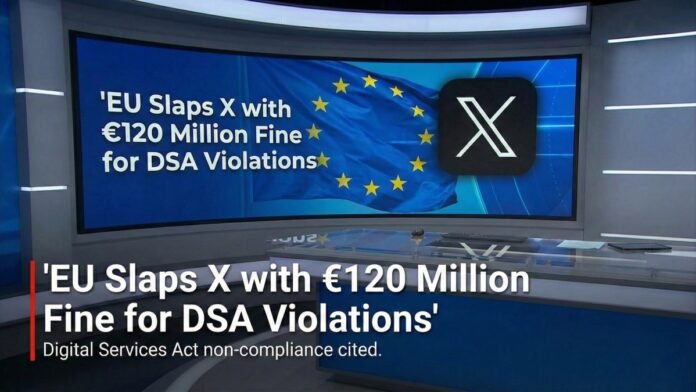
The European Union has taken its toughest action yet against Elon Musk’s social media platform, X, for violating digital security regulations. The EU Commission has imposed a hefty fine of €120 million (approximately ₹1,080 crore) on X for violating the Digital Services Act (DSA). The EU Commission states that X violated three key rules related to transparency, security, and user protection, which could have led to users receiving inaccurate information about the blue tick and advertising database.
Strict Transparency Rules Under the DSA
According to the European Commission, the X platform did not comply with the DSA standards, which aim to protect users from scams, misinformation, and fake content. The EU clarified that any negligence or violation of the rules under the DSA could result in significant financial action, and X committed this serious negligence. The Commission’s investigation, which began two years ago, concluded that X breached its transparency obligations under the DSA framework that mandates platforms assume greater accountability for safeguarding European users.
Serious Questions About the Blue Checkmark
The EU alleges that the Blue Checkmark on X was designed to mislead users. The Commission stated that this design could encourage scammers and fake account creators, as users would not understand the basis for the blue tick. The EU described this as a “deceptive design” that completely violates online security standards. On X, anyone can pay to obtain the “verified” status without the company meaningfully verifying who is behind the account, making it difficult for users to judge the authenticity of accounts and content they engage with.
The Commission specifically found that X’s blue checkmark system deceives users by failing to prohibit deceptive design practices on its services. This violation puts users at risk of scams, including impersonation frauds and various manipulations by malicious entities. The EU Executive Vice President stated clearly, “Deception, concealment of advertisements, and obstruction of research are unacceptable under European digital law. The DSA exists to prevent such activities”.
Opacity in Ad Database, Problems for Researchers
EU regulations require all platforms to provide an open and transparent database of their advertisements. This should clearly indicate who placed the advertisement, who was targeted, and what the intended purpose was. However, X’s ad database was found to be not only incomplete, but also experienced unreasonable delays in accessing the data. This made it difficult for analysts and researchers to identify fake ads and propaganda.
The Commission found that X’s advertisement repository doesn’t comply with DSA requirements for transparency and accessibility, saying the company imposes excessive delays in processing requests for access. The regulator also found that the ads repository doesn’t house information like the content or topic of ads, as well as who paid for those ads.
EU Calls Blocking Data Access for Researchers a Major Crime
According to the investigation report, X deliberately created obstacles to data access for researchers. The EU Executive Vice President stated clearly, “Deception, concealment of advertisements, and obstruction of research are unacceptable under European digital law. The DSA exists to prevent such activities”. X has failed to provide researchers with data on views and likes, despite this being an obligation under the DSA.
The Commission emphasized that shutting out researchers has no place online in the EU, as it undermines the ability to study platform effects, misinformation spread, and systemic risks. This obstruction violates the DSA’s provisions requiring platforms to provide access to public data for vetted researchers investigating systemic risks.
Fine Breakdown and Proportionality
The €120 million fine was calculated based on the gravity of each specific infringement. The breakdown includes €45 million for the deceptive blue checkmark violation, €35 million for the flawed ad repository, and €40 million for barriers to researcher data access. Commission officials stated that the fine is based on proportionality rather than the maximum possible penalty, which could reach 6% of a tech company’s annual global turnover.
While the penalty is relatively small compared to previous fines against other US tech giants, it marks the Commission’s inaugural decision regarding a platform’s non-compliance with the DSA. An EU official noted that this investigation concerned transparency, while other ongoing proceedings concerning manipulation of information and handling of illegal content are still being conducted.
Musk’s Reaction and X’s Retaliation
Elon Musk reacted to the fine with his characteristic bluntness, labeling the Commission’s announcement as “Bullshit” on X. The situation escalated further when X subsequently blocked the European Commission’s advertising account, allegedly over policy breaches. This retaliation came just days after the fine was announced, demonstrating the escalating tension between the platform and EU regulators.
The ruling has drawn strong reactions from US officials, with the Trump administration planning to go to war with the EU over the $140 million fine. The transatlantic dispute highlights the growing conflict between US tech companies and European regulatory frameworks.
Compliance Requirements and Future Implications
X now has 60 days to inform the Commission of its plans to rectify the blue checkmark violation and 90 days to respond with action plans for addressing the breaches relating to ads and public data transparency. The Commission has mandated that X must provide clear compliance plans or face further recurring penalties.
This landmark penalty triggers US fury as Brussels enforces its first digital transparency sanction, setting a precedent for how the EU will regulate major tech platforms under the DSA framework. The Commission’s action signals that deceptive practices, lack of ad transparency, and obstruction of research will not be tolerated in the European digital landscape.