


























Key Points
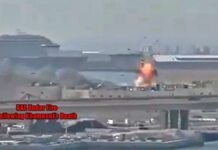
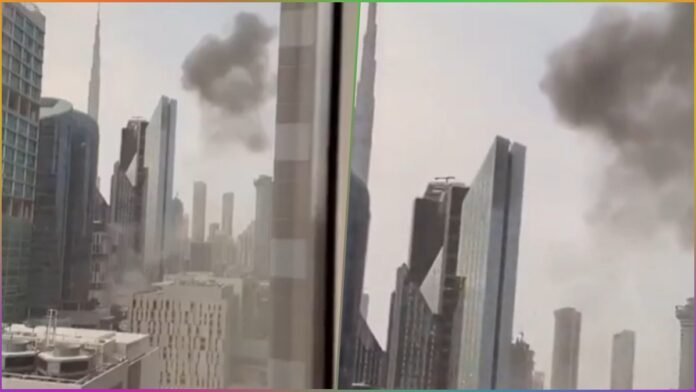
- Debris from an intercepted Iranian drone hit a building in the Dubai International Financial Centre (DIFC) on Friday morning.
- Massive plumes of smoke were seen near Sheikh Zayed Road, though UAE authorities reported no casualties.
- Several multinational firms, including major banks and consultancies, have evacuated staff from Dubai’s financial hub.
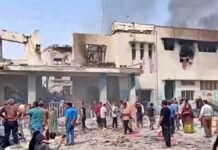
- In Lebanon, Israeli airstrikes have reduced portions of Beirut’s southern suburbs to rubble, with at least 15 reported dead.
- The conflict, now on its 14th day, has triggered the closure of the Strait of Hormuz and pushed global oil prices past $100 per barrel.
The regional war involving Iran and Israel reached the doorstep of global finance on Friday morning when loud explosions rattled the central districts of Dubai. At approximately 8:20 AM local time, residents near the Dubai International Financial Centre (DIFC) reported hearing powerful blasts that caused buildings to vibrate. Shortly after, thick clouds of black smoke were visible drifting across the skyline, with the iconic Burj Khalifa in the background.
The Dubai Government Media Office quickly moved to de-escalate panic, confirming that the city’s air defense systems had successfully intercepted a “hostile aerial target.” According to official statements, debris from the interception fell on the facade of a building in the central district, causing minor structural damage but no injuries. This incident followed a similar scare on Thursday, when a drone crashed near the financial district, prompting global institutions like Citi, Deloitte, and PwC to allow employees to work remotely or relocate to safer zones.
Regional Retaliation and the Toll on the Gulf
The UAE has increasingly become a focal point of Iranian retaliation since the U.S. and Israel launched joint strikes on Iranian military assets on February 28. Analysts suggest that the UAE is being targeted due to its deep strategic and economic ties with Western powers. Reports indicate that the UAE has intercepted over 1,500 drones and 300 missiles since the conflict began, marking the heaviest bombardment the nation has faced in its modern history.
The attacks are not limited to Dubai. On Friday, Saudi Arabia reported intercepting multiple drones targeting Riyadh’s Diplomatic Quarter, while sirens were heard blaring in Bahrain following strikes on fuel storage tanks. This coordinated assault on Gulf infrastructure has raised fears of a total regional economic shutdown, particularly as Iran maintains its blockade of the Strait of Hormuz.
Devastation in Beirut: A City Under Siege
While Dubai grapples with drone threats, the situation in Beirut has turned into a humanitarian catastrophe. Israeli warplanes carried out an “extensive wave” of airstrikes on Thursday night and early Friday morning, targeting what they described as Hezbollah strongholds in the Dahiya district. However, the strikes have expanded into central areas, including the Burj Hammoud and Aisha Bakkar districts.
Local residents described the night as a “living hell,” with continuous explosions turning residential blocks into mountains of debris. Lebanon’s Public Health Ministry has confirmed that at least 15 people were killed in the latest 24-hour cycle, though the toll is expected to rise as search-and-rescue teams struggle to navigate streets choked with wreckage and active fires. The “Dahiya Doctrine,” an Israeli military strategy involving heavy strikes on urban infrastructure, appears to be in full effect as the Israeli government vows to “crush” Iranian-allied groups across the Levant.
Global Economic and Humanitarian Aftermath
The dual-front escalation has sent shockwaves through global markets. With the Strait of Hormuz closed, Brent crude oil prices have surged, leading to secondary economic crises in countries like India, where LPG and fuel shortages are already being reported.
The humanitarian cost is also climbing. The UNHCR reports that tens of thousands of civilians are fleeing Tehran for rural areas, while in Dubai, the “Dubai dream” faces an existential threat as expatriates and tourists begin a mass exodus. As both sides refuse to yield and the conflict enters its third week, the international community remains on high alert for further strikes on civilian and economic landmarks across the Middle East.