
































Key Points:
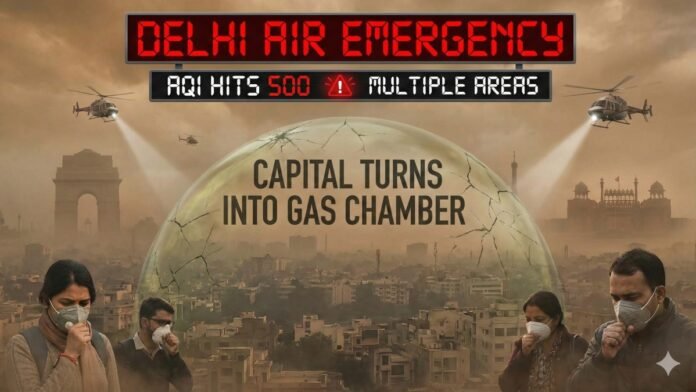
- AQI reaches 500 in Ashok Vihar, Rohini, Jahangirpuri, and Wazirpur on Monday morning
- Delhi’s average AQI recorded at 456, indicating severely critical conditions
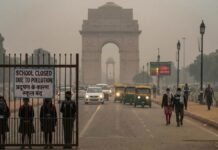
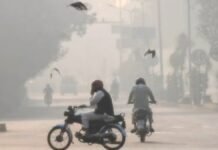
- Visibility drops to less than 3 meters due to combined smog and dense fog
- 38 out of 39 monitoring stations recorded ‘severe’ pollution levels on Sunday
- Doctors warn against outdoor activities as PM2.5 particles penetrate deep into lungs
The Air Quality Index crossed the 500 mark in several Delhi localities on Monday morning at 6 AM, with Ashok Vihar, Rohini, Jahangirpuri, and Wazirpur recording the maximum possible reading. The average AQI in the national capital reached 456, indicating a severely critical situation where breathing open air has become difficult for residents. Additional monitoring stations showed alarming readings, with Anand Vihar at 493, Nehru Nagar at 489, Okhla at 483, RK Puram at 483, and Vivek Vihar at 493.
Double Whammy of Smog and Fog
Delhiites are currently facing a double whammy of weather conditions, dealing with dense fog along with toxic smog. The situation has become so severe that nothing is visible even at a distance of 3 meters, forcing vehicles to crawl on the roads. According to the CPCB’s SAMEER app on Sunday, 38 of Delhi’s 39 active air quality monitoring stations recorded ‘severe’ levels of pollution by 4 pm, while only Shadipur registered a ‘very poor’ category.
Health Emergency: Doctors Issue Stern Warnings
Health experts have warned of serious health risks due to prolonged exposure to polluted air, advising people to avoid going out for walks or exercising, especially in the mornings. Health expert Sheila Yadav explained that with AQI levels hovering between 300 and 400, and sometimes exceeding 450, exposure to polluted air can cause fine particles like PM2.5 to penetrate deep into the lungs. She recommended that physical activity should be done indoors, and people should go outside only when absolutely necessary, while also suggesting a healthy diet, plenty of water, and seasonal fruits to help flush out toxins.
GRAP-4 Fails to Control Crisis
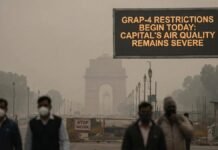
Despite the implementation of GRAP-4 in Delhi, the most stringent stage of the Graded Response Action Plan, the situation is not coming under control. The wind speed remains very low, allowing pollutants to accumulate and creating a situation where people can be exposed to toxic air even inside their homes. The persistent severe conditions indicate that current measures are insufficient to tackle the scale of the pollution crisis.
No Relief Expected: Weather Department Forecast
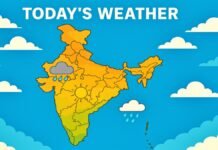
The Meteorological Department had warned on Sunday that dense fog would engulf Delhi on Monday, with maximum temperature expected around 23 degrees Celsius and minimum around eight degrees Celsius. According to the IMD, there is no possibility of rain in Delhi for the next 5 days, making the situation unlikely to improve. The AQI level might improve only if there is an increase in wind speed or rain, but the Meteorological Department indicates such a possibility is very low.