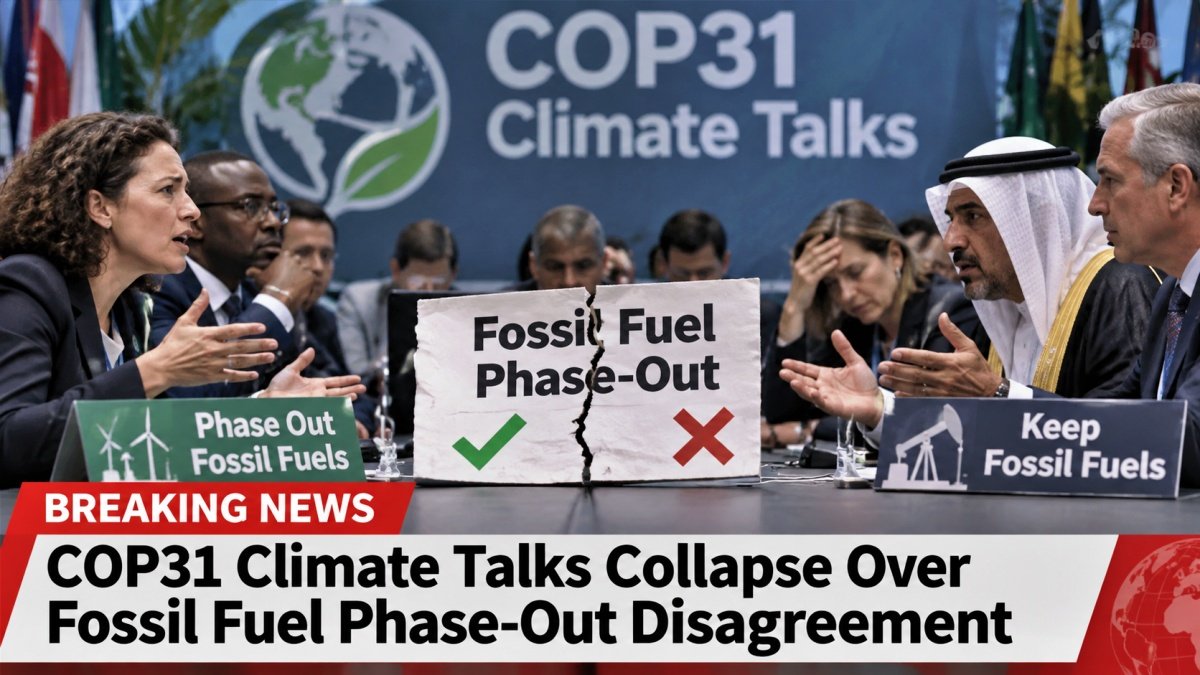
The COP31 climate summit concluded without a consensus agreement on Sunday after a major standoff over fossil fuel language led to a chaotic finale.
Key Points
- No Consensus: The summit failed to produce a final agreement despite running 48 hours into overtime.
- EU Opposition: The European Union led a bloc of 130 countries in rejecting the draft for lacking fossil fuel phase-out language.
- India’s Stance: India supported the draft text, advocating for nationally determined and equitable energy transitions.
- Science Concerns: Critics labeled the draft a rollback that prioritises carbon capture over deep systemic changes.
- Diplomatic Failure: The outcome highlights the difficulty of multilateral action when parties refuse to compromise on core issues.
Stalemate in Antalya
ANTALYA: The United Nations climate talks at COP31 in Turkiye ended in a significant diplomatic deadlock on Sunday, November 22, 2026. Despite the conference extending into a record 48 hours of overtime, delegates were unable to reach a consensus on a final climate action agreement. The primary point of contention was the inclusion of explicit language regarding a phase-out of fossil fuels.
The European Union, supported by approximately 130 other nations, spearheaded the objections against the consensus cover text proposed by COP31 President Murat Kurum. The EU argued that the draft failed to address the urgent need for action to prevent disastrous global warming. Ireland’s Climate Minister, Darragh O’Brien, expressed profound disappointment, stating that the draft risks deepening the gap between global commitments and the actual science required to limit warming to 1.5 degrees Celsius.
On the opposing side, India, China, and Saudi Arabia expressed comfort with the proposed framing. These nations, part of the Like Minded Developing Countries (LMDC) coalition, maintain that fossil fuels are necessary for economic development in the foreseeable future. Indian Environment Minister Bhupendra Yadav emphasized that climate ambitions must be balanced with practical means of implementation, including finance and technology for developing nations.
Criticism of the Antalya Pact
The proposed agreement, often referred to as the Antalya Pact, faced sharp criticism from nations already experiencing the severe impacts of climate change. Panama formally objected to the text, describing it as a setback. Panama’s chief climate negotiator, Ana Aguilar, argued that the document repeats previous commitments without closing the gap between reality and scientific demands, while placing too much weight on technologies like carbon capture utilisation and storage (CCUS).
The LMDC coalition also raised concerns regarding the principles of equity and common but differentiated responsibility. Spokesperson Amandeep Garg noted a dilution of the principle that developed countries should bear historical responsibility for emissions. The coalition argued that the cover decision fails to connect past emissions with the imminent risk of exceeding the 1.5 degree Celsius threshold.
While the LMDC expressed discomfort with certain elements of the text, they indicated a willingness to move forward to maintain engagement. However, the lack of clarity on adaptation finance remained a significant point of contention for these developing economies.
Implications for Global Climate Policy
The inability of the COP presidency to pass a consensus text is being viewed by analysts as a stark illustration of the challenges facing multilateral climate action. Because the UN process requires unanimous agreement from over 190 country representatives, the lack of a deal highlights how the lowest common denominator can stall progress when fundamental issues like fossil fuel transition remain unresolved.
Nakul Sharma, a senior policy advisor at the E3G climate think tank, stated that the rejection of the cover decision was not a failure of diplomacy but a reflection of the need to protect the credibility of the Paris Agreement. He noted that the summit exposed a difficult truth, showing that global action cannot move at the pace required if parties remain unwilling to compromise on the core challenges of the energy transition.
According to reports from PBS and the Los Angeles Times, the breakdown of the talks underscores the growing divide between the Global North and the Global South. As the world faces a reality of 1.5 degree Celsius overshoot, the failure to secure a binding agreement in Antalya may signal a period of increased difficulty in achieving coordinated international climate targets.