

























Key Points
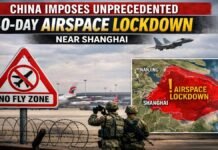
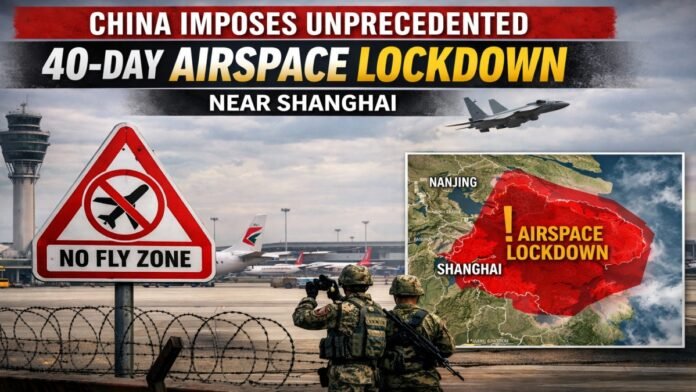
- Unexplained Closure: The 40-day restriction, running from March 27 to May 6, covers a vast area from the Yellow Sea to the East China Sea.
- Surface to Unlimited: The zones are classified as “SFC-UNL,” effectively barring all flight activity at any altitude without a declared military exercise.
- Strategic Timing: Analysts suggest China is exploiting the U.S. military’s preoccupation with the war in Iran to challenge regional allies like Japan and South Korea.
- Diplomatic Impact: The move follows the postponement of President Donald Trump’s visit to Beijing, which has been rescheduled for mid-May.
- The “Dragon’s Maneuver”: A recent lull in Taiwan Strait incursions is now being reinterpreted as a tactical deception to mask long-term operational preparations.
As the global community remains fixated on the “Operation Epic Fury” campaign in the Middle East, China has quietly implemented the longest unexplained offshore airspace restriction in recent history. According to Notices to Air Missions (NOTAMs) verified by the U.S. Federal Aviation Administration (FAA), Beijing has cordoned off enormous sections of the maritime approaches north and south of Shanghai.
The restrictions, which began on March 27 and are slated to last until May 6, 2026, encompass an area larger than the main island of Taiwan. Unlike typical three-day windows reserved for live-fire drills or missile tests, this 40-day lockdown has been issued without any official justification, sparking fears that the People’s Liberation Army (PLA) is transitioning into a state of permanent operational readiness.
Operational Preparedness or Tactical Signaling?
Ray Powell, Director of Stanford University’s SeaLight project, described the “SFC-UNL” (Surface to Unlimited) classification as particularly alarming. This designation implies a total reservation of the sky, potentially for complex maneuvers involving high-altitude surveillance, aerial refueling, and electronic warfare.
“The absence of a declared exercise over such an unprecedented period suggests this is not a one-time drill,” Powell noted, “It implies a position of maintained operational preparedness that China no longer feels the need to announce or defend.”
Military experts at the U.S. Naval War College believe the restricted zones are meticulously chosen to overlook approaches facing Japan and South Korea. Christopher Sharman, director of the China Maritime Studies Institute, observed that the designated airspace could be used to rehearse maneuvers designed to block U.S. intervention routes in the event of a regional conflict.
Exploiting the “Iran Distraction”
The timing of the lockdown appears calculated to coincide with a period of overextension for the United States. With significant U.S. carrier groups currently stationed in the Gulf to manage the conflict with Iran, Beijing may perceive a window of opportunity to shift the balance of power in the Western Pacific.
This development has cast a shadow over the upcoming diplomatic calendar. President Donald Trump was originally scheduled to visit Beijing in late March to meet with Chinese leader Xi Jinping. However, that summit was delayed by five weeks to allow the President to oversee the war effort in Washington. The White House recently announced the trip has been rescheduled for May 14 and 15, 2026, just days after the current airspace restrictions are set to expire.
Decoding the “Dragon’s Maneuver”
The 40-day closure has also forced a re-evaluation of China’s recent behavior in the Taiwan Strait. For weeks leading up to the lockdown, the PLA had notably reduced its daily incursions into Taiwan’s Air Defense Identification Zone (ADIZ). While some initially viewed this as a de-escalation gesture ahead of the planned Trump-Xi summit, Taiwanese security officials now argue it was a “false message of peace.”
By creating a temporary lull, Beijing may have been attempting to lower regional guardrails while simultaneously preparing for the massive, sustained training cycle currently underway behind the curtain of the restricted airspace. As the May 6 deadline approaches, all eyes remain on the East China Sea to see if these “silent skies” are the prelude to a new and more aggressive phase of Chinese maritime strategy.