



























Key Points
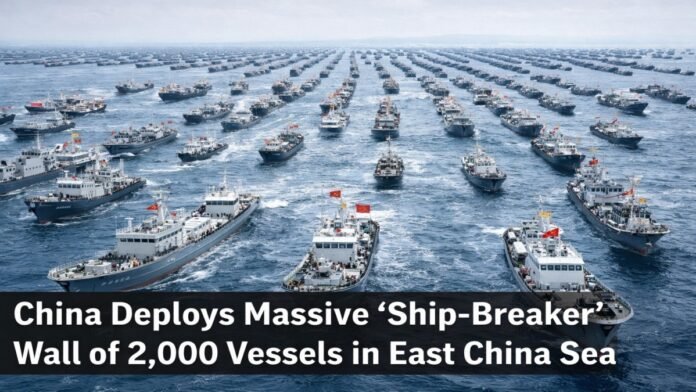
- NASA and ingeniSPACE imagery shows 2,000 Chinese vessels arranged in a complex geometric formation spanning 400 kilometers.
- Experts characterize the deployment as an “impenetrable wall” designed to block naval movement and seize maritime routes.
- The maneuver specifically targets territorial rivals, including Taiwan, Japan, and the Philippines.
- The use of fishing vessels, rather than warships, allows China to maintain “plausible deniability” while creating a tactical blockade.
- This escalation occurs alongside the Iran-Israel conflict, threatening a dual-front global trade and security crisis.
As the world’s attention remains fixed on the volatile conflict in the Middle East, a new and equally chilling strategic development has emerged in the East China Sea. Recent satellite data analyzed by NASA and the geospatial intelligence firm ingeniSPACE reveal that China has constructed what experts are calling a “ship-breaker,” a massive, coordinated formation of roughly 2,000 vessels. Stretching across 400 kilometers of vital international waters, this formation is interpreted as a precursor to a total maritime blockade.
Analysis of images captured in late 2025 and finalized in March 2026 shows these ships are not engaged in standard commercial fishing. Instead, they are positioned in a precise geometric “labyrinth” that could effectively neutralize the maneuverability of modern naval destroyers and carrier strike groups through sheer physical presence.
Encirclement of Regional Rivals
The location of this 400-kilometer wall is strategically calculated to exert maximum pressure on three key nations: Taiwan, Japan, and the Philippines. China has long asserted territorial claims over these waters, and this deployment appears to be a physical manifestation of those claims.
Jennifer Parker, a former Australian naval warfare officer, noted that this formation is likely a dry run for “area denial” operations. By saturating the sea with thousands of small, agile boats, China can paralyze the naval response of its neighbors during a localized crisis. Jason Wang of ingeniSPACE highlighted that the complexity of the patterns suggests a high level of military command and control, far beyond the capabilities of a standard fishing fleet.
The Tactics of Plausible Deniability
The decision to utilize fishing vessels, part of China’s so-called “People’s Armed Forces Maritime Militia,” serves two primary tactical objectives:
- Naval Obstruction: In a high-stakes conflict, these vessels act as a low-cost, high-impact barrier. Larger warships cannot easily navigate through thousands of smaller craft without risking collisions or international incidents, effectively slowing down any intervention.
- Grey Zone Warfare: By using civilian-registered boats, Beijing can dismiss international condemnation by claiming the activity is purely commercial. This “strategy of denial” makes it difficult for international bodies to justify a military counter-response without appearing as the aggressor.
Gregory Poling, Director at the CSIS in Washington, remarked that the sheer concentration of these vessels is unprecedented in modern maritime history, signaling a shift from territorial posturing to active blockade preparation.
Implications for Global Trade and India
This aggressive maritime posturing comes at a time of extreme global instability. With the Iran-Israel conflict already disrupting oil supplies in the Red Sea and pushing Brent crude past $100 per barrel, a secondary blockade in the East China Sea could prove catastrophic for the global economy.
For India, the stakes are particularly high. A significant portion of India’s trade with East Asian economies passes through these maritime corridors. Furthermore, any disruption in the East China Sea would further strain global energy logistics, potentially exacerbating the fuel and LPG shortages already being felt in domestic markets. As the “ship-breaker” wall remains in position, global strategists warn that the Indo-Pacific is now on a hair-trigger, mirroring the tensions currently tearing through the Middle East.