

































Key Points:
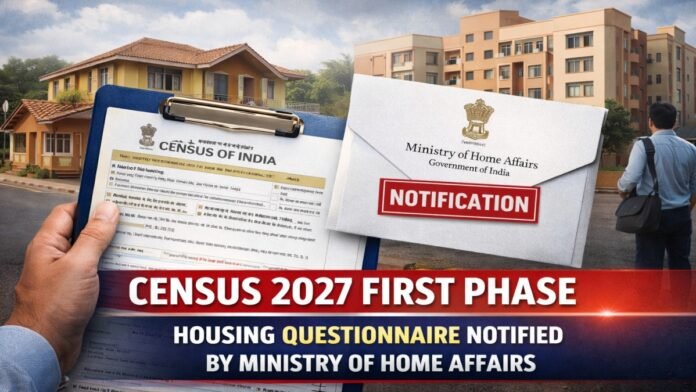
- First phase questionnaire for Census 2027 notified by Ministry of Home Affairs
- Focuses on house listing and housing census, covering building details and family structure
- Questions include construction materials, water source, toilet facilities, vehicle ownership
- Notification issued under Census Act, 1948, supersedes January 2020 guidelines
- Second phase population count questionnaire to be notified at appropriate time
- Census officers will collect data from all households in designated areas
The Ministry of Home Affairs on Thursday issued the official notification for the first phase questionnaire of Census 2027, marking a critical step toward India’s first decennial census in 16 years. The notification, released through the Registrar General and Census Commissioner, outlines the House-listing and Housing Census Schedule that will gather comprehensive data on residential infrastructure, household amenities, and asset ownership across the nation’s approximately 300 million households.
The first phase, which will precede the actual population enumeration, focuses exclusively on housing and household characteristics. According to the notification, this phase will supersede the previous guidelines issued in January 2020, which were rendered obsolete after the 2021 census was postponed indefinitely due to the COVID-19 pandemic. The second phase questionnaire, covering population count and demographic details, will be distributed separately at a later date, likely in mid-2026.
Comprehensive Housing Data Collection
The questionnaire mandates the collection of 23 distinct data points for each household. Census officers will record building identification numbers, both municipal and census-specific, along with detailed construction specifications. The survey will document primary materials used for floors, walls, and roofs, categorizing them into predefined classifications such as cement, mud, wood, or thatch. Housing condition assessment will classify structures as good, livable, or dilapidated, providing crucial data for urban planning and disaster management.
Household structure information will capture the family serial number, total usual residents, and detailed identification of the head of household, including name, gender, and social category, specifically whether they belong to the Scheduled Castes, the Scheduled Tribes, or other categories. Ownership status will be classified into owned, rented, or encroached categories, while the number of living rooms will be counted to assess overcrowding indicators.
Amenities and Asset Inventory
The questionnaire includes an extensive section on basic amenities and modern conveniences. It will document the number of married couples residing in each household, drinking water sources, whether from taps, hand pumps, or tankers, and the primary source of lighting. Sanitation facilities will be recorded with specific questions on toilet availability, type, and connectivity to drainage systems.
Census officers will also inquire about bathroom availability, kitchen presence, LPG or PNG connections, and primary cooking fuel. The asset inventory section reflects contemporary living standards, asking about ownership of radio, television, internet facilities, laptops, computers, telephones, mobile phones, smartphones, bicycles, scooters, motorcycles, mopeds, cars, jeeps, and vans.
Additional questions cover the main cereal consumed by the family and a mobile number for census-related communication only. The notification explicitly states that mobile numbers will be used solely for official census purposes and will not be shared with other government departments.
Legal Framework and Implementation
The notification has been issued under the provisions of the Census Act, 1948, which empowers the government to collect census data and makes it mandatory for citizens to provide accurate information. The Act also prescribes penalties for deliberate misinformation or obstruction of census officers.
The Office of the Registrar General and Census Commissioner has begun preparations for the massive data collection exercise, which will involve approximately 3 million enumerators visiting every household. Training programs for census officers are scheduled to commence in late 2026, with the house listing phase expected to begin in early 2027, preceding the population enumeration by several months.
Latest Updates and Budget Allocation
Senior Home Ministry officials confirmed that the government has allocated ₹12,000 crore for Census 2027 in the upcoming budget, nearly double the expenditure of Census 2011. The increased budget accounts for digital data collection devices, GPS mapping, and enhanced security protocols. The notification also incorporates lessons from the pandemic, including questions about remote work facilities and digital connectivity that were absent in previous census schedules.
The ministry has established a dedicated portal for citizens to preview the questionnaire and raise queries. Census officials will carry tablet computers for real-time data entry, a significant upgrade from the paper-based system used in 2011. The data collection will be synchronized with the National Population Register update, though the notification clarifies that the census remains a separate statistical exercise.
Significance for Policy Planning
The housing and amenities data from the first phase will be crucial for implementing various government schemes, including Pradhan Mantri Awas Yojana, Swachh Bharat Mission, and the Saubhagya electrification program. Urban planners will use the building condition data to identify structures requiring retrofitting, while the asset ownership information will help target subsidies for digital literacy programs.
The notification concludes by directing all state governments and union territory administrations to prepare necessary infrastructure and coordinate with census officers to ensure smooth implementation of the House-listing and Housing Census Schedule across their jurisdictions.