






























Key Highlights
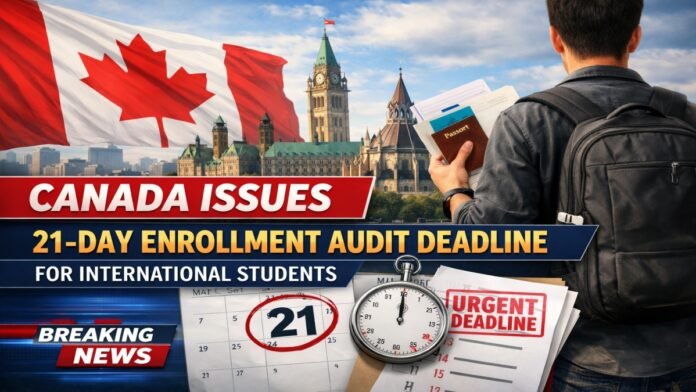
- Strict 21-Day Deadline: Students must submit official enrollment letters and full academic transcripts within a three-week window upon receiving a notice.
- Integrity Crackdown: The move follows Auditor General Karen Hogan’s March 23, 2026, report, which exposed over 150,000 flagged cases of potential non-compliance.
- Indian Students Affected: Hundreds of Indian students are among those receiving notices, as the IRCC seeks to rectify years of “negligent enforcement.”
- Revocation Risk: Failure to meet the deadline or to provide authentic documentation will result in the immediate cancellation of temporary resident status.
- Monthly Oversight: The IRCC is now mandated to report all fraud and non-compliance investigations to the House of Commons by the 15th of every month.
The landscape for international education in Canada has shifted toward aggressive enforcement as the federal government moves to “take back control” of the International Student Program. In a sudden directive issued this April, Immigration, Refugees and Citizenship Canada (IRCC) began serving notices to thousands of permit holders, demanding comprehensive proof of their academic standing. This new regulation requires students to submit documentation within a rigid 21-day timeframe, a move that has sent shockwaves through the international student community, particularly among the large Indian diaspora.
This administrative surge is a direct response to a scathing audit tabled in the House of Commons on March 23, 2026. Auditor General Karen Hogan revealed that between 2023 and 2024, the IRCC flagged approximately 150,000 cases of potential non-compliance, such as students not attending classes or working beyond permitted hours, yet only 4,000 investigations were actually launched. The audit further identified 800 individuals who obtained permits through fraudulent documents between 2018 and 2023 without facing any enforcement action.
The Verification Process and Mandatory Requirements
The notices now being sent to students are not mere requests but formal compliance audits. To maintain their legal status, students must provide:
- A current Letter of Enrollment: An official document from their Designated Learning Institution (DLI) confirming they are actively pursuing their registered program.
- Academic Transcripts: Complete records from both their current Canadian institution and previous schools to verify a consistent and legitimate academic trajectory.
If a student fails to respond within the 21-day window or if the documentation is found to be fraudulent, the IRCC has the authority to revoke their temporary resident status immediately. This “overcorrection,” as some experts describe it, is intended to flush out “non-genuine” students and diploma mills that have exploited the system.
Growing Anxiety in the Student Community
The speed of these new measures has created a climate of panic. Indian students, who form the largest segment of Canada’s international student population, are disproportionately represented in the audit. Many express concern that administrative delays at their respective colleges could prevent them from obtaining the necessary letters within the 21-day limit.
Mississauga-based immigration consultant Kanwar Sumit Singh Sierah noted that while the crackdown is necessary for system integrity, the timing is a significant concern. Sierah highlighted that many of the most egregious fraud cases from previous years involve individuals who have already transitioned to work permits or permanent residency, meaning the current students are bearing the brunt of a “long-overdue” cleanup. He questioned the accountability of the colleges themselves, many of which may have facilitated these discrepancies through lax reporting.
Increased Parliamentary Oversight
The IRCC is now under intense political pressure to show results. Under new protocols, the department must submit a detailed progress report on all permit fraud and non-compliance investigations to the House of Commons Standing Committee on Citizenship and Immigration by the 15th of every month. This ensures that the department’s “streamlining” of investigations, as promised by Minister Lena Metlege Diab, remains transparent and consistent as Canada aims to reduce its temporary resident population to below 5% by 2027. For students currently in the country, the message is clear: the era of minimal documentation is over, and maintaining status now requires absolute transparency and rapid response.